
Abraham Lincoln, a man of towering intellect and razor wit, once opined, “He who represents himself has a fool for a client.” One wonders if Lincoln, in his transcendent foresight, was prophesying the curious spectacle now unfolding in our politics—specifically, the sight of Prime Minister Philip Davis K.C. standing, not in a courtroom, but in the august halls of Parliament, in defense of… himself.
On May 28, 2025, during his Budget Communication to Parliament for the fiscal year 2025/2026, the Prime Minister, who also dons the cap of Minister of Finance, I mean why settle for one hat when you can wear two?, confidently declared that, for the first time since Independence, his administration would not only achieve a balanced budget, but a surplus to boot.
A moment of historic grandeur? Or, perhaps, a misunderstanding of elementary economic forecasting? Let’s examine.
Let’s begin with the record. During his budget communication, Prime Minister Davis proclaimed:
“More than a balanced budget – a budget with a surplus.”
A bold assertion. Audacious even. And, at first blush, one could hardly blame his online acolytes for erupting in rapturous self-congratulation. Why, if taken at face value, it would seem the Davis administration had already achieved this surplus. The very heavens themselves might have cracked open in celebration.
But alas—language matters. And the subtle art of political rhetoric often trips over its own cleverness.
Nowhere in that original statement was it clearly presented that this budgetary “achievement” was a projection—a forecast, not a financial fait accompli. In response to the ensuing confusion, Deputy Prime Minister Chester Cooper gallantly attempted to clarify, though one suspects his efforts were about as well-received as a raincloud at Junkanoo.
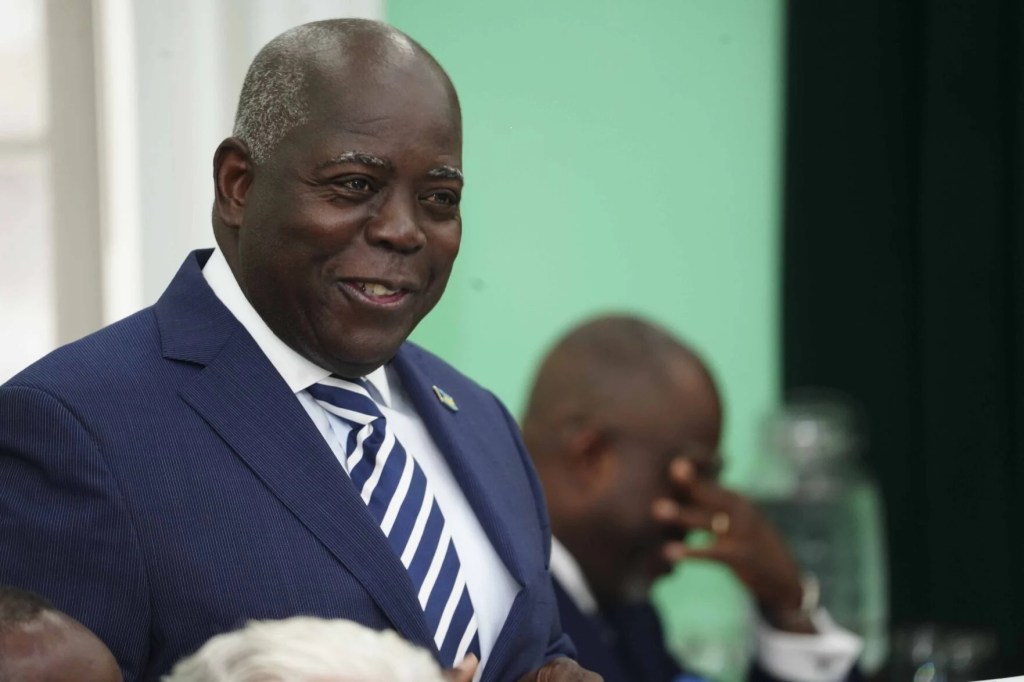
Rather than acknowledge the confusion created, Prime Minister Davis doubled down with a tone bordering on sanctimony. From The Nassau Guardian, June 2025:
“They have tried to dismiss it as merely a forecast. Have they not noticed that every budget is a forecast?”
A revelation of such profundity, one would think he had discovered gravity.
Indeed, Prime Minister, the Opposition has noticed. That is precisely why they questioned the manner in which your statement was framed. The issue here is not whether budgets are forecasts—this is rudimentary economics—but that your original announcement lacked the nuance, or honesty, to make that clear.
And so we find ourselves in the theater of the absurd, where the Prime Minister, now reduced to playing both prosecutor and defense attorney, must repeatedly clarify to the public, his party, and perhaps even to himself, that his so-called “surplus” has not yet materialized.
Ironically, his supporters—those ever-loyal apostles of the “New Day”—continue to trumpet an accomplishment that, by the Prime Minister’s own belated admission, has not occurred.
What lessons are to be drawn from this rather embarrassing debacle?
Certainly not humility. Prime Minister Davis, in classic form, chose to chastise the Opposition with supercilious disdain rather than admit to a poorly worded announcement. One suspects that had the Honorable Member exercised the same caution with his phrasing as he does with his courtroom objections, this entire farce might have been avoided.
Instead, we are left with a Prime Minister whose defenders are still clinging to a fiscal fantasy, a Deputy Prime Minister whose voice was drowned out in the din of damage control, and a populace that has grown weary of being spoken at, rather than spoken to.
In sum: If Prime Minister Davis must persist in representing himself, then he should consider Lincoln’s words not as a historical footnote—but as a warning.
END
 My Morning Paper