
Prime Minister Philip Davis recently took to the airwaves to deliver what can only be described as a feel-good headline: the New Day PLP government would eliminate Value-Added Tax (VAT) on uncooked food as a bold move to ease the cost of living for Bahamian families.
Cue the applause.
That is, until the Nassau Guardian did something rather inconvenient — it applied basic, real-world mathematics to the figures provided by the government itself. Using the government’s own declaration that it would forgo $15 million in VAT revenue, The Guardian calculated that the average household would see savings of approximately $11 per month, or $127 per year.
Apparently, math is now offensive.
The Guardian’s calculation did not emerge from thin air; it flowed directly from numbers publicly announced by the Office of the Prime Minister (OPM). Yet instead of offering a counter-calculation or a clearer breakdown, the government chose indignation over information.
In an article titled “OPM on defensive: Guardian stands by VAT story,” the Prime Minister’s Office insisted the newspaper had committed a “miscalculation” and made an “erroneous claim.” However — and this is the truly remarkable part — OPM provided no calculations of its own to demonstrate how The Guardian was wrong.
None. Zero. Zilch.
PAUSE, because this part matters.
The $15 million figure was not invented by journalists; it was announced by Minister of Economic Affairs Michael Halkitis himself. Therefore, The Guardian’s math was not only reasonable — it was inevitable. When the government supplies the figures, it cannot later pretend shock when someone uses them.
But unwilling to relive another embarrassment reminiscent of their much-touted “budget surplus,” the New Day PLP government scrambled to reframe the narrative, stating:
“When that $15 million is averaged among the 118,221 households in The Bahamas (as recorded in the 2022 census), the savings amount to $11 per month or $127 a year.”
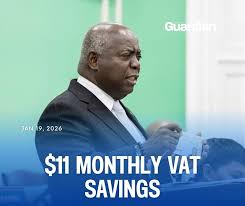
Which, of course, is exactly what The Guardian reported.
Then came the pivot.
OPM now claims that The Guardian mistakenly equated the government’s fiscal impact with consumer benefit, asserting that the $15 million represents a “bottom-line fiscal impact number” after accounting for business credits and substituted spending — and that the real consumer benefit is somehow “significantly larger.”
Say what now?
If that is the case, where are the numbers? Where is the breakdown? Where is the explanation that transforms $15 million into something more substantial for Bahamian families standing at the grocery checkout?
Even more telling, multiple economic and financial experts consulted by The Nassau Guardian expressed confusion over the government’s explanation — confirming that this was not a failure of public understanding, but a failure of public communication.
Then, as if the waters were not muddy enough, OPM added yet another layer of contradiction, claiming that any estimate of average monthly savings is “not credible” without updated data from a Household Expenditure Survey — noting that the last survey was completed in 2013 and a new one is still underway.
So let us get this straight.
The government announced a sweeping cost-of-living relief measure, provided a headline figure, promoted it as wealth-building policy — and now says that no one can credibly calculate its impact because the necessary data does not exist?
If that is the case, one must ask: Was this policy introduced without proper homework? And if so, why should the public trust numbers that the government itself now suggests are unreliable?
The people of The Commonwealth of The Bahamas will always welcome genuine, viable solutions to ease the crushing cost of living, especially under current economic conditions. But the Bahamian people are not obligated to suspend critical thinking — particularly when broad promises are rolled out conveniently close to a general election.
Relief announcements without transparent calculations are not policy; they are performance.
And condemning a newspaper for doing arithmetic with government-supplied figures only reinforces the uncomfortable suspicion that the New Day PLP government prefers applause over accountability.
END
 My Morning Paper