
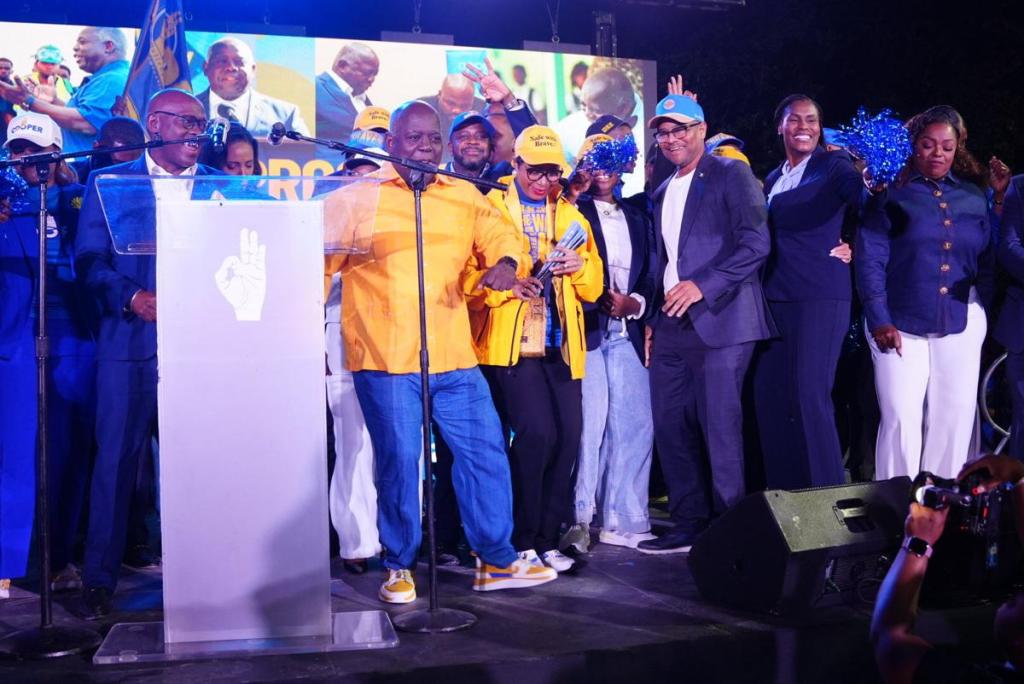
Last night the Progressive Liberal Party officially launched its campaign for the 2026 general election — though one could argue they have never truly stopped campaigning. The event, staged at Baha Mar, felt less like the unveiling of a serious national agenda and more like a well-funded theme party without a theme.
Front and centre was Prime Minister Philip “Brave” Davis, once again making the now-familiar claim that when the PLP came to office in September 2021, they had to “rescue the country from collapse and put it on the road to recovery.”
It is a dramatic line. It is cinematic. It is also highly debatable.
The “Rescue” Narrative
The Davis administration took office at a time when The Bahamas — like the rest of the world — was emerging from the economic shock of COVID-19. Borders had reopened in late 2020. Tourism numbers were rebounding sharply throughout 2021. Major resorts were reopening. Global recovery trends were already underway.
To hear the Prime Minister tell it, however, one might imagine the country was minutes away from being sold for scrap metal.
The question that continues to go unanswered is simple:
What specific emergency fiscal or structural interventions did the Davis administration implement immediately upon taking office that constitute a “rescue”?
If the country was on the brink of collapse, where was the collapse in measurable terms? Tourism was rebounding. GDP growth returned in 2021 and accelerated in 2022. Revenue collections rose largely in tandem with global recovery patterns. Was this divine intervention — or simply global normalization?
The Greatest Hits: VAT, Minimum Wage, and Agreements
According to reporting in The Nassau Guardian, the Prime Minister highlighted several “achievements”:
- Raising the national minimum wage
- Signing approximately 60 industrial agreements with trade unions
- Reducing VAT from 12% to 10%
Let’s examine them.
VAT: The Gift That Keeps on Giving [Him Talking Points]
Yes, VAT was reduced from 12% to 10% in January 2022. That is fact.
What is rarely emphasized is that VAT has been broadened in scope over time, and consumers continue to experience high prices driven by global inflation, shipping costs, and domestic markups. A 2% reduction sounds significant on paper. In the grocery aisle, it often feels symbolic.
Moreover, while certain breadbasket items remain VAT-exempt, questions persist about the extension of VAT to items and services that disproportionately affect working families. The relief narrative does not always align with lived experience.
If this VAT reduction was the economic masterstroke that “rescued” the nation, why do so many Bahamians still report struggling with cost-of-living pressures?
Two percent off a taxed item does not equal economic transformation.
Minimum Wage Increase
The national minimum wage increased from $210 to $260 per week in July 2022 — the first increase in several years.
That is measurable progress.
But here again is the inconvenient question:
Has that increase kept pace with inflation, rent hikes, electricity bills, food prices, and insurance costs?
A wage increase without structural cost-of-living reforms risks becoming political decoration rather than economic liberation.
Industrial Agreements
Signing dozens of industrial agreements is commendable — if those agreements translate into real productivity gains, fiscal sustainability, and improved services.
But agreements signed are not reforms completed. Contracts negotiated are not economic diversification achieved.
The average Bahamian wants to know:
Where is the structural transformation?
Where is the diversification beyond tourism and financial services?
Where is the debt trajectory heading?
Debt, Deficit, and the Fiscal Cliff
If the PLP rescued the country from a fiscal cliff, then transparency demands clear metrics:
- What is the current national debt trajectory?
- What is the deficit position relative to GDP?
- How much of the revenue rebound is organic growth versus post-pandemic normalization?
These are not partisan questions. They are national ones.
The public deserves to see not just celebratory headlines but audited numbers, medium-term fiscal projections, and debt-to-GDP sustainability plans.
Because if you claim to have saved the house from burning down, it is reasonable for the homeowner to ask to see the fire report.
The Second Term Question
Prime Minister Davis is now asking for a second term “to continue the progress.”
But progress toward what?
- Has crime meaningfully declined?
- Has energy reform lowered electricity costs?
- Has healthcare accessibility improved in measurable, system-wide ways?
- Has economic inequality narrowed?
Campaign launches are meant to inspire. Instead, this one raised more questions than confidence.
If the first term was about “rescue,” the second must logically be about transformation. Yet the rhetoric sounds suspiciously like a replay of 2021 — same storyline, new backdrop.
The Bahamian electorate is not allergic to progress. It is allergic to exaggeration.
If there was a rescue, show the receipts.
If there was recovery, show who recovered.
If there is progress, show who progressed.
Because a campaign launch at a luxury resort, wrapped in applause and carefully selected statistics, does not automatically equal national advancement.
And as 2026 approaches, voters may begin asking a dangerous question for any incumbent:
If this is what rescue looks like, what exactly were we saved from?
The Progressive Liberal Party (PLP) government fails for one reason; it is their nature.
END
 My Morning Paper