
For the past several days, one could be forgiven for thinking that the government had just fought and won some historic constitutional battle over the governance of Freeport. The speeches have been fiery. The declarations dramatic. The comparisons to history unmistakable.
But once the dust settles and the arbitration tribunal’s findings are actually read, a far less triumphant picture begins to emerge.
Prime Minister Philip Davis now appears determined to ride what he describes as a “victory” over the Grand Bahama Port Authority (GBPA) for as much political mileage as possible as the country edges closer to a general election. Yet many Bahamians, after examining the ruling itself, are asking a very simple question: what exactly was won?
According to reporting by The Nassau Guardian, the Prime Minister declared in Parliament that the “old order” in Freeport was coming to an end. In doing so, he dismissed critics as “tissue leaders” and “jelly backs” while pledging to “break” the existing GBPA order.
The language was unmistakably evocative of the historic rhetoric of Sir. Lynden Pindling and his famous Bend or Break Speech delivered in 1969 — a moment that confronted discrimination and immigration practices in the port area during a very different era.
But invoking Pindling’s historic stand raises an uncomfortable question: is this truly a similar moment of national confrontation, or simply political theatre attempting to borrow the gravity of history?
Because if one returns to the beginning of this dispute, the government’s objective was very clear.
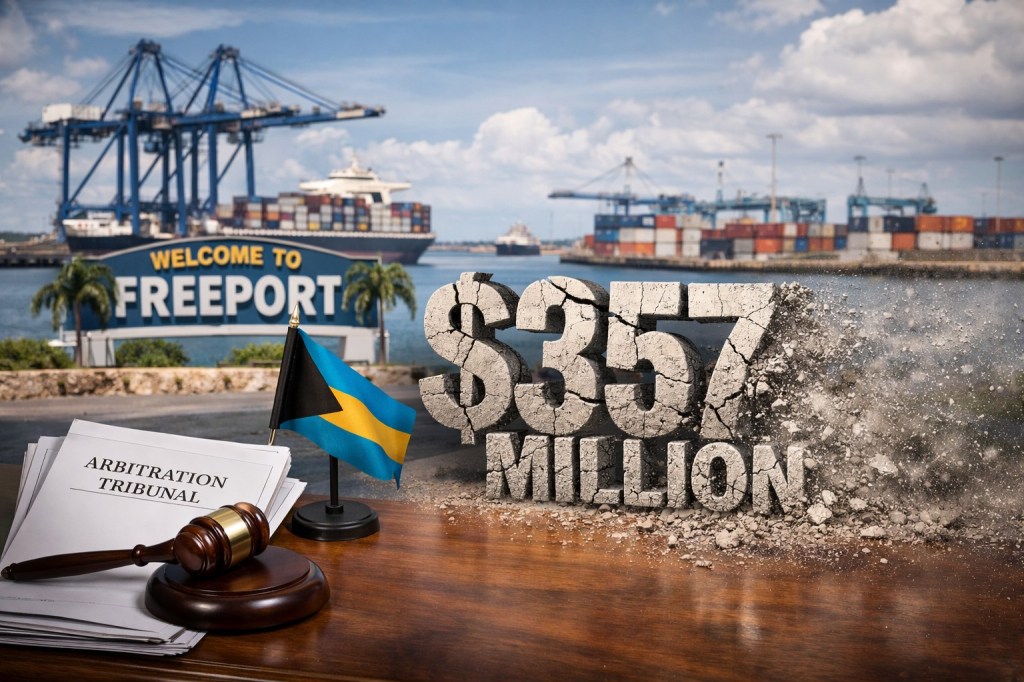
The administration of the Progressive Liberal Party asserted that the GBPA owed the government $357 million in back fees and payments under the Hawksbill Creek Agreement framework. That was the central claim. That was the headline number. And that was the basis upon which the confrontation was launched.
Yet when the arbitration tribunal issued its award, that massive financial claim did not materialize as a victory for the government.
Instead, the ruling largely clarified legal principles that were already widely understood but it would appear that Prime Minister is still dangling the promise of a “payout”; much like Lincoln Bain and his claim of $100,000.
What the Tribunal Confirmed:
The tribunal did affirm certain points:
- The GBPA does not possess exclusive or “pre-eminent” powers that override Bahamian law.
- The laws of the Government of The Bahamas have always applied in Freeport and continue to apply.
But these were not revolutionary discoveries.
Parliamentary sovereignty over Freeport has long existed under:
- The Bahamian Constitution
- Clause 3(9) of the Hawksbill Creek Agreement
- Various statutes enacted by Parliament over the past six decades
In other words, the tribunal largely acknowledged a legal reality that already existed.
What the Tribunal Did Not Do:
Equally important is what the award did not grant.
Despite some political messaging suggesting otherwise, the tribunal did not provide the government with new legal authority to unilaterally rewrite or nullify provisions of the Hawksbill Creek Agreement.
It did not suddenly arm the government with sweeping new powers over the GBPA structure.
Rather, it simply recognized the validity of the legal framework already in place.
A Victory… or a Pivot?
Which brings us back to the original claim.
If the dispute began with a demand for $357 million in back payments, and the arbitration ruling does not deliver that financial windfall, then it is reasonable to ask whether the government’s current celebration represents a victory — or a pivot.
A pivot from a financial claim that failed to materialize into a political narrative that “we stood up to the GBPA.”
One cannot help but notice the rhetorical shift.
First it was about recovering hundreds of millions of dollars owed to the Bahamian people.
Now it is about breaking an “old order.”
The question remains: if the government always possessed the legal authority, it now claims to have “won,” what exactly required breaking?
A Curious Contrast
In Parliament, the Prime Minister argued that he could not accept an arrangement in which “two families decide the fate of tens of thousands of Bahamians in Freeport.”
That may sound compelling in a speech.
But it also invites an awkward observation. Critics have long pointed out that the economic life of New Providence itself is heavily influenced by a small circle of powerful families and business interests.
Yet that reality appears far less troubling when it occurs outside the boundaries of Freeport.
What Happens Next?
The tribunal’s ruling effectively confirms that the Government of The Bahamas has always possessed the authority to legislate for Freeport if it chooses to do so.
Which leads to the real question — the one that actually matters.
If the government already had the power, and the tribunal merely confirmed that reality, what will it now do with it?
Will new policies follow?
Will reforms actually be implemented?
Or will this moment simply fade into the long tradition of political victories that exist more in speeches than in tangible change?
Because while history remembers moments like Pindling’s Bend or Break speech for the profound transformations that followed, history is far less generous to moments when rhetoric exceeds results.
And for the residents and businesses of Freeport, Grand Bahama, what ultimately matters is not who claims victory — but whether anything meaningful has actually changed.
END
 My Morning Paper