
One would think that after an arbitration ruling, the matter would be settled.
That, after all, is the point of arbitration.
Yet here we are.
Despite a ruling in the dispute between the Government of The Bahamas and the Grand Bahama Port Authority (GBPA), the public is now being treated to a prolonged back-and-forth that feels less like governance and more like theatre. Each side appears determined to squeeze a few more headlines from a matter that was supposedly resolved by a tribunal.
For the GBPA, perhaps the continued sparring is about protecting its institutional position in Freeport.
For the government, however, the motivations appear far more convenient.
Because while the public is invited to watch this constitutional ping-pong match, another story quietly unfolds in the nation’s finances.
On 27 February 2026, The Nassau Guardian reported under the headline “Growing arrears raise fiscal concerns” that the government’s unpaid invoices and arrears had ballooned to $241 million, compared with $121 million at the same point the previous year.
That is not a rounding error.
That is a doubling.
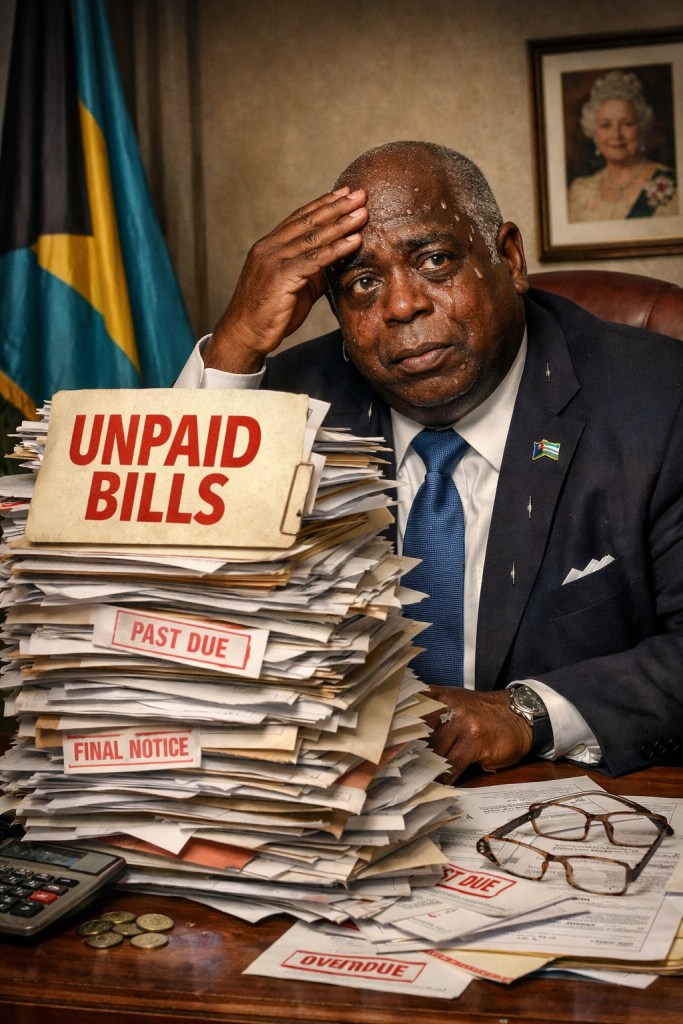
The report noted that the administration of Philip Davis still expects revenue intake in the second half of the 2025/2026 fiscal year to bring the government’s finances back in line with its target of a $75 million surplus.
This raises a rather basic question.
Did the same miracle occur last year?
When the government promised that revenue intake during the second half of the 2024/2025 fiscal year would also align the numbers with its fiscal goals, did it actually happen? And if it did, why are arrears now climbing so dramatically?
Because here lies the curious logic of what might best be described as superstitious economics.
According to the government’s narrative, the public should not worry about the growing mountain of unpaid bills. Yes, the country may currently be hundreds of millions of dollars in arrears — but apparently, we are all meant to relax and trust that the latter half of the fiscal year will arrive like a benevolent economic fairy, wave its wand, and transform those arrears into a surplus.
One might call that optimism.
Others might call it accounting by wishful thinking.
Which brings us back to the GBPA dispute.
If the arbitration ruling has already reset the legal and commercial relationship between the parties, why is the matter still dominating public discourse? Why are government officials still trading rhetorical blows with the GBPA?
Could it be that the political value of the fight now outweighs the legal value of the ruling?
After all, it is far easier to keep the public focused on a quarrel in Freeport than to explain why government arrears have doubled in a year while officials simultaneously promise a surplus.
In politics, distraction is often the most convenient fiscal policy.
And if the public conversation remains fixed on arbitration drama rather than the country’s growing pile of unpaid bills, then perhaps the spectacle has already served its purpose.
The Bahamian people deserve better.
END
 My Morning Paper