
Just as the dust had begun to settle following the arbitration ruling between the Government of The Bahamas and the Grand Bahama Port Authority (GBPA), the New Day Progressive Liberal Party (PLP) suddenly found the need to convene a town hall meeting in Freeport to “clear the air.”
This is curious, because the air—at least legally—had already been cleared.
The international tribunal’s ruling was quite plain: the government’s claim that the GBPA owed $357 million for administrative services between 2018 and 2022 was dismissed.
Instead, the tribunal determined that the mechanism the government relied upon had been replaced by a later arrangement negotiated in the 1990s, meaning the government could not retroactively calculate and enforce those claims in the way it attempted.
In short, the headline number that fueled years of political rhetoric—$357 million—did not survive arbitration.
Yet, somehow, once the ruling landed, the country was suddenly invited to a political “clarification session.”
One must ask: if the tribunal’s findings were already on record, what exactly needed clearing?
Then came the convenient narrative shift, according to reporting in The Nassau Guardian, Prime Minister Philip “Brave” Davis told attendees at the Belinda M. Wilson Centre that the GBPA may now be building a legal strategy claiming it “cannot pay” the liabilities the government says it is owed.
If that is indeed the Port Authority’s strategy, then the obvious question becomes:
Is the PLP now building its own defense—an “at least we tried” defense?
Because the uncomfortable political reality remains unchanged.
The government entered arbitration seeking $357 million, and that claim was dismissed in full by the tribunal.
Yes, the ruling confirmed that a payment mechanism between the government and GBPA exists and can be reviewed going forward, but the specific financial windfall that had been repeatedly invoked in speeches, press conferences, and political commentary did not materialize.
That fact alone explains why a sudden town hall meeting might now be necessary.
It is my opinion that the Davis administration entered this legal battle knowing the path to recovering $357 million would be extremely difficult—if not legally untenable.
Prime Minister Davis is widely regarded as an experienced attorney, a King’s Council. It strains credibility to believe that someone with his legal background would not have carefully weighed the strength of the claim before proceeding.
But politics often operates by a different set of incentives.
If you bring the claim and lose, you can still claim that you fought for the people.
If you bring the claim and win, you are a national hero.
And if you lose?
Well, you simply hold a town hall meeting and start explaining why the real story is something else entirely.
After all, if the government gambled with the people’s money in pursuit of political mileage, what’s the harm? The Minister of Finance assures us there will still be a $75 million surplus.
So why worry?
In the end the Hawksbill Agreement Was Clarified — But The Money Was Not Recovered
To be fair, the tribunal did clarify important aspects of the Hawksbill Creek Agreement.
It confirmed that the government retains regulatory authority in Freeport and that a payment mechanism between the GBPA and the state remains enforceable through 2054.
Those are legitimate outcomes.
But they are not the same as recovering $357 million.
And for months, that $357 million figure was the centrepiece of the government’s public messaging.
Now, with that claim dismissed, the narrative appears to be shifting.
From Arbitration to Political Theatre, which brings us back to the town hall meeting.
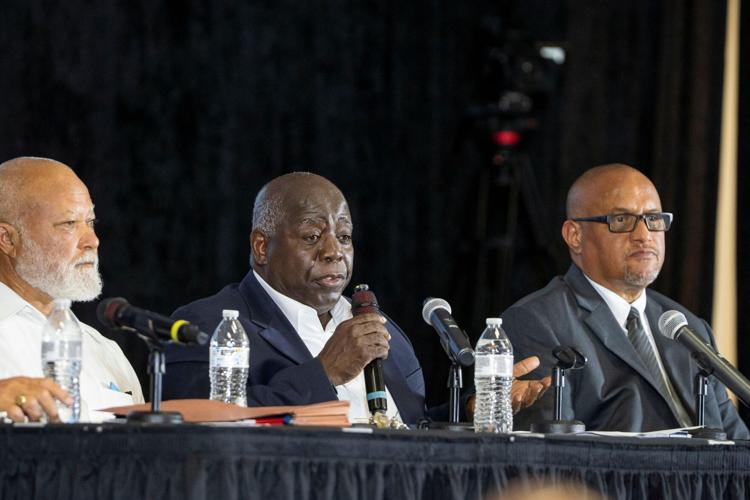
What was presented as an effort to “clear the air” looked, to many observers, more like a political rally. The event featured the Prime Minister alongside attorneys Gregory Moss, Ernie Wallace, and Terrence Gape, while opposition figures attempting to speak were reportedly heckled by attendees.
For an event supposedly focused on national clarity, it appeared to have a very partisan atmosphere.
Opposition leader Michael Pintard went so far as to describe the gathering as essentially a PLP rally rather than a neutral forum for discussion.
And perhaps that is precisely the point.
Because if the main objective—recovering $357 million—was not achieved, then the next best strategy is to reframe the conversation.
Suddenly the issue is no longer the missing $357 million.
Now the focus is on future payment mechanisms, potential negotiations, and hypothetical defences the GBPA might raise.
In politics, the best distraction from a failed objective is often a brand-new narrative.
What makes the entire episode even more troubling is the tone the government adopted throughout the process.
From the beginning, the Davis administration and its political allies aggressively attacked anyone who questioned the strategy. Critics were accused of siding with the Port Authority or failing to support The Bahamas.
But in a democracy, it is entirely possible—and entirely reasonable—to support the national interest while questioning the method used to pursue it.
Apparently, that nuance was unwelcome.
The tribunal’s findings were clear.
The $357 million claim did not succeed.
And yet the public is now being asked to attend political meetings designed to “explain” a ruling that already speaks for itself.
Which leaves many Bahamians asking a very simple question:
If recovering $357 million was the central objective of this entire legal battle…
What exactly happened?
Or, to put it in the language many frustrated observers might use:
“Daddy Brave… what happened?”
The Bahamas deserves better.
The Progressive Liberal Party (PLP) fails for one reason; it is their nature.
END
 My Morning Paper