
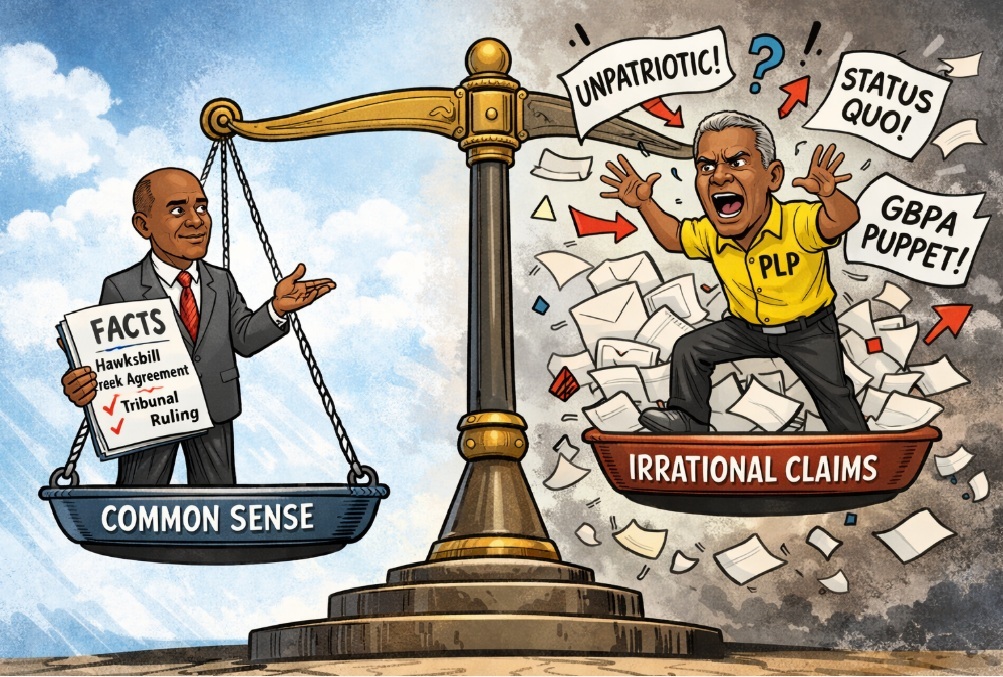
There are mornings when you open the newspaper expecting clarity and instead receive a theatrical production. Yesterday’s installment from Fred Mitchell, chairman of the New Day Progressive Liberal Party (PLP), was very much in the category of political theatre — dramatic, loud, and curiously short on specifics.
In a recent broadside, Mr. Mitchell accused the Leader of the Opposition, Michael Pintard of being everything short of a saboteur for daring to articulate a vision for Freeport that does not perfectly mirror the government’s daily talking points about the Grand Bahama Port Authority (GBPA).
Apparently, in the new political dictionary of the PLP, disagreement equals “unpatriotic.”
One imagines the framers of the Hawksbill Creek Agreement rolling gently in their archives at the idea.
When Disagreement Becomes “Unpatriotic”
Mr. Mitchell claims that Mr. Pintard’s views are “perilously close” to those of the GBPA. A serious allegation, if true. But as usual, the chairman neglected to explain how.
In fact, publicly available statements from Mr. Pintard tell a rather different story. The Opposition leader has repeatedly said that the two families who control the GBPA — the Haywards and the St. Georges — should divest their shares to allow greater Bahamian ownership of the Port.
That hardly sounds like a love letter to the Port Authority.
Mr. Pintard has also argued that reforms can be made to give Bahamians more say while preserving the Hawksbill Creek Agreement, which governs the relationship between the government and the Port Authority and is set to expire in 2054.
If recognizing a binding agreement that still has nearly three decades left to run is now considered “unpatriotic,” then contract law everywhere may wish to take a seat and steady itself.
The fact is that The Tribunal Has Already Changed the Landscape.
Lost in the government’s daily drumbeat is a rather important fact.
Following arbitration between the government and the GBPA, a tribunal ruling clarified that the Bahamian government does possess regulatory authority within Freeport, while the GBPA remains responsible for certain obligations outlined in the Hawksbill Creek Agreement.
In other words:
- The government has regulatory powers.
- The Port Authority must meet its obligations under the agreement.
For most observers, that seemed a fairly straightforward outcome. Not quite the revolutionary overthrow of the Port Authority some had promised, but certainly not the catastrophe some feared either.
Which raises an awkward question.
If the legal framework is now clarified, what exactly is the government’s plan going forward?
The Sound of Drums, But No Map
Instead of a detailed blueprint for the economic revival of Freeport, Bahamians are treated to a daily recital of who is or is not sufficiently patriotic.
Yet the same government that now proclaims a crusade against the Port Authority also presided over:
- The unresolved saga of the Freeport airport redevelopment, and
- The collapse and resale complications surrounding the Grand Lucayan resort.
Both were once presented as cornerstones of Grand Bahama’s revival. Both remain, shall we say, works very much in progress.
One might reasonably expect that a government so eager to expel the GBPA would at least outline what replaces it, especially considering the Hawksbill Creek Agreement remains legally in force until 2054.
Expelling the Port Authority tomorrow would not simply be a matter of political will. It would almost certainly involve legal and financial consequences, none of which the public has been told about.
Curiously, the loudest voices calling for immediate expulsion rarely discuss the bill that might follow.
The Curious Case of the “Status Quo”
Mr. Mitchell also accuses the Opposition of supporting the “status quo.”
But if the tribunal has already clarified the government’s regulatory powers — something the government itself celebrates — then the status quo has already changed.
Which leaves us wondering:
If the government now has the authority it sought, why the continuing political war drums?
Could it be that the original objectives of the arbitration were not achieved exactly as planned, and the public now requires a steady supply of rhetorical fireworks to compensate?
A Final Morning Thought
Bahamians deserve more than political name-calling dressed up as patriotism.
The residents of Freeport, in particular, deserve something even more radical: a clear plan.
The government now has confirmed regulatory authority.
It would therefore seem like an excellent moment to present a detailed roadmap for revitalizing the city — investment strategy, governance reforms, infrastructure development, and timelines.
Unless, of course, the reason for the daily speeches about the GBPA is much simpler.
Sometimes when the drums are loud enough, no one notices that there is no marching plan at all.
The Progressive Liberal Party fails for one reason; it is their nature.
END
 My Morning Paper