
Buried on page three of The Tribune is a headline that reads less like leadership and more like a man discovering his job description almost at the end of his term: the Prime Minister is “trying to get his head wrapped around” NHI payment delays.
Now, ordinarily, that might be a fair admission—if the person speaking were not Philip “Brave” Davis… who just also happens to be the Minister of Finance, just imagine that.
Yes, the same office ultimately responsible for the flow of government payments, including those tied to National Health Insurance.
So, let’s get this straight: doctors aren’t being paid on time, laboratories are frustrated, providers are organizing themselves into associations just to advocate for basic compensation—and the man in charge of the country’s finances is publicly “just hearing about this” and “only now going to look into it.”
One is left to wonder: looking into what, exactly? His own ministry?
Because if the Prime Minister, in his capacity as Minister of Finance, does not know why payments are delayed… then who does? And more importantly—who is actually in control of the Ministry of Finance?
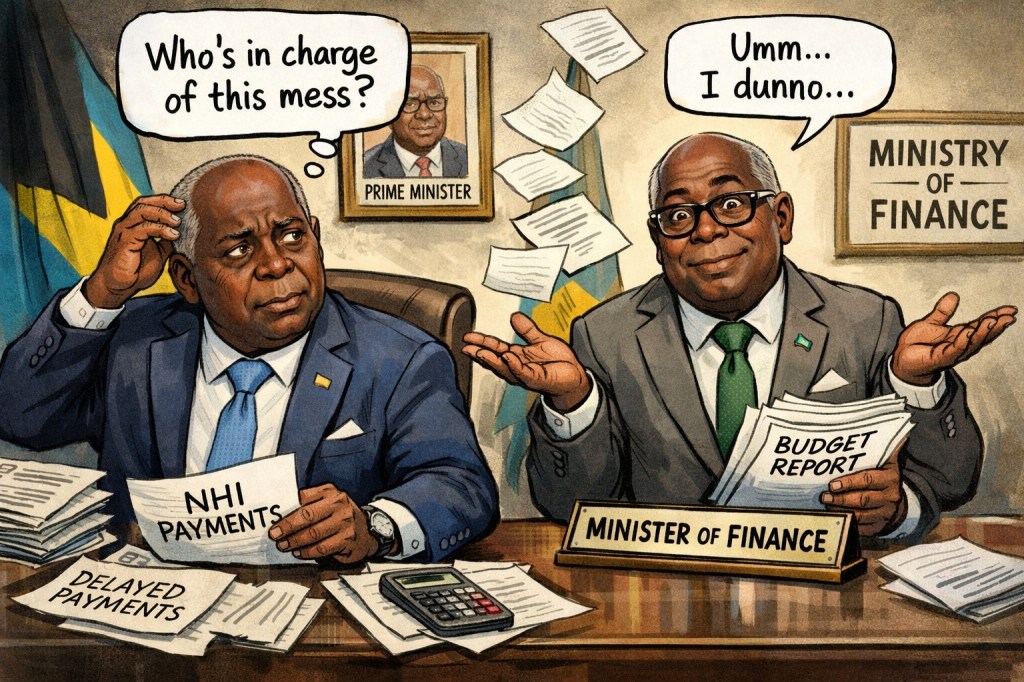
This isn’t a minor administrative hiccup. The NHI programme is not some obscure line item buried deep in a budget appendix. It is a central pillar of public healthcare, affecting doctors, providers, and ultimately the lives of Bahamians. Payment delays in such a system are not “glitches”—they are systemic failures with real consequences.
The explanation offered—those ever-convenient “bureaucratic glitches”—has become the governmental equivalent of “the dog ate my homework.” Reliable, repeatable, and increasingly unconvincing.
Even more concerning is the contradiction: on one hand, the government previously suggested “irregularities” in billing; on the other, providers themselves have pushed back, stating that such characterizations misunderstand how the system actually operates. So, which is it? Faulty billing, or faulty administration?
Many right-thinking Bahamians are now thinking the latter.
And while this back-and-forth plays out in the press, doctors wait. Laboratories wait. Patients—whether they realize it or not—wait too.
There is something almost comical, in a darkly ironic way, about a Prime Minister expressing frustration at a problem that falls squarely under his own ministerial portfolio. It’s like watching a man file a complaint against himself, then promise to investigate himself thoroughly.
Perhaps the most charitable interpretation is that there is a breakdown in communication within the Ministry of Finance. The less charitable interpretation? That there is no communication to break down.
Either way, the conclusion is the same: leadership cannot function on surprise. A Prime Minister cannot afford to be the last to know—especially when he is also supposed to be the first responsible.
One hopes that Philip Davis does, in fact, “get his head wrapped around this” soon. Because while the phrasing may be light, the situation is anything but. This is not an abstract policy debate—it is the operational backbone of healthcare in the Bahamas.
And if the Minister of Finance needs to be briefed on what the Minister of Finance is doing, then the country has a far bigger problem than delayed payments.
The Progressive Liberal Party (PLP) fails for one reason; it is their nature.
END
 My Morning Paper