
Ah yes—because nothing says “healthy, thriving democracy” quite like a poll you can’t see, can’t verify, and apparently wasn’t meant to be looked at too closely… like the political equivalent of “trust me, bro.”
Now, let’s talk about this with the appropriate level of raised eyebrow, shall we?
Back in 2022, Philip Davis was enjoying a very respectable post-election honeymoon glow, buoyed by an approval rating reportedly around 67% after his first 100 days. Perfectly normal. Governments win elections, people feel hopeful, and for a brief, shining moment everyone pretends potholes are “temporary character features.”
But—and this is important—that number came from a sample of 1,064 people in a country of roughly 400,000. Statistically speaking, that’s about 0.26% of the population. Which is fine, by the way, if the poll is scientifically conducted, transparent in its methodology, and properly randomized.
Because here’s the thing: small samples can absolutely be valid. That’s how polling works. But only when you can actually see how the sausage was made. Otherwise, it’s not polling—it’s numerology with better branding.
And now, fast forward to today, where the Progressive Liberal Party proudly points to a new poll—surveying 805 people—as evidence that they are cruising toward victory in the next general election. Eight hundred and five people. Roughly 0.2% of the population.
Again, not inherently invalid… if the methodology is sound, disclosed, and independently credible.
But here’s where things get delightfully murky.
According to The Nassau Guardian, the PLP claims 38% support versus 18% for the Free National Movement. To which the FNM responded, in what might be the most relatable political statement ever: “Fishermen never say their fish stink.”
And honestly, that might be the most statistically rigorous part of this entire situation.
Because when a poll is commissioned, released, and promoted by the same political party that benefits from it—without clear disclosure of sampling methods, margins of error, weighting, or even basic transparency—you don’t have a crystal ball. You have a mirror.
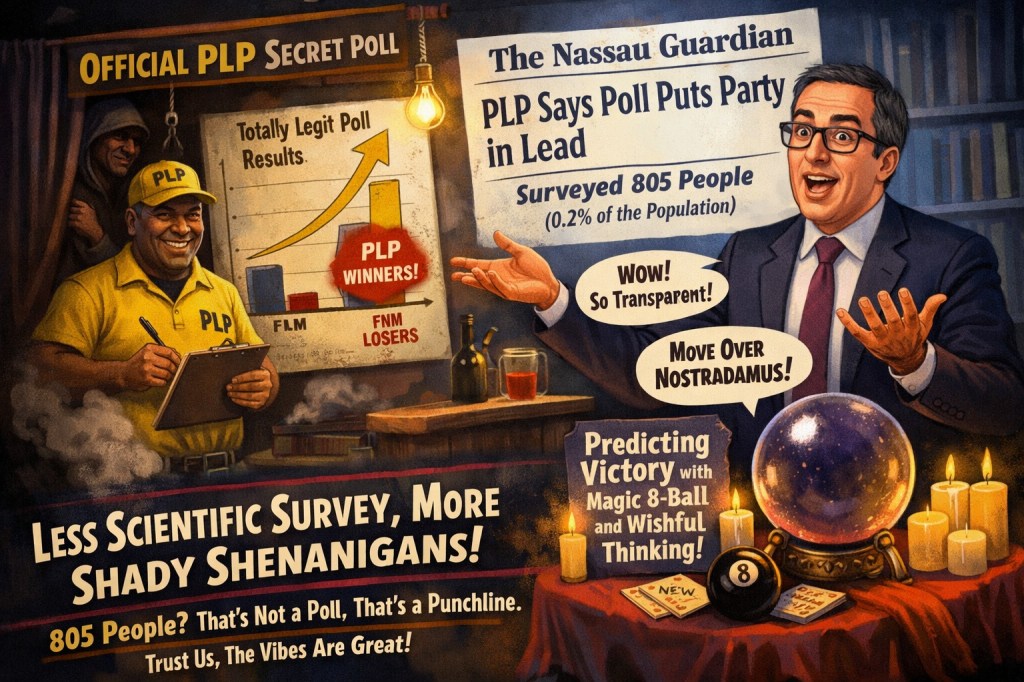
A very flattering mirror. The kind found in a carnival funhouse, where somehow, you are both taller and more popular than reality suggests.
Now, to be fair—and this is where we stay grounded—random sampling can produce reliable insights even with a few hundred respondents. That’s Polling 101. But secrecy and science are not natural allies. If anything, secrecy is what science actively tries to avoid. You publish your methods. You show your work. You invite scrutiny.
You do not conduct what appears to be a politically convenient survey and then ask the public to accept it on vibes alone.
Because when you look at numbers like these, they don’t scream “data-driven certainty.” They whisper, “internal reassurance.” The kind of numbers that say, “Everything is fine,” while the political equivalent of a check engine light is blinking quietly in the background.
And that’s the real question here: if everything is fine—if support is genuinely strong and growing—why the need for a poll that feels like it was conducted somewhere between a strategy meeting and a group chat?
Why not publish the full methodology? Why not let independent analysts tear it apart and confirm its strength?
Unless of course… you’re not entirely sure they would.
Because projecting confidence and having confidence are not the same thing. One is a press release. The other survives scrutiny.
So, are they sensing trouble? Not necessarily panic—but perhaps enough uncertainty to start shaping the narrative early. To say, “We’re winning,” not just to the public, but maybe to themselves.
And if this is the new standard, then fantastic. I, too, will be commissioning a poll. Sample size: me, two friends, and a cousin
And I’m delighted to report that early findings show overwhelming support for my candidacy as the next Pope.
Because apparently, in this Brave New world of mystery polling, anything is possible… as long as you don’t ask too many questions.
The Progressive Liberal Party (PLP) fails for one reason, it is their nature.
END
 My Morning Paper