
Yesterday in the Business Section of The Nassau Guardian, it was reported that stocks rallied and oil sinks after Trump hints at a possible end to war, even as Iran denies talks”, on the very same page as this story was another article that entitled; “GBPC buyout one step closer – Govt. seeks House approval to guarantee $280 loan for GBPC shares and working capital – New SPV created”
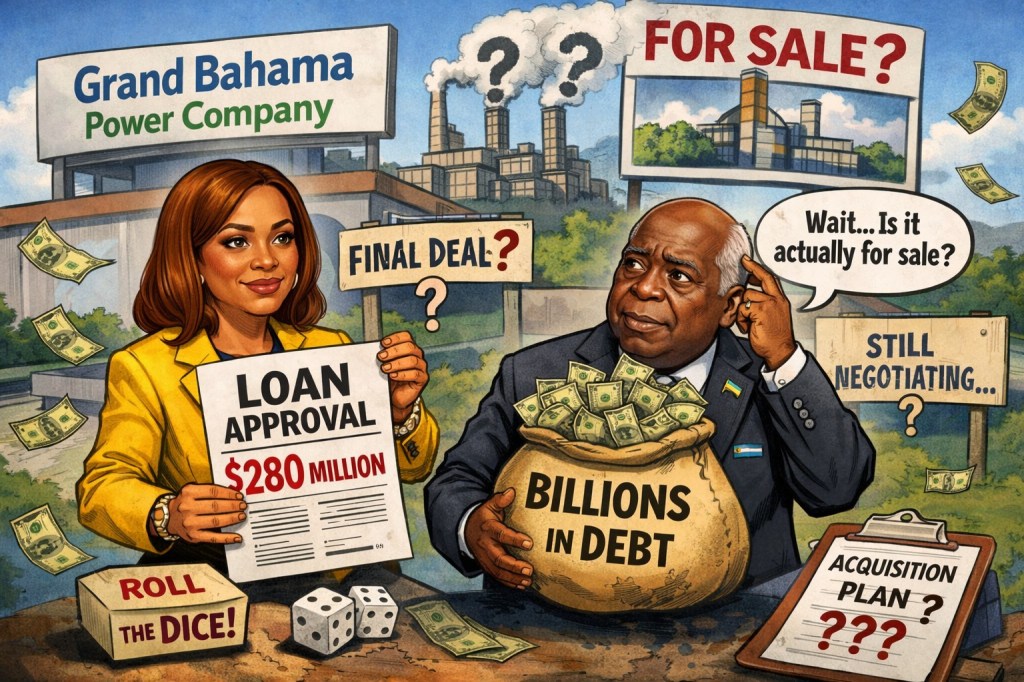
Nothing says sound fiscal management quite like reaching for the national credit card before you’ve even confirmed what’s in the shopping cart.
Let’s walk through this carefully, because beneath the comedy is a sequence of events that is, factually, exactly as puzzling as it sounds.
According to reporting from The Nassau Guardian, the administration led by Philip Davis has moved to guarantee $280 million in borrowing through a newly created vehicle, Grand Bahama Energy Company Limited. The purpose? To acquire the voting shares of Grand Bahama Power Company (GBPC), with financing structured as:
- $200 million for acquisition (via a consortium led by Standard Chartered)
- $80 million for capital expenditure and working capital (via RBC Bahamas)
So far, so decisive. So confident. So… premature?
Because in the very same news cycle, the CEO of GBPC — Dave McGregor — felt compelled to gently remind everyone that while discussions with Emera (GBPC’s parent) are “productive,” there is no final agreement.
Not “agreement pending signature.”
Not “terms finalized.”
Not even “we’re basically there.”
No. Final. Agreement.
Which raises the obvious question: what exactly is Parliament being asked to approve borrowing for?
Because what we appear to have here is a government:
- advancing loan guarantees,
- establishing a special purpose vehicle,
- signalling near-certainty of acquisition,
…while the seller is still publicly saying, “We’re talking.”
That’s not closing a deal. That’s manifesting one.
Now, to be fair — and this is where we separate satire from reality — governments often move ahead with financing structures in anticipation of a deal. This is not unheard of. In large infrastructure or utility acquisitions, especially involving state interests, you prepare the financing early so you can act quickly once terms are finalized.
But here’s where it gets politically awkward:
The public posture has been one of confidence bordering on inevitability, while the counterparty is still emphasizing uncertainty and ongoing negotiation. That mismatch creates the impression — fair or not — that the government may be trying to:
- Signal seriousness to the seller (i.e., “we have financing ready, let’s close”),
- Box itself into a political commitment to force momentum, or
- Shape public expectations so that backing away becomes politically costly.
In other words, this may not be confusion — it may be strategy.
A risky one.
Because if the deal falls through, the administration is left explaining why it sought approval to guarantee hundreds of millions in debt for an acquisition that never materialized. And if the deal does go through, the obvious follow-up becomes: on what terms, and at what price, given the apparent urgency?
There’s also a deeper governance question here. When a government moves this far ahead of a finalized agreement, it shifts Parliament’s role from scrutinizing a completed deal to effectively endorsing a negotiating position mid-stream. That’s a subtle but important difference.
So yes, as the House debates borrowing $280 million, the Bahamian public is left watching what feels like a financial version of Schrödinger’s acquisition:
The Grand Bahama Power Company is both being bought and not yet for sale — at the exact same time.
And the only thing that seems fully confirmed…
is the loan.
END
 My Morning Paper