
There’s an old saying—often attributed to Euripides—that whom the gods wish to destroy, they first make mad. Now, I’m not saying that applies here… but if the rhetorical shoe fits, and it’s doing a full tap dance, who am I to interrupt the performance?
Because what we are witnessing from Philip Davis isn’t just a shift in narrative—it’s a full Olympic-level gymnastics routine, complete with flips, twists, and the occasional “wait, wasn’t this a non-issue last week?”
Let’s walk through this carefully—because facts matter, even when the storyline doesn’t.
At the outset, when Michael Pintard raised concerns about fraudulent passports, the Prime Minister’s response was essentially: prove it or pipe down. That “put up or shut up” energy suggested there was nothing to see here—just another overexcited opposition chasing shadows.
Fair enough. Governments should demand evidence.
But then—plot twist—evidence was presented. Documents were laid. Concerns substantiated.
And suddenly, the script changed.
Now, we’re told that the government knew all along. That there was an ongoing investigation. That somehow, the opposition raising the alarm was actually… inconvenient. Late, even. Possibly disruptive.
So, let’s get this straight:
It was a non-issue… until it was a known issue… that was already under investigation… but also somehow endangered by being exposed?
That’s not a timeline—that’s a riddle wrapped in a contradiction, served with a side of political improv.
And just when you think the plot couldn’t thicken further, the Prime Minister introduces a new villain into the story: the Free National Movement.
Apparently, a policy implemented under the previous administration to streamline passport renewals somehow “weakened” the system—so much so that it allegedly impacted the issuance of new passports, opening the door to fraud.
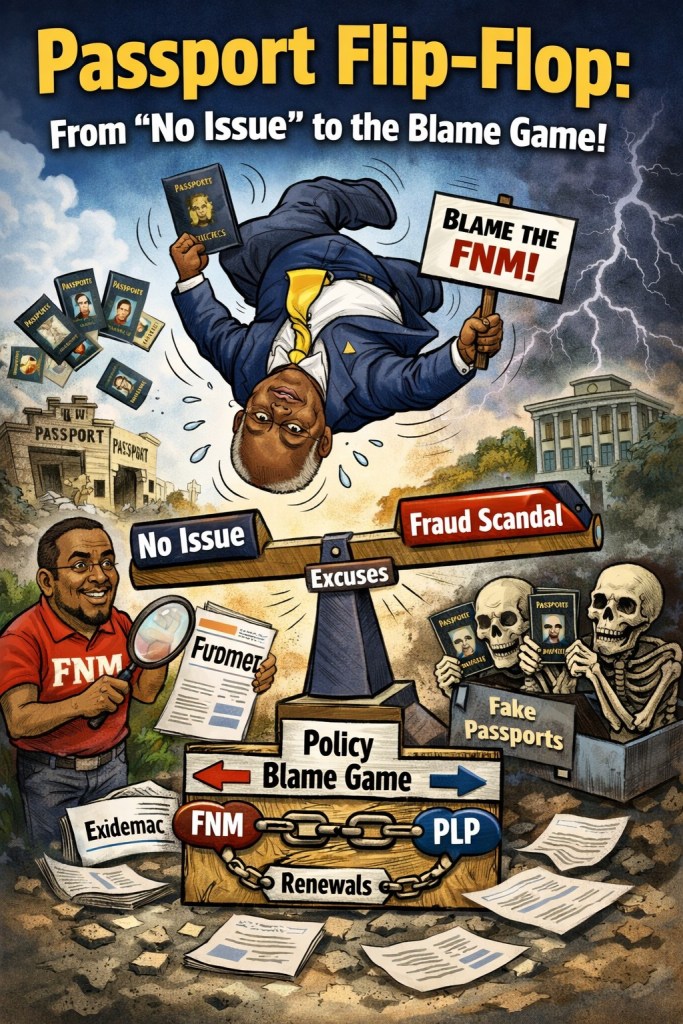
Now here’s where things move from confusing to downright fascinating.
Because administratively—and this is basic governance, not partisan spin—passport renewals and new passport issuance are typically distinct processes. Renewals often involve verifying existing records, while new passports require fresh identity validation, documentation checks, and biometric safeguards.
So, the obvious question becomes:
How does making it easier for a law-abiding citizen to renew an existing passport suddenly create a loophole for issuing fraudulent new passports—especially after the previous administration has already left office?
Is there evidence that the renewal policy directly altered identity verification standards for new applicants?
Was there a procedural overlap that compromised security protocols?
Or is this simply a case of retroactive blame assignment—where yesterday’s “non-issue” needs a historical scapegoat today?
Because if fraudulent passports were being issued after the Free National Movement demitted office, then the responsibility for oversight, enforcement, and correction lies squarely with the current administration. That’s not political bias, that’s how governance works.
And yet, here we are—being asked to believe that a policy for renewals somehow cast a long bureaucratic shadow into a completely different process, under a completely different government, at a completely different time.
At this point, the narrative isn’t just shifting—it’s shapeshifting.
Meanwhile, the Prime Minister asks the nation: “Who is steady enough to lead?”
It’s a fair question. A very fair question.
But it cuts both ways.
Because steadiness isn’t just about criticizing your opponent—it’s about maintaining a consistent, credible position when issues arise. It’s about clarity when the public is seeking answers, not confusion dressed up as strategy.
And when the story moves from:
“There’s no issue,”
to
“We knew about the issue,”
to
“The issue is actually their fault,”
…well, the Bahamian people are left trying to figure out whether they’re watching leadership—or an audition for political theatre.
Either way, tickets are free. Accountability, unfortunately, is not.
The Bahamas deserves better.
The Progressive Liberal Party (PLP) fails for one reason; it is their nature.
END
 My Morning Paper