
There’s something almost magical about watching Philip Davis rediscover the very behaviour he once condemned—like a man who spent years shouting at a leaking roof, only to inherit the house and quietly put out buckets instead of fixing it.
While in opposition, Davis—then the indignant voice of the Progressive Liberal Party—spared no breath in chastising the Free National Movement (FNM) for dodging questions in the House of Assembly. Transparency, accountability, respect for the Bahamian people—these were not just talking points; they were moral imperatives. Or so we were told.
Then came the much-advertised “New Day.”
And apparently, on this New Day, unanswered questions are just part of the weather forecast.
Over 130 questions—many posed by Opposition Leader Michael Pintard—have been left hanging in parliamentary limbo. Not delayed, not deferred, but effectively ghosted. Among them, a rather inconvenient inquiry about what exactly this government has done to enhance transparency and accountability—you know, those campaign promises that tend to age like milk in the Bahamian sun.
The explanation? Well, according to the Prime Minister, the previous FNM administration did it too.
Ah yes, the timeless defense of the playground: “They started it.”
It’s a fascinating pivot. What was once “arrogance” and “contempt for the Bahamian people”, Davis’s own words in 2021, has now been rebranded as… precedent. One might call it hypocrisy; others might call it political evolution. Either way, it seems the bar for governance has not been raised—just carefully stepped over.
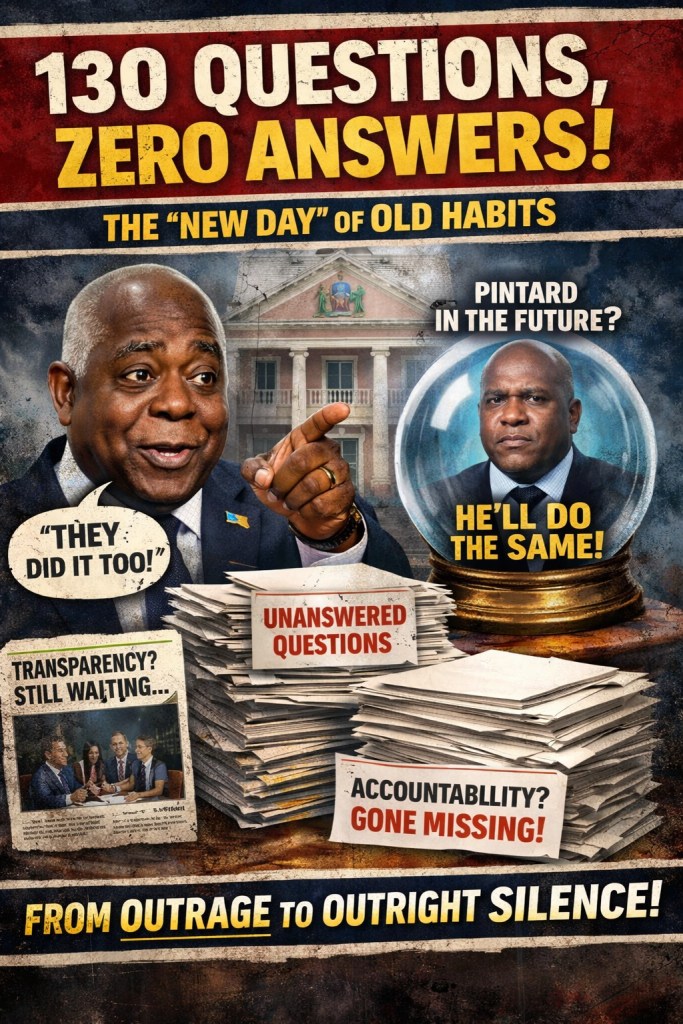
And the unanswered questions are not trivial matters. They touch on issues of governance, transparency mechanisms, national development priorities, and public accountability. In other words, the very things a government might want to clarify if it were, say, asking the public for renewed trust at the ballot box.
Instead, we are given Golden or is it now Blue silence—and an interesting bit of speculative fiction.
Because in defending his record, Davis has taken it upon himself to predict that a future government led by Michael Pintard would behave the same way. Which is quite a claim. Not just a political jab, but a kind of prophetic certainty: that no matter who is elected, the answers will remain elusive.
It’s a convenient argument. If everyone is going to fail, then no one is uniquely accountable for failing now.
But here’s the problem: that logic doesn’t inspire confidence—it erodes it. It tells the Bahamian people that promises of transparency are little more than campaign-season theatre, destined to be shelved alongside manifestos once power is secured.
So, the real question isn’t whether a future administration might follow this pattern. It’s why this one already has.
Because if the standard for leadership is no longer “do better,” but simply “do no worse than the last guy,” then the New Day starts to look suspiciously like the same old night—just with different speeches and fewer answers.
END
 My Morning Paper