
Yesterday morning, on what should have been the serene and reflective morning of Good Friday, I expected a pleasant message from the Chairman of the New Day Progressive Liberal Party (PLP), Fred Mitchell. At first, it appeared that his message might begin on a positive note. But, as has become customary with the PLP’s messaging, the tone quickly took a darker turn.
What began as a story about encouraging a young woman to participate in the democratic process quickly devolved into what has become the hallmark of the PLP’s current campaign: fearmongering disguised as political persuasion.
In recounting his canvassing efforts, Mr. Mitchell described encountering an 18-year-old student who hopes to study medicine but expressed little interest in politics. Rather than inspire the young woman through optimism, policy, or opportunity, Mr. Mitchell instead warned her that if she did not vote for the PLP, the scholarships she hopes to rely on could be cancelled.
That, in essence, is the foundation of the PLP’s current campaign slogan: “Choose Progress.”
But when one examines the messaging closely, it becomes apparent that “Choose Progress” has less to do with progress and far more to do with manufacturing fear.
Mr. Mitchell even went so far as to frame the upcoming election in almost biblical terms, declaring that Bahamians must choose “progress over the work of the devil.” Such rhetoric may make for dramatic political theatre, but it raises a simple question: if the PLP truly had a record of undeniable progress, why rely so heavily on fear?
Because the truth is that when one examines the PLP’s record over the past four and a half years, the results are far less impressive than their slogan suggests.
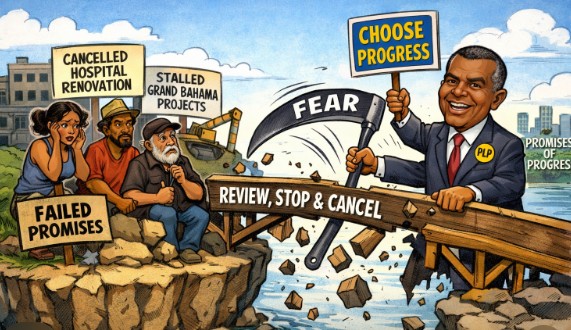
Nowhere is this clearer than in Grand Bahama.
For years, Grand Bahamians have heard promises of economic revival, transformative development, and renewed opportunity. Yet the island continues to wait. Projects that could have pushed the island forward were instead reviewed, stalled, or abandoned, leaving Grand Bahama residents asking a very simple question: Where exactly is this progress we are being told to choose?
Mr. Mitchell often attempts to deflect attention by accusing the Free National Movement (FNM) of being “servants of the Grand Bahama Port Authority.” The irony of this accusation is difficult to ignore. While the PLP accuses others of allegiance to the Port Authority, Grand Bahama itself has seen little of the economic revival repeatedly promised by this administration.
If the Chairman wishes to tell stories while canvassing, perhaps he should tell the young woman about the government’s own version of “review, stop, and cancel.”
Will he explain how the PLP cancelled the existing arrangements to renovate the Princess Margaret Hospital and returned the funds earmarked for that project—delaying critical improvements to the nation’s healthcare infrastructure?
Will he explain how the government halted or reconsidered several initiatives left in place by the previous Free National Movement (FNM) administration—initiatives that, if carried through, might have moved the country further ahead than it stands today?
Of course, those stories are unlikely to make it into the Chairman’s canvassing speeches. They do not fit neatly into the narrative of a government claiming a “stellar and enviable record.”
I have said before that there is the truth, and then there is PLP truth. Unfortunately, the two rarely occupy the same space.
The Bahamian people deserve better than a government that has spent four and a half years waffling through governance, only to now campaign on a slogan that suggests progress is something voters must protect rather than something they have already experienced.
Progress is not a slogan.
Progress is not fear.
Progress is not telling a young woman that her dreams may disappear unless she votes for a particular party.
If the PLP truly believed in progress, they would not need to frighten Bahamians into choosing it.
They would simply be able to show it.
Instead, after nearly a full term in office, the best argument they can offer the country is a warning: vote for us, or everything may disappear.
That is not progress.
That is political fear dressed up as a campaign motto.
The Progress Liberal Party (PLP) fails for one reason; it is their nature.
END

 My Morning Paper