My Morning Paper – 27 Apr. 2026 – Crying Foul in a Game He Perfected

It seems the Chairman has suddenly discovered a most tragic affliction: selective outrage. One minute he’s cruising to the airport, the next he’s clutching his pearls over FNM billboards like they’ve committed some unprecedented crime against humanity. Apparently, in his world, political messaging only becomes “nasty” when someone else does it better.

His lament reads less like a statesman’s concern and more like a man shocked—shocked!—to find mudslinging happening in a game his own team practically invented. After all, this is the same PLP playbook that gave us years of relentless attacks in opposition, followed by an encore performance while in government. But now, suddenly, the tone is too harsh? The irony could power the entire national grid.

And let’s not pretend this is about “desperation.” If the FNM is leaning into negative campaigning, then by the Chairman’s own standard, they’re simply excelling at a craft the PLP has spent years perfecting. The only difference now is that the criticisms hitting the New Day PLP are landing a little too close to home—less fiction, more uncomfortable fact.
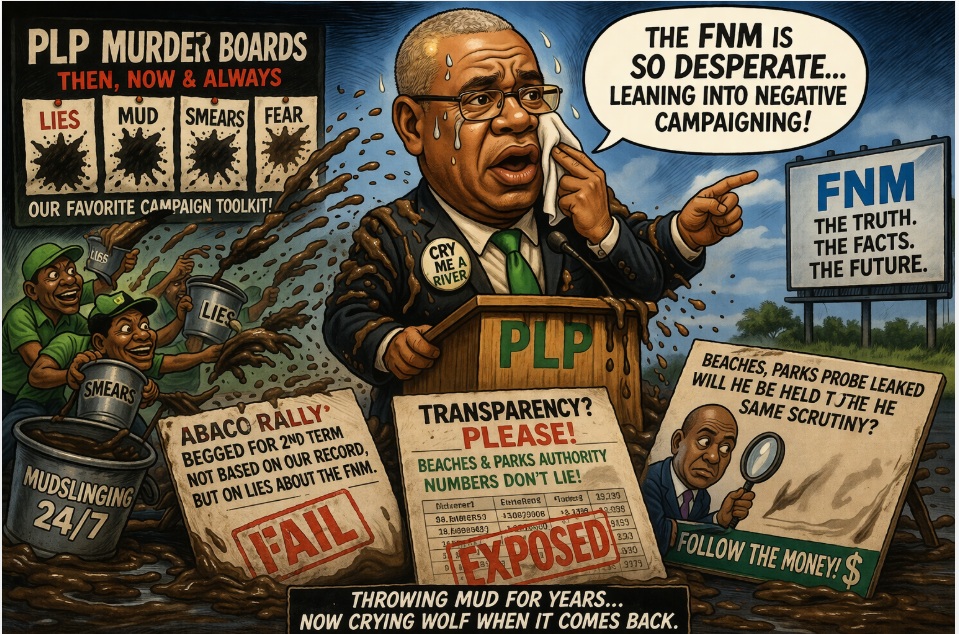
The Chairman’s call for a “vigorous and punchy defense” is particularly amusing. Translation: when they attack, it’s righteous; when others respond, it’s reckless. One might even admire the consistency—if not for the complete lack of self-awareness.

Take Abaco, for example. The recent rally wasn’t so much a presentation of achievements as it was a nostalgic tour of alleged FNM failures—many of which were generously seasoned with exaggeration, if not outright fiction. It worked once, and now the hope is lightning will strike twice, even as the island waits for tangible progress that never quite seems to arrive.

And then we arrive at the pièce de résistance: the claim of transparency. According to the Chairman, everything is “in plain sight.” Indeed—so plain, in fact, that the numbers themselves appear to be staging a quiet protest. If transparency were truly the hallmark of this administration, then the leadership at Beaches and Parks would be subjected to the same forensic-level scrutiny applied to others. Funny how accountability always seems to be a one-way street.

In the end, the Chairman crying foul over “nasty campaigning” feels less like a genuine concern and more like a seasoned boxer complaining about punches mid-fight—after years of throwing the first and hardest blows.

If nothing else, it’s a reminder: in politics, the loudest cries of victimhood often come from those most fluent in the art of attack.

The Progressive Liberal Party (PLP) fails for one reason, it is their nature.

END
My Morning Paper – 24th April 2026 – Accountability Deferred, Transparency Denied

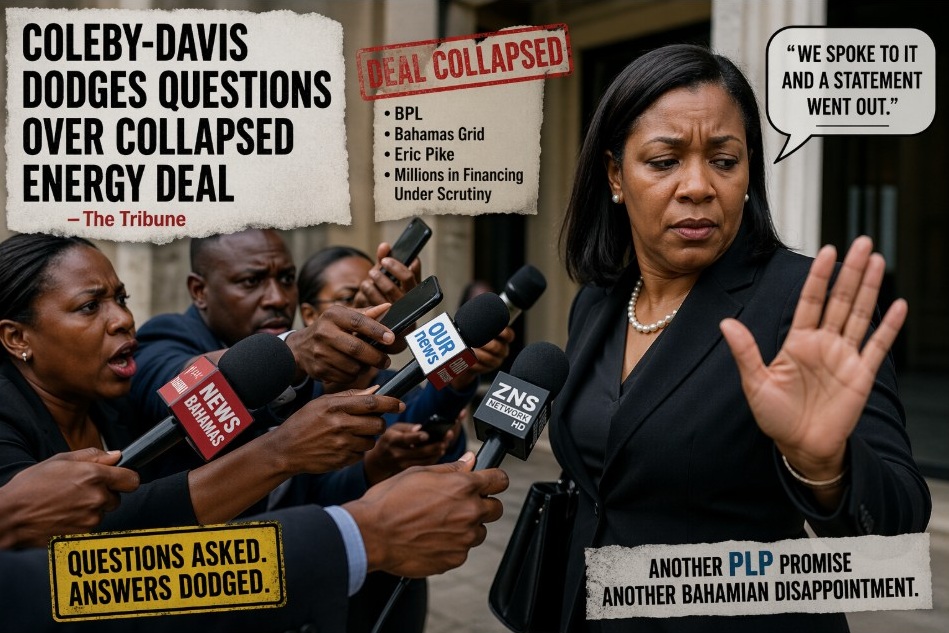
From the very moment JoBeth Coleby-Davis told Opposition Leader Michael Pintard that she would only answer his parliamentary questions if he first survived an internal leadership contest within the Free National Movement (FNM), the tone was set—not for accountability, but for deflection. It was a remark that revealed more about the government’s posture than any formal statement ever could. Years later, those questions remain unanswered, and the pattern has only deepened.

Now we arrive at the latest episode involving Bahamas Power and Light (BPL), Bahamas Grid Company, and the much-touted energy reform arrangement tied to U.S. executive Eric Pike. According to reporting from The Tribune, a deal described as central to modernizing New Providence’s grid has effectively unravelled less than two years into what was supposed to be a 25-year agreement. When pressed, Minister Coleby-Davis offered little more than a rehearsed line — “a statement went out”—before cutting off further inquiry.

That is not transparency. That is choreography.

The government’s attempt to rebrand what appears to be a breakdown as a “transition” follows a now-familiar script. Bahamians have seen this before, most notably with the Our Lucayan situation in Grand Bahama, where optimistic framing was used to soften hard realities. In this case, the public is again being asked to accept reassurance in place of explanation, confidence in place of clarity.

But the facts, as presented, raise legitimate concerns. A key partner has exited. A flagship agreement has faltered prematurely. Millions in financing are under scrutiny. Yet, the level of detail provided to the public remains minimal, controlled, and carefully filtered.

This is where the broader criticism of the Progressive Liberal Party (PLP) finds its footing—not in partisan rhetoric, but in observable governing habits. The administration campaigned heavily on accountability and transparency, presenting these as cornerstones of its mandate. However, instances like this BPL matter, alongside others such as the Beaches and Parks controversy, suggest a governing style that prefers managed messaging over open scrutiny.

Even when responses are eventually given, they often generate more questions than answers—sometimes contradicting earlier positions or introducing new ambiguities. Press engagements become limited. Questions are deflected. And substantive engagement is replaced with carefully staged communication.

It creates the impression of a government more comfortable speaking at the public than to it.

The irony is hard to ignore. The same administration that once championed a “Blueprint for Change” now promotes a “Blueprint to Progress.” But progress, by any reasonable standard, requires measurable outcomes, clear communication, and public trust built on transparency—not semantics.

So, the question naturally follows: what exactly constitutes this “progress”?

Because for many observers, the list of unanswered questions—from Parliament to press briefings to national projects—continues to grow. And until those questions are met with direct, consistent, and verifiable answers, the gap between promise and practice will remain impossible to ignore.

The Progressive Liberal Party (PLP) fails for one reason; it is their nature.

END

My Morning Paper- 22 April 2026 – A Desperate Plea from a Desperate Man – Midweek Edition

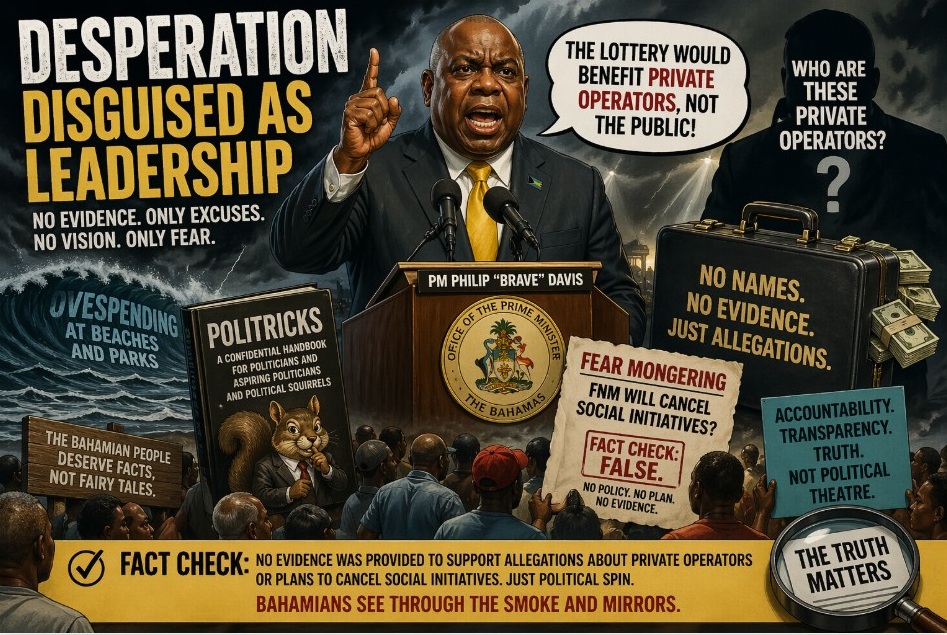
On Monday night, Philip Davis took to the national stage—not to clarify policy, not to account for governance, but to mount what can only be described as a carefully dressed act of political desperation. This came, of course, after sidestepping growing public concern over issues like reported overspending within Beaches and Parks—matters that demand transparency but instead receive theatrical deflection.

Prime Minister Davis ran the full gamut of what Bahamians have come to recognize as “politicks”: a blend of insinuation, selective outrage, and a not-so-subtle pivot into fearmongering. The irony is almost too neat. While referencing the satirical book Politricks – “A Confidential Handbook for Politicians and Aspiring Politicians and Political Squirrels”, the Prime Minister and his Progressive Liberal Party seem less amused by its humour and more committed to turning its caricature into governing strategy—weaponizing satire against Michael Pintard while embodying its very lessons.

A headline from The Tribune reads: “Davis: Lottery would benefit private operators rather than public.” It is a striking claim—serious, consequential, and notably unsupported by any publicly presented evidence. The Prime Minister asserts that the Free National Movement’s (FNM’s) proposal for a national lottery would enrich unnamed “private operators” at the expense of the Bahamian people. But who are these operators? Where is the documentation? What contractual framework is being referenced?

In the absence of specifics, the accusation reads less like policy critique and more like a calculated attempt to seed suspicion and fear. If such a claim were grounded in fact, it would demand immediate disclosure and national scrutiny. Instead, Bahamians are left with an allegation suspended in midair—heavy enough to alarm, but too vague to verify.

Equally concerning is the Prime Minister’s pivot into familiar territory: fear. The suggestion that a future FNM administration would dismantle social initiatives such as the National School Breakfast Programme or the National Youth Guard is a serious charge. Yet, again, no direct policy statements, manifesto excerpts, or verifiable commitments have been cited to substantiate this claim. Political debate is expected; unsubstantiated warnings presented as inevitabilities are something else entirely.

This raises an uncomfortable question: who, exactly, is being “desperate” here?

The Davis administration has been quick to label the Opposition as such. Yet the pattern on display tells a different story—one where allegations are made without evidence, and hypothetical rollbacks are presented as certainties. That is not the language of confidence; it is the language of a campaign searching for traction.

The Prime Minister also took aim at Michael Pintard’s leadership, suggesting he is unable to command his party. This line of attack appears rooted in internal political shifts—members who have chosen to depart. But political parties, by their nature, evolve. Individuals make decisions, alliances shift, and leadership is ultimately measured not by unanimity but by the confidence of those who remain. By that standard, the FNM’s base continues to signal its support.

What remains unanswered, however, is perhaps more telling than what was said. If the government opposes a national lottery so vigorously, whose interests are being protected? The Bahamas already operates within a legalized gaming environment—one in which domestic “number houses” function openly. The question is not whether gaming exists, but how it is structured, regulated, and who ultimately benefits. Opposition to reform, without clarity, invites scrutiny.

As PLP supporters hung on the Prime Minister’s every word at the rally, the scene may have felt energizing in the moment. But beyond the applause, beyond the rhetoric, the substance was thin. What emerged was not a roadmap for governance, but a portrait of a government leaning heavily on accusation and apprehension—hoping, perhaps, that one will compensate for the absence of the other.

In the end, the “wave” the Prime Minister referenced may indeed be real—but not in the way he intended. It is a wave of public frustration, built not on opposition slogans, but on unanswered questions, unmet expectations, and a growing impatience with politics that substitutes clarity with conjecture.

And if that wave is now turning, it is not because of what the Opposition has done—but because of what the government has failed to convincingly explain.

The Progressive Liberal Party (PLP) government fails for one reason; it is their nature.

END

My Morning Paper – April 21st, 2026 – Deflection and Desperation: The PLP’s Failure to Address Real Issues

Only a leader desperate for to remain in power takes to a national stage and chooses to engage in political propaganda instead of addressing meaningful ways to deal with real issues that affect the lives of the average working person. This type of leader amounts to nothing more than a political entertainer and cannot and should not be taken seriously.

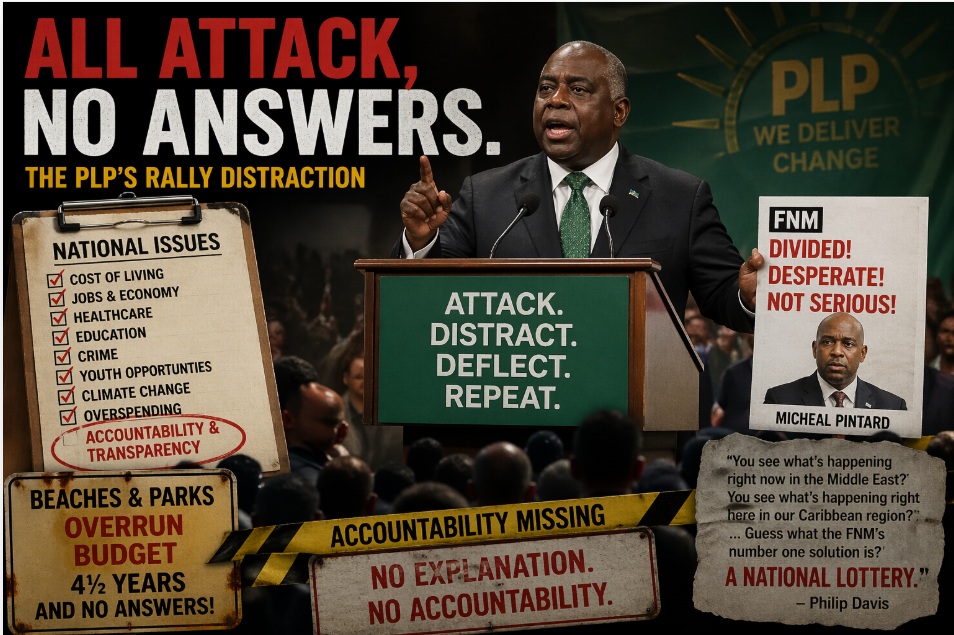
Now, what stands out most from that rally is not simply that the Progressive Liberal Party (PLP) chose to criticize the opposition—that’s expected in politics—but that it did so while sidestepping the very issues it is constitutionally responsible for addressing. When a governing party devotes significant time to attacking opponents instead of accounting for its own record, it invites scrutiny about what it is avoiding.

Philip Davis framed the Free National Movement (FNM) and its leader the Hon. Michael Pintard as unserious and desperate. But that line of attack cuts both ways. If the government believes the opposition’s proposals are weak, the most effective rebuttal would be to clearly present stronger alternatives and demonstrate measurable progress on national priorities—economic growth, cost of living, public services, and fiscal discipline. Instead, the emphasis appeared to be on character attacks and political framing rather than substance.

That absence becomes even more glaring when considering unresolved matters of public concern. The issue surrounding overspending within Beaches and Parks is not a trivial administrative detail—it speaks directly to fiscal management and accountability. McKell Bonaby had an opportunity, both at the rally and previously during the Budget Debate, to provide clarity: What caused the overruns? Were there procurement failures, poor forecasting, or mismanagement? What corrective measures are in place? Those are straightforward questions that taxpayers reasonably expect answers to.

Instead, the decision to pivot toward attacking the opposition—both at the rally and during the Budget Debate—creates the impression of deflection. Criticism of the opposition is politically convenient; explaining budget overruns is politically difficult. But governance demands the latter. When a sitting member of parliament repeatedly avoids addressing a documented financial concern while engaging in partisan attacks, it raises legitimate doubts about transparency and accountability.

Prime Minister Davis’s remarks on global instability—referencing geopolitical tensions, regional challenges, climate change, and economic shifts—introduce an even deeper contradiction. He suggests these are “serious times” requiring “serious people,” yet does not clearly articulate his administration’s concrete policy responses to those very challenges. If these are indeed the defining issues of the moment, then where are the detailed strategies? Where is the roadmap for economic resilience, climate adaptation, or regional competitiveness?
His critique of the national lottery proposal hinges on the argument that it is insufficient in the face of global crises. But that argument only holds weight if it is paired with a clear articulation of what is sufficient. Simply dismissing an opposition idea without presenting a robust alternative leaves a vacuum. The obvious question follows: what are the administration’s priority solutions, and why were they not the focus of the address?
There is also an internal inconsistency in the rhetoric. On one hand, the Prime Minister claims the opposition is engaging in negativity and desperation. On the other, a significant portion of his own platform at the rally is dedicated to questioning the opposition leader’s competence and unity. If the stated standard is to avoid “getting in the mud,” then the messaging should reflect a higher level of policy-driven engagement.
Ultimately, political rallies are opportunities—not just to energize supporters—but to demonstrate leadership through clarity, accountability, and vision. When those opportunities are used primarily for partisan attacks, it weakens public confidence in the seriousness of governance. The electorate is left not with a clearer understanding of how their challenges will be addressed, but with unanswered questions:
• Why has overspending in key departments not been fully explained?
• What specific policies are being implemented to address the global and regional challenges cited?
• If a national lottery is dismissed as inadequate, what are the administration’s primary economic solutions?
Those are not opposition talking points—they are governance obligations. Until they are answered directly and transparently, criticisms of the opposition risk sounding less like leadership and more like distraction.
The Progressive Liberal Party (PLP) fails for one reason; it is their nature.

END

My Morning Paper- 15th April 2026 – Running on Fear, Governing on Empty: Davis in Grand Bahama

In what can only be described as a thinly veiled exercise in political desperation, Prime Minister Philip Davis’ recent remarks in Grand Bahama leaned heavily on alarmism rather than substance. Framed as a warning to voters, his speech instead revealed a troubling reliance on fearmongering—particularly the attempt to resurrect the long-dead Oban proposal as a cautionary tale of what a Free National Movement (FNM) government might bring.

The Oban project, announced in 2018 under the Minnis administration, did indeed collapse amid scrutiny over the developers’ credibility and the lack of proper environmental approvals. That much is factual. However, to suggest that this single failed proposal represents the entirety of what an FNM government would offer today is not just misleading—it is politically convenient. It allows Davis to avoid a far more pressing question: what, exactly, has his own administration delivered for Grand Bahama after four and a half years in office?

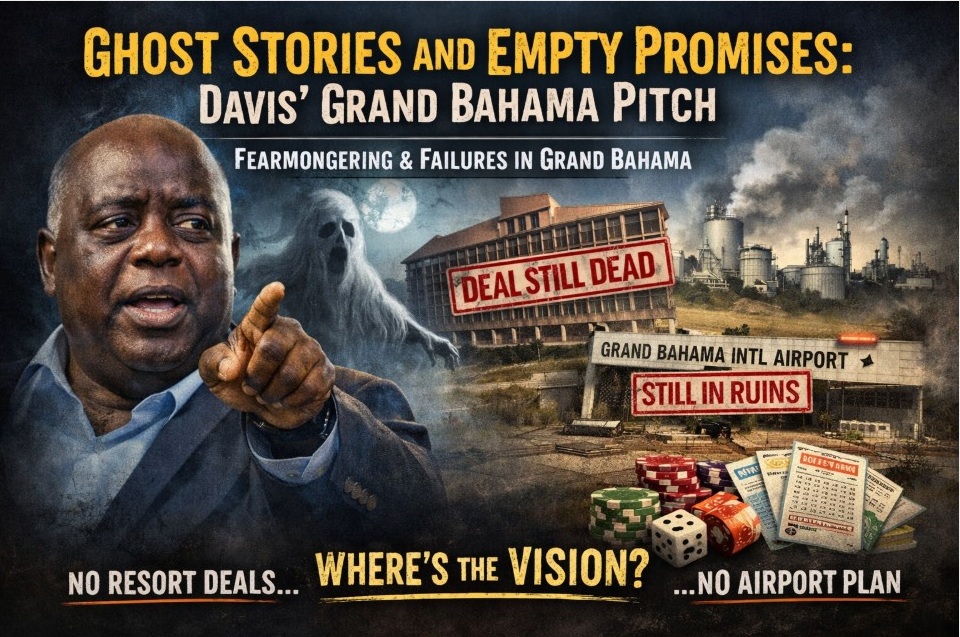
The answer, by most measurable standards, is very little of substance. Despite inheriting a global economic rebound following the COVID-19 pandemic—particularly in tourism—Grand Bahama has not experienced the same level of recovery or targeted investment as New Providence. The most glaring failures remain the government’s inability to finalize and execute a viable deal for the Grand Lucayan Resort and the continued stagnation surrounding the redevelopment of the Grand Bahama International Airport. Both are critical pillars for the island’s economic revival, and yet both remain unresolved despite repeated announcements and shifting negotiations.

Against this backdrop, Davis’ appeal to voters to “choose the PLP” rings hollow. Political rhetoric about “standing up” to the Grand Bahama Port Authority may generate applause on a rally stage, but it does not create jobs, attract investment, or restore economic confidence. Even the arbitration outcome—where the government secured regulatory authority—has yet to translate into a clear, actionable development plan. Grand Bahamians are still waiting.

Equally concerning is the Prime Minister’s invocation of a “colonial mindset” as a political attack line. Such language is not only inflammatory but distracts from the absence of a coherent vision for the island. If anything, it raises the question of why, after nearly a full term in office, the Davis administration has yet to articulate a detailed and credible roadmap for Grand Bahama’s long-term growth. Accusations of colonial thinking may stir emotion, but they do not substitute for leadership or policy clarity.

Then there is the matter of the national lottery. Davis’ dismissal of the proposal as a “gimmick” is, at best, inconsistent. The record shows that the Progressive Liberal Party (PLP), during the Christie administration—with Davis serving as Deputy Prime Minister—oversaw the legalization and regulation of web shop gaming, despite a 2013 referendum in which voters rejected both web shops and a national lottery. To now deride a lottery as turning the country into a “numbers house” ignores the reality that such gaming operations are already a normalized and significant part of the Bahamian economy.

In the end, what was presented in Grand Bahama was less a vision for the future and more an attempt to revive fears of the past. But voters are not only looking backward—they are assessing the present. And on that measure, the Davis administration’s record in Grand Bahama leaves far more questions than answers.

The Progressive Liberal Party (PLP) government fails for one reason; it is their nature.

END

My Morning Paper 13th April 2026 – Lottery vs. Number Houses: What Is the PLP Really Protecting?

It is a remarkable bit of political theatre when the Progressive Liberal Party (PLP) suddenly discovers moral outrage over a national lottery—an idea it once flirted with, entertained, and in broader terms, helped normalize through the legalization and expansion of domestic gaming.

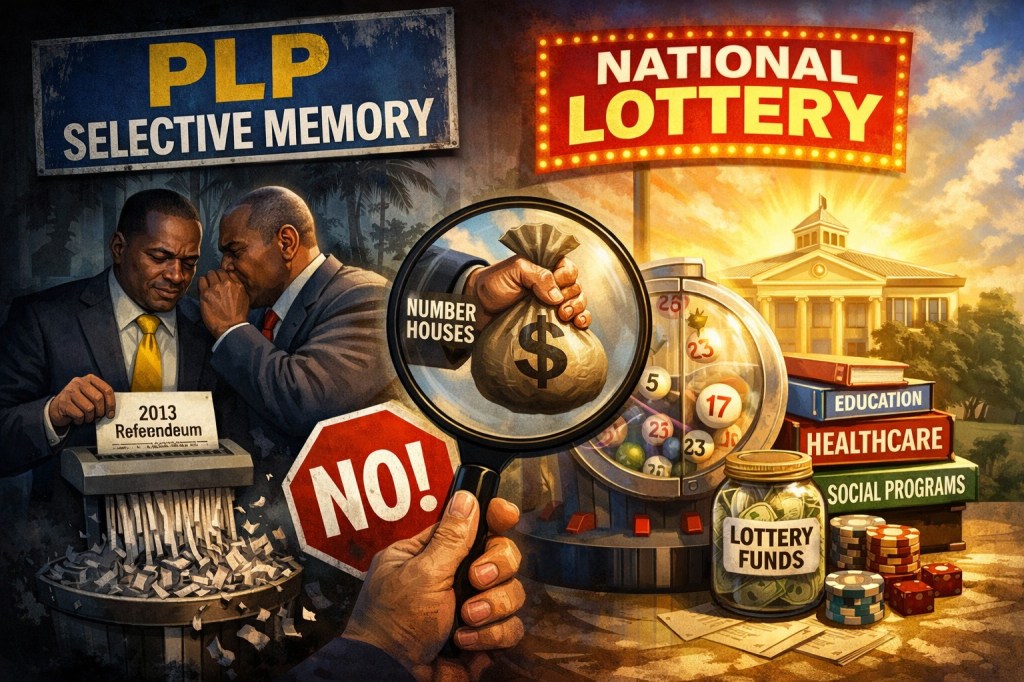
The statement attacking Michael Pintard and the Free National Movement is less a principled objection and more a convenient reinvention of history. To hear the PLP now, one would think they have always stood as guardians against the social ills of gaming. Yet Bahamians have not forgotten that it was under PLP governance that the gaming landscape was fundamentally altered—particularly following the 2013 referendum on web shop gaming, which the government at the time dismissed as “non-binding,” effectively treating it as an opinion poll before proceeding in a direction many voters had rejected.

That decision did not eliminate gaming—it consolidated it. A small number of operators were legitimized and empowered, creating a structured but limited industry. So, the question now becomes unavoidable: why is a government that enabled and regulates “number houses” suddenly opposed to a broader, more transparent national lottery model?

The PLP’s critique that a lottery is a “gimmick” rings hollow when placed against this backdrop. If anything, the distinction they are trying to draw—between a regulated lottery and existing gaming operations—feels artificial. Both rely on games of chance. Both generate revenue from participation. The only meaningful difference is scale, transparency, and who ultimately benefits.

Their argument leans heavily on cautionary tales from abroad, particularly referencing scandals in the Dominican Republic. Certainly, corruption risks exist in any system lacking proper oversight. But to suggest that the mere existence of a lottery inevitably leads corruption is intellectually lazy. By that logic, any public institution—from procurement to infrastructure—could be dismissed outright due to corruption risks elsewhere. The real issue is governance, not the mechanism itself.

And this is where the tone of the PLP’s response becomes almost ironic. A party that has often bristled at being labelled obstructionist now finds itself reflexively opposing a proposal that could, if properly structured, provide a dedicated revenue stream for education, healthcare, and social programs. Instead, their response leans on dismissiveness rather than substantive counter-policy.

Their defense—that they prefer to invest in programs like BTVI, BAMSI, and entrepreneurial support—is not inherently wrong. These are worthwhile initiatives. But investment requires funding, and funding requires either taxation, borrowing, or alternative revenue streams. If the objection to a lottery is principled, then the PLP owes the public a clear explanation of how they intend to sustainably finance these ambitions without increasing the national debt or tax burden.

Which leads to the more uncomfortable question—one the PLP carefully avoids: who benefits from maintaining the current gaming structure?

It is not unreasonable to observe that the existing “number houses” operate within a controlled environment with established stakeholders. A national lottery, particularly one with transparent oversight and public accountability, could disrupt that balance. It could redistribute market share, introduce competition, and alter revenue flows. So when resistance emerges, it is fair—indeed necessary—to ask whether this is about public policy or private interests.

To be clear, this is not an accusation, but an observation rooted in political pattern. Governments rarely resist revenue-generating mechanisms without reason. And when that resistance contradicts their own historical posture on similar issues, scrutiny is warranted.

Ultimately, the debate over a national lottery should not be reduced to slogans like “gimmick” or “slush fund.” It deserves a serious, fact-based discussion about regulation, transparency, economic impact, and social responsibility. What Bahamians are getting instead is a selective memory from the Progressive Liberal Party and a response that feels less like leadership and more like deflection.

And that, perhaps, is the most telling point of all.

The Progressive Liberal Party (PLP) fails for one reason; it is their nature.

END

My Morning Paper- 110 April 2026 – When ‘Better’ Becomes ‘Uncertain’: Revisiting the Grand Lucayan Decision

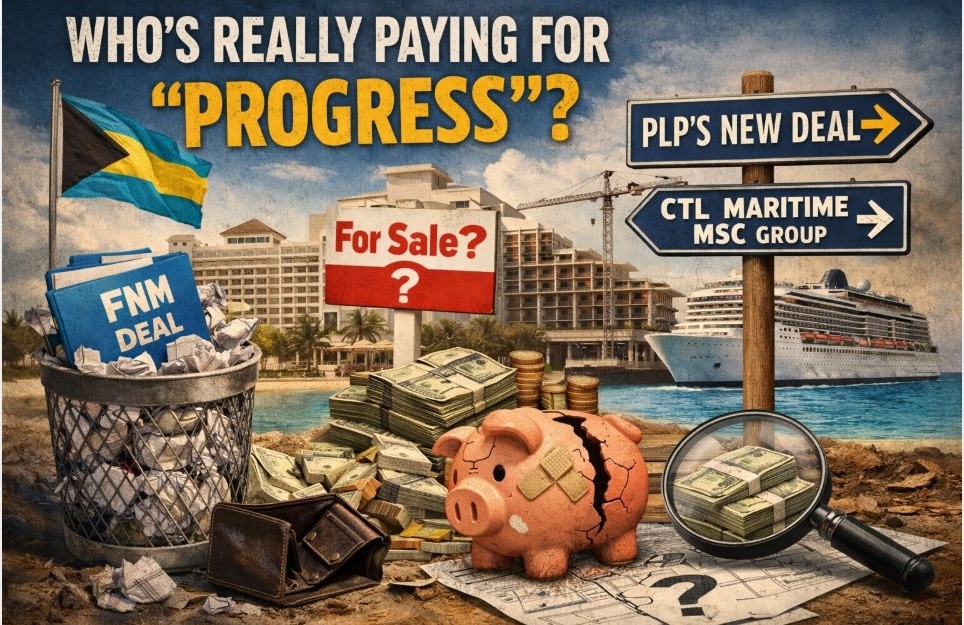
Today the Progressive Liberal Party (PLP) proudly thumps its chest and declares “PROGRESS” after overseeing yet another signing ceremony tied to the long-suffering Grand Lucayan Resort. One might be forgiven for thinking that after years of false starts, aborted agreements, and recycled optimism, Bahamians would have learned to ask a very simple question: progress compared to what?

Because let us not forget—this is the very same administration that, upon taking office, swiftly abandoned a deal left in place by the Free National Movement (FNM). That deal, we were told, was fundamentally flawed, not in the best interest of the Bahamian people, and unworthy of proceeding. It was cast aside with confidence, replaced with promises of something better, stronger, more credible.

And yet here we are.

After multiple failed attempts and shifting narratives, the PLP now points to an agreement involving the Concord Wilshire Capital as evidence that their judgment was sound all along. But if this is “progress,” it is a peculiar kind—one that seems to require constant revision, external reinforcement, and, most tellingly, new partners to make the numbers work.

Because buried within the celebratory headlines is a rather inconvenient detail: Concord Wilshire has now entered into an arrangement with CTL Maritime, a subsidiary of the MSC Group. And suddenly, the questions that should have been asked a year ago become unavoidable today.

If Concord Wilshire had the financial capacity to execute a $120 million purchase and redevelopment, why is it only now, nearly a year later, that a major international player must step in to “advance the project”? Why does ownership seem to materialize only after this partnership is announced? And perhaps most importantly, who is really carrying the financial weight here?

The Bahamian people were once assured—quite memorably by Deputy Prime Minister Chester Cooper—that the money would “hit the bank.” It was a bold, confident declaration meant to signal certainty. Today, however, it feels less like a promise fulfilled and more like a question deferred.

Because if CTL Maritime is now acquiring parcels of the development and spearheading key components such as the proposed MSC Beach Club, one must reasonably ask whether Concord Wilshire was ever fully capitalized to deliver the project on its own. And if not, why was the Bahamian public led to believe otherwise?

This is not merely a matter of technical financing arrangements; it strikes at the heart of the PLP’s decision-making. They scrapped an existing deal on the grounds of national interest, only to replace it with an arrangement that now appears dependent on external rescue or reinforcement. That is not strategic foresight—it is, at best, hopeful improvisation.

And the concerns do not end there. Beyond the initial acquisition, the broader vision for the Grand Lucayan includes multiple phases: cruise resorts, a mega yacht marina, a casino, and extensive redevelopment works. These are not minor undertakings. They require deep, sustained capital and a proven capacity to execute at scale.

So, the obvious question arises: if there are already signs of financial strain or dependency at this early stage, what confidence should Bahamians have that the remaining phases will be completed? Will each new milestone require yet another partner, another announcement, another reconfiguration of the deal?

Meanwhile, the government, led by Philip Davis, speaks glowingly of “enhanced capacity” and “global reach.” These are fine words, polished for press releases and podiums. But they do little to address the growing perception that this project, like so many before it, is being held together by shifting alliances rather than firm foundations.

None of this is to suggest that Bahamians do not want the Grand Lucayan revitalized. On the contrary, the desire for economic renewal in Grand Bahama is both genuine and urgent. But hope is not a substitute for transparency, and optimism cannot replace accountability.

If this is indeed a transformational deal, then the details should withstand scrutiny. The financing should be clear. The ownership structure should be unambiguous. And the path to completion should not depend on a revolving door of new participants stepping in to steady the ship.

Until then, “progress” remains a word in quotation marks—proclaimed loudly, but proven quietly, if at all.

The Progressive Liberal Party (PLP) government fails for one reason; it is their nature.

END

My Morning Paper- 10 April 2026 – Blueprint or Reprint? The PLP’s Recycling of Promises

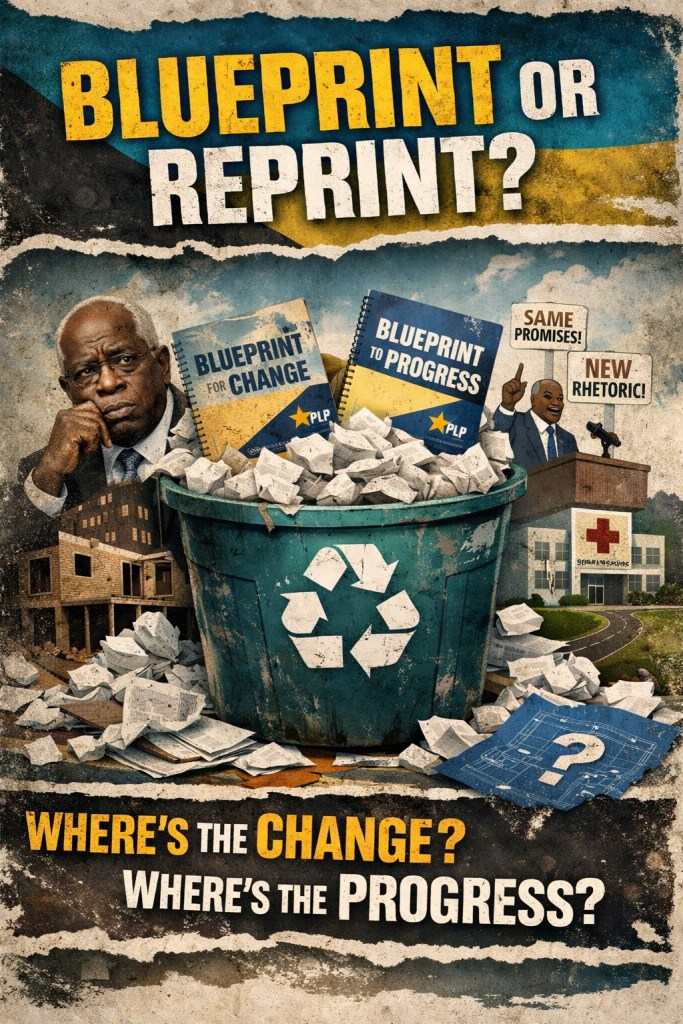
Wednesday night’s unveiling of the Progressive Liberal Party’s (PLP) so-called “Blueprint to Progress” was less a bold step forward and more a weary déjà vu—an echo of the very same “Blueprint for Change” that carried them into office. One could be forgiven for wondering whether this was a policy launch or a reprint.

The obvious questions right-thinking Bahamians ask themselves is what exactly changed, and where precisely is this promised progress?

According to reporting from The Nassau Guardian, the event was polished, choreographed, and heavy on rhetoric—but conspicuously light on tangible documentation. No physical plan was released at the time, only a parade of promises. That alone should give pause. Serious governance is not theatre; it demands substance over spectacle.

More troubling, however, is the substance that did emerge. A careful review of the announcements reveals a pattern that is difficult to ignore: many of the pledges presented as part of this “new” blueprint are, in fact, recycled commitments—initiatives that were either explicitly promised or reasonably expected during the PLP’s first term.

Take immigration enforcement. The proposal for biometric systems, stricter penalties, and tighter employer compliance sounds decisive—until one recalls that immigration reform has been a persistent national issue for years. If these measures are as straightforward and necessary as now suggested, why were they not meaningfully implemented earlier in the administration’s tenure?

The same question applies across multiple sectors.

Housing? The promise of affordable housing pipelines, public-private partnerships, and rehabilitation of abandoned properties is not novel. These are foundational policy tools—ones that could have been activated early to alleviate the very crisis now being highlighted.

Healthcare? Commitments to complete the Freeport Health Campus and expand services in New Providence have been ongoing talking points. Yet, years into governance, these projects remain works in progress rather than completed achievements.

Energy, agriculture, education, and labour reforms follow a similar script: ambitious targets, familiar language, and timelines that extend conveniently into a future contingent on re-election.

Even the proposal to reduce food imports by 25% by 2030 raises an eyebrow. Food security has long been identified as a national priority. Why does a concrete benchmark emerge now, rather than at the outset of the administration when decisive early action could have yielded compounding benefits?

None of this is to suggest that these policies are inherently flawed. On the contrary, many are sensible and, if executed effectively, could provide real benefits. But that is precisely the issue: if these ideas were always sensible, why were they not treated with urgency from day one?

The uncomfortable inference is that the line between governance and campaigning has blurred. Promises that could have been fulfilled—or at least substantially advanced—during the first term are being repackaged as incentives for a second.

This raises a deeper concern about the New Day PLP’s political strategy. There is an old, cynical theory in politics: to position oneself as the solution, one must first ensure the persistence of the problem. Whether intentional or not, the effect here is similar. Challenges that could have been mitigated earlier are now being reintroduced as justifications for renewed trust.

And so, we return to the central contradiction. The PLP asks the Bahamian people to “choose progress,” yet the evidence suggests that much of what is being offered as progress is, in reality, deferred change.

If the “Blueprint for Change” did not deliver the transformative impact implied by its name, then what confidence should the public have that a “Blueprint to Progress” will fare any better—especially when it appears to rely on the same foundation?

This is not merely a matter of political point-scoring. It is a question of accountability. Governance is not judged by the elegance of its promises but by the consistency of its delivery. Reintroducing prior commitments as new initiatives risks undermining public trust and invites scepticism about both capacity and intent.

In the end, the issue is not whether the PLP can articulate a vision for the future. It clearly can. The issue is whether that vision represents genuine forward movement or simply a reframing of what should have already been achieved.

Because if there was no meaningful change, then the question remains—what exactly is this progress the Bahamian people are being asked to choose?

The Progressive Liberal Party (PLP) government fails for one reason; it is their nature.

END

My Morning Paper -6th April 2026 – Crying ‘Collusion’ to Create Confusion

There’s political spin… and then there’s whatever performance Fred Mitchell delivered in that voice note. At some point, you stop wondering whether the facts are being bent and start realizing they’ve been tied into a full pretzel.

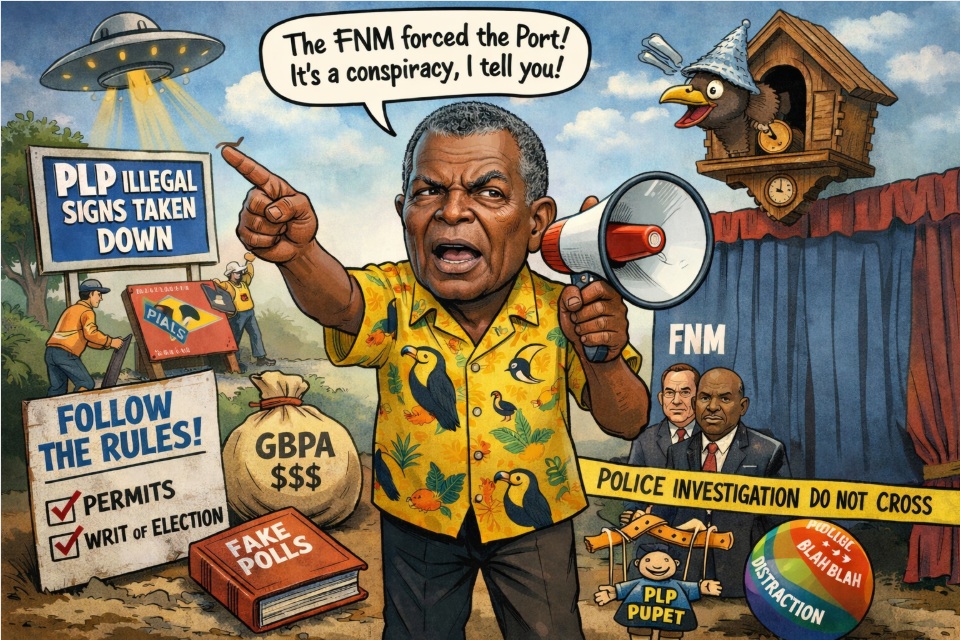
Let’s start with the central claim: that Dwayne Sands and the Free National Movement (FNM) by somehow “forcing” the Grand Bahama Port Authority to remove PLP signs—as though the GBPA is a puppet and the FNM is backstage pulling strings or even the other way around.

That version might make for good late-night storytelling, but it collapses under even the lightest scrutiny.

What actually happened is far less theatrical and far more inconvenient for the Progressive Liberal Party narrative:
The PLP put up signs where they were not supposed to, before they were legally allowed to, and outside established guidelines. When complaints were initially ignored, the FNM called their bluff—putting up their own signs to force equal enforcement. Suddenly, rules mattered again. The GBPA acted. And just like that, order was restored.

Not collusion. Not conspiracy. Just compliance—something the PLP seems to treat like an optional suggestion rather than a requirement.

And that’s really the heart of the issue: a party that behaves as though laws are for “other people,” then cries foul when those same laws are finally applied.

Mitchell’s outrage, then, isn’t about injustice—it’s about inconvenience.

Even more curious is his attempt to revive the tired tale that the GBPA is somehow bankrolling the FNM. This from a party that now proudly claims it takes no money from the GBPA—as though that erases decades of political entanglements overnight. One is left to wonder: when exactly did this newfound moral purity begin? Before or after it became politically useful to say so?

Then comes the usual detour into personality politics—taking shots at Michael Pintard while attempting to canonize Philip Davis as the face on every billboard, every poster, every conceivable surface. The irony is thick: a party claiming “team unity” while plastering one man’s image everywhere like a national security blanket.

If that’s confidence, it’s a very nervous kind.

And just when you think the rant couldn’t drift further off course, Mitchell attempts to bait the FNM into commenting on an active police matter involving Marvin Dames. That’s not just reckless—it’s transparently desperate. When you can’t win on facts, you try to drag your opponent into controversy, even if it means undermining due process.

It’s a tactic, yes—but not a particularly respectable one.

At some stage, the performance stops being sharp political commentary and starts resembling something else entirely: the ramblings of a man more interested in noise than nuance, more committed to deflection than truth. There’s a difference between seasoned and stale—and increasingly, Mitchell’s interventions feel less like strategy and more like static.

If this is the PLP’s idea of leadership messaging, then the real question isn’t whether the public is being misled—it’s how much longer they’re expected to take it seriously.

The Progressive Liberal Party (PLP) fails for one reason; it is their nature.

END

My Morning Paper April 4th 2026 – The Myth of Progress: How Fear Became the PLP’s Campaign Tool – Fear Is Not Progress

Yesterday morning, on what should have been the serene and reflective morning of Good Friday, I expected a pleasant message from the Chairman of the New Day Progressive Liberal Party (PLP), Fred Mitchell. At first, it appeared that his message might begin on a positive note. But, as has become customary with the PLP’s messaging, the tone quickly took a darker turn.

What began as a story about encouraging a young woman to participate in the democratic process quickly devolved into what has become the hallmark of the PLP’s current campaign: fearmongering disguised as political persuasion.

In recounting his canvassing efforts, Mr. Mitchell described encountering an 18-year-old student who hopes to study medicine but expressed little interest in politics. Rather than inspire the young woman through optimism, policy, or opportunity, Mr. Mitchell instead warned her that if she did not vote for the PLP, the scholarships she hopes to rely on could be cancelled.

That, in essence, is the foundation of the PLP’s current campaign slogan: “Choose Progress.”

But when one examines the messaging closely, it becomes apparent that “Choose Progress” has less to do with progress and far more to do with manufacturing fear.

Mr. Mitchell even went so far as to frame the upcoming election in almost biblical terms, declaring that Bahamians must choose “progress over the work of the devil.” Such rhetoric may make for dramatic political theatre, but it raises a simple question: if the PLP truly had a record of undeniable progress, why rely so heavily on fear?

Because the truth is that when one examines the PLP’s record over the past four and a half years, the results are far less impressive than their slogan suggests.

Nowhere is this clearer than in Grand Bahama.

For years, Grand Bahamians have heard promises of economic revival, transformative development, and renewed opportunity. Yet the island continues to wait. Projects that could have pushed the island forward were instead reviewed, stalled, or abandoned, leaving Grand Bahama residents asking a very simple question: Where exactly is this progress we are being told to choose?

Mr. Mitchell often attempts to deflect attention by accusing the Free National Movement (FNM) of being “servants of the Grand Bahama Port Authority.” The irony of this accusation is difficult to ignore. While the PLP accuses others of allegiance to the Port Authority, Grand Bahama itself has seen little of the economic revival repeatedly promised by this administration.

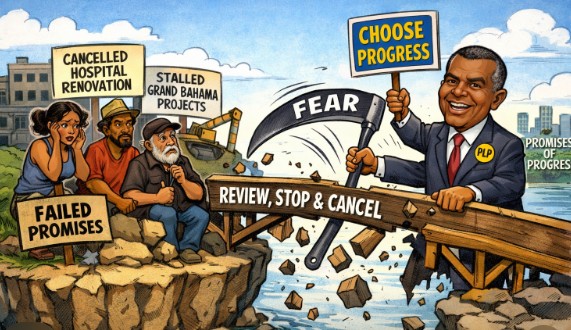
If the Chairman wishes to tell stories while canvassing, perhaps he should tell the young woman about the government’s own version of “review, stop, and cancel.”

Will he explain how the PLP cancelled the existing arrangements to renovate the Princess Margaret Hospital and returned the funds earmarked for that project—delaying critical improvements to the nation’s healthcare infrastructure?

Will he explain how the government halted or reconsidered several initiatives left in place by the previous Free National Movement (FNM) administration—initiatives that, if carried through, might have moved the country further ahead than it stands today?

Of course, those stories are unlikely to make it into the Chairman’s canvassing speeches. They do not fit neatly into the narrative of a government claiming a “stellar and enviable record.”

I have said before that there is the truth, and then there is PLP truth. Unfortunately, the two rarely occupy the same space.

The Bahamian people deserve better than a government that has spent four and a half years waffling through governance, only to now campaign on a slogan that suggests progress is something voters must protect rather than something they have already experienced.

Progress is not a slogan.
Progress is not fear.
Progress is not telling a young woman that her dreams may disappear unless she votes for a particular party.

If the PLP truly believed in progress, they would not need to frighten Bahamians into choosing it.

They would simply be able to show it.

Instead, after nearly a full term in office, the best argument they can offer the country is a warning: vote for us, or everything may disappear.

That is not progress.

That is political fear dressed up as a campaign motto.

The Progress Liberal Party (PLP) fails for one reason; it is their nature.

END