
The latest statement from Minister of Energy, Utilities and Aviation JoBeth Coleby-Davis regarding the widespread power outages across New Providence raises more questions than it answers.
The Minister acknowledged the hardship experienced by residents, businesses, medical facilities, and public services and explained that, according to Bahamas Power and Light (BPL), severe weather and intense lightning activity triggered a major fault at the Blue Hills Power Station. She also assured the public that the Government is working to strengthen generation, transmission, grid stability, renewable energy integration, and the long-term resilience of the country’s electricity system.
Those are reassuring words. The problem is that Bahamians have been hearing reassuring words since she took over as the minister.
The Progressive Liberal Party came to office promising to fix the country’s energy crisis and improve the reliability of electricity. Minister Coleby-Davis has repeatedly spoken about modernizing the grid, increasing resilience, and preparing BPL for periods of peak demand and severe weather. Yet after another widespread blackout, Bahamians are once again being told that bad weather exposed the system’s vulnerabilities.
That naturally leads to an obvious question: weren’t those vulnerabilities precisely what the Government said it was addressing?
If strengthening grid resilience, improving system stability, and protecting critical infrastructure from failures caused by severe weather are already underway, then where exactly does that work stand? How many of the promised upgrades have been completed? Which projects remain outstanding? What measurable improvements have been delivered since these commitments were first announced?
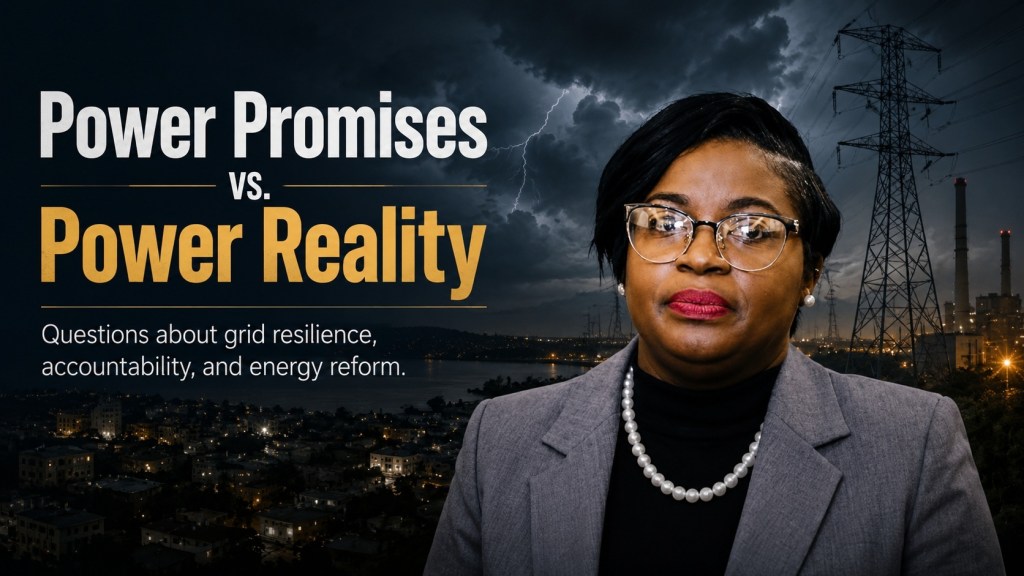
The Minister herself said that Bahamians “want to know why the system remains vulnerable” and “what work is being done to strengthen the grid.” She is absolutely right. Those questions deserve more than carefully crafted press releases—they deserve detailed, transparent answers.
One point also deserves clarification. The Minister’s statement attributes the incident to severe weather and lightning activity that triggered a major fault. Meanwhile, public comments from BPL’s CEO referred to an explosion in the generator room. Those explanations are not necessarily inconsistent—equipment faults caused by lightning can lead to explosions—but the public would benefit from a clear technical explanation of exactly what occurred and whether the failure exposed weaknesses that should already have been addressed.
The PLP Government cannot continue to campaign on promises of modernization while governing with explanations that sound remarkably similar to those Bahamians have heard after previous blackouts. Every major outage is followed by assurances that improvements are coming, resilience is being strengthened, and reliability will soon improve. At some point, the public is entitled to ask a simple question: when do these promises become measurable results?
If the Government is indeed advancing improvements to generation, transmission, grid stability, renewable energy integration, and long-term resilience, then it should have no difficulty providing a comprehensive progress report. Which milestones have been achieved? Which remain incomplete? What timelines should Bahamians expect?
After years of promises, “we’re working on it” is no longer an adequate response.
The Bahamian people are not asking for perfection. They understand that storms happen and equipment can fail. What they expect is accountability, transparency, and evidence that the investments and reforms repeatedly promised are making the electricity system less—not more—vulnerable to foreseeable events like severe weather.
Because if resilience was the promise, another island-wide blackout naturally invites the question: how much progress has really been made?
The people of The Bahamas deserve better.
END

