
If politics in The Bahamas were a streaming series, this week’s episode would be titled:
“We Have Investigated Ourselves and Found an Administrative Error.”
Let’s unpack.
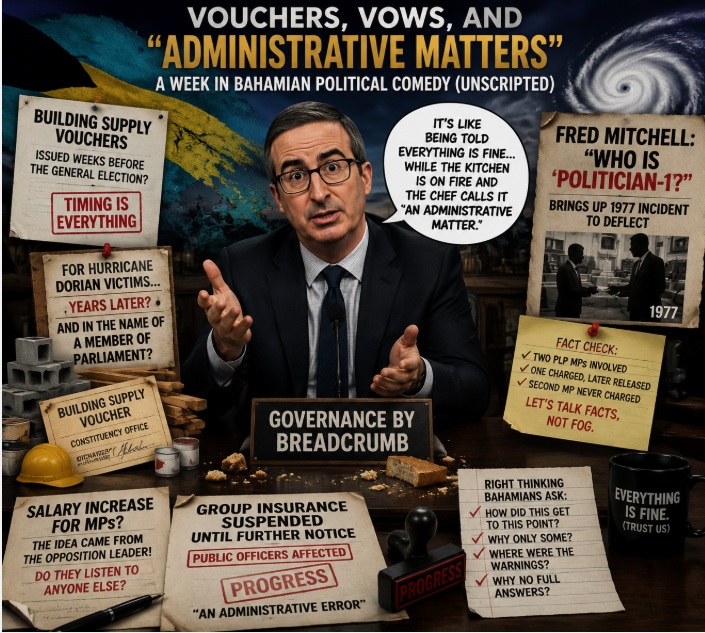
The Voucher Question That Keeps Reappearing Like Bad Wi-Fi
This past week, reports circulated that building supply vouchers were issued in the lead-up to the most recent general election period, with claims that they were linked to assistance efforts for persons affected by Hurricane Dorian.
The government position, as previously stated in various forms, is that such assistance falls under ongoing recovery and social support measures.
But critics — or as they are often known in Bahamian politics, “people asking inconvenient questions in public” — raised a few simple issues:
Why now, years after Hurricane Dorian, are these interventions still appearing in politically sensitive timeframes?
And why do some of the vouchers appear, according to reports, to be associated with specific parliamentary offices or representatives?
Now, to be clear, there is no publicly verified finding of wrongdoing established by a court or independent investigation in relation to these voucher reports. What exists in the public space is political dispute, competing narratives, and a lot of side-eyes in capital letters.
Still, as many might say: when government assistance programs and election cycles start overlapping like badly aligned floor tiles, people tend to notice the cracks.
The Fred Mitchell “Historical Memory Challenge”
Then came the Chairman of the Progressive Liberal Party (PLP), Fred Mitchell, entering what can only be described as the “and what about 1977?” segment of the national discourse.
According to his remarks, opposition criticism was framed as damaging to The Bahamas’ reputation, particularly regarding ongoing international allegations involving parliamentary conduct and references to a figure described in reporting as “Political-1” in a broader legal context.
At the same time, he referenced historical incidents involving alleged exchanges of cash in Parliament dating back to 1977, suggesting the opposition should account for past events as well.
Here is where fact and Fred Mitchell’s “facts” politely shake hands and walk in opposite directions:
Because if we were to look past the fact of how long ago this was and take it seriously then we would uncover these facts. It was two PLP members of parliament that we caught exchanging the money. One was charged and later released, while the second PLP member of parliament was never charged.
In short: history is being used at the convenience of the questionable memory of the Chairman of the PLP.
Salaries, Suggestions, and Selective Memory
Another strand of the week’s discussion involved proposals regarding increases in parliamentary salaries.
Critics pointed out what they saw as inconsistency: on one hand, political leadership suggesting adjustments to compensation; on the other, referencing similar ideas as if they originated elsewhere depending on the audience.
Supporters counter that remuneration reviews are standard governance practice and part of periodic public sector adjustments.
So, what do we have?
A policy discussion that somehow always manages to feel like a personality dispute.
The Insurance “Administrative Matter”
And then came the line that has quietly become the most politically dangerous phrase in the English language:
“An administrative matter.”
Reports indicated that group insurance coverage involving Colina Insurance and government employees had been disrupted or suspended, prompting concern among public officers.
Subsequently, the Office of the Prime Minister stated that “progress” had been made in resolving the issue for some public officers.
Some.
Not all.
Just… some.
Which immediately triggered the obvious questions:
How does a government-wide insurance arrangement become partial coverage?
How does a breakdown reach the point of suspension before resolution?
And how is the public expected to interpret “progress” that still includes uncertainty for affected workers?
Now, to be precise: the government has described the matter as administrative, and there is no public evidence presented that this was anything other than a processing or contractual issue.
But from a communications standpoint, it lands somewhere between:
“Everything is fine”
and
“We are currently investigating why everything was not fine.”
If we zoom out, the pattern is familiar:
A controversy emerges.
Details are partial.
Political actors respond with competing narratives.
And the public is left doing the least efficient job imaginable:
trying to assemble a full picture from intentionally fragmented information.
It is governance by breadcrumb.
Or as right-thinking Bahamians might put it:
“It’s like being told dinner is ready, but the chef also admits the kitchen is on fire and insists this is just a ventilation issue.”
Final Thought
Whether it’s vouchers, historical references, salary debates, or insurance disruptions, the recurring theme is not necessarily scandal — it is opacity meeting urgency and calling itself normal.
And that, more than any single allegation, is what keeps turning routine governance into weekly political theatre.
Because at some point, the question stops being what happened?
and becomes:
Why does every explanation feel like it’s still buffering?
The Bahamas deserves much better than a government that treats its citizens as an after though.
END
 My Morning Paper