My Morning Paper 30th June 2026 – “The $1.56 Million Question”

Former Prime Minister Hubert Ingraham recently remarked that nobody can “tief” an election.

Perhaps.

But politics has always been less concerned with stealing elections than with making sure voters remember who showed up with gifts shortly before polling day.

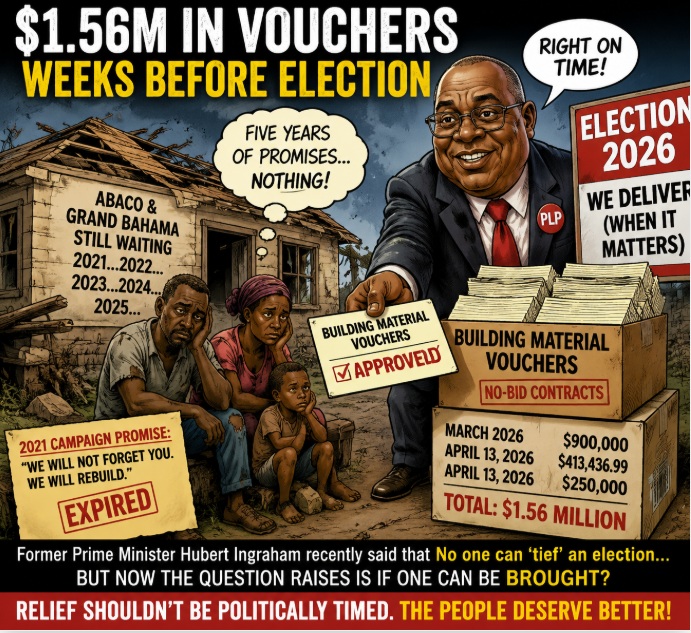
Which brings us to the curious case of the $1.56 million in building material vouchers that suddenly appeared in the closing weeks before the 2026 general election.

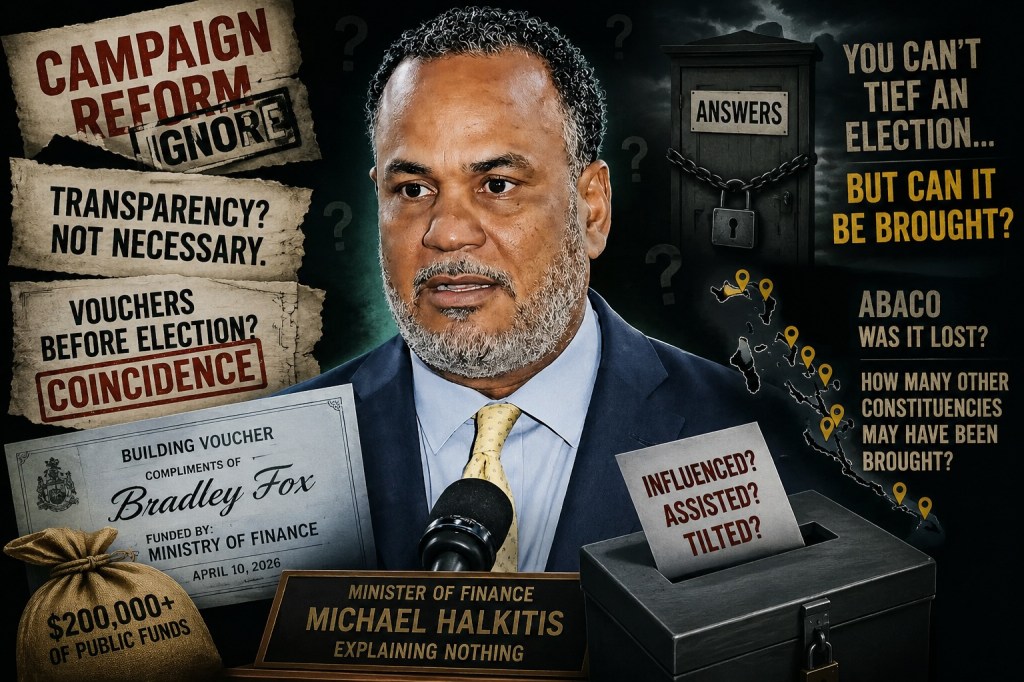
According to reporting by The Nassau Guardian and the Government’s own procurement disclosures, the Davis administration approved approximately $1.56 million in building material vouchers for residents of Grand Bahama and Abaco just weeks before Bahamians headed to the polls.

The records reportedly show that on April 13, 2026, the government awarded a $413,436.99 no-bid contract to Contractors Direct Ltd. for building material vouchers and another $250,000 no-bid contract to Premier Importers Limited for the same purpose. Combined with approximately $900,000 in voucher contracts awarded in March, the total reached roughly $1.56 million in the final weeks before election day.

Now there is absolutely nothing wrong with helping storm victims rebuild their homes.

The question is why it apparently took an election campaign to discover that they needed help.

After all, the plight of homeowners in Abaco and Grand Bahama was one of the central political arguments advanced by then Opposition Leader Philip Davis and the Progressive Liberal Party during the 2021 campaign.

Bahamians were told repeatedly that families affected by Hurricane Dorian had been neglected by the previous Free National Movement administration.

The message was simple:

Elect us and we will do better.

The PLP won.

Then came 2022.

Then 2023.

Then 2024.

Then 2025.

And suddenly, as if by political miracle, wallets opened, vouchers appeared and building materials started flowing just as election signs were being hammered onto utility poles around the country.
One almost must marvel at the timing.

Apparently, these roofs were not leaking in 2022.

The walls were not collapsing in 2023.

The need was not urgent in 2024.

But by early 2026, the crisis had apparently become so severe that over $1.5 million had to be mobilised immediately and through no-bid contracts no less.

Talk about efficient government.

The Official Opposition and its leader, Michael Pintard, have repeatedly called for details surrounding the programme and questioned its administration and timing.

Meanwhile, despite multiple opportunities in Parliament, Prime Minister Davis declined to directly address the allegations surrounding the vouchers programme.

That silence inevitably creates questions.

If this programme was part of a long-term reconstruction strategy, where was it for four years?

If these families were genuinely abandoned in 2021, why did they apparently remain abandoned until 2026?

And perhaps most importantly, why did disaster recovery begin to move at campaign speed only when the campaign itself began?

There is also the awkward matter of reported vouchers carrying the name of then PLP candidate and current MP Bradley Fox.

Again, there has been no finding of wrongdoing and no evidence proving that votes were bought.

But governments should understand that perception matters.

When public money begins moving rapidly immediately before an election, when elected officials refuse to answer questions about the programme and when transparency is replaced by silence, people are inevitably going to ask uncomfortable questions.

Perhaps this is why figures such as Fred Mitchell have historically shown little enthusiasm for measures such as campaign finance reform and stronger transparency legislation.

Sunlight, after all, has always been the natural enemy of political convenience.

The biggest irony of all is that the people of Abaco and Grand Bahama genuinely needed help.

Many of them needed it in 2021.

Many needed it in 2022.

Many needed it in every year since.

Disaster recovery, however, appears to have been placed on a different construction schedule.

One tied not to hurricane season.

But to election season.

The people of The Commonwealth of The Bahamas deserve better.

END
My Morning Paper – 24th June 2026 – Fred Mitchell and the War on Sunlight

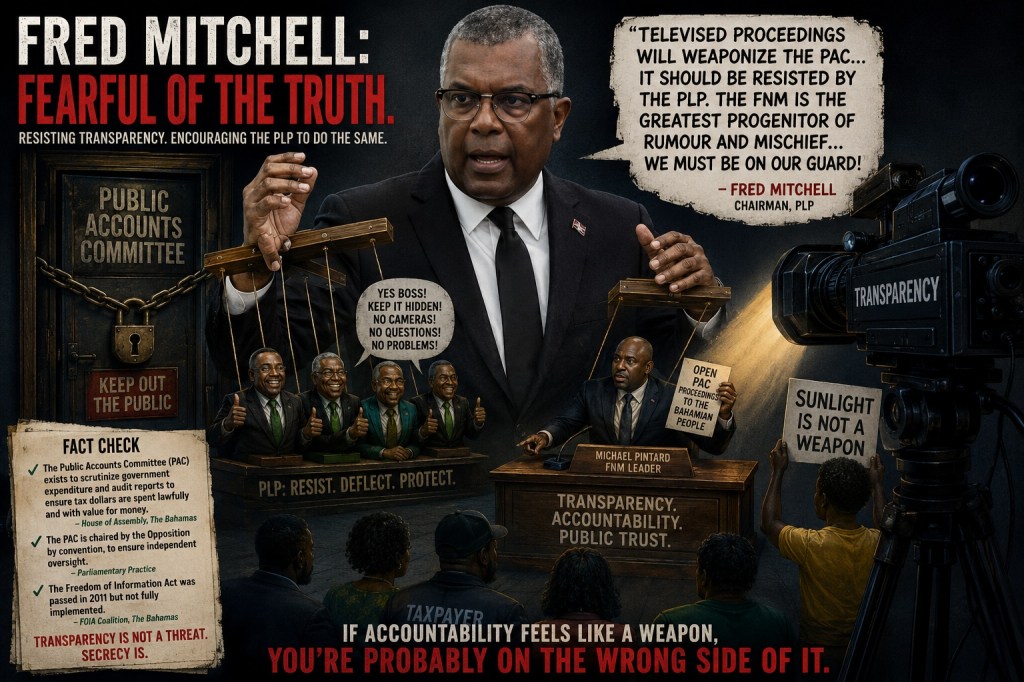
And yet again we have Chairman Fred Mitchell of the Progressive Liberal Party (PLP) riding into battle against one of the greatest threats to modern politics: people seeing what their government is doing.

In his latest voice note, Mr. Mitchell appears to have discovered a new menace to democracy — cameras.

Apparently, according to the Chairman, the suggestion by Opposition Leader Michael Pintard that proceedings of the Public Accounts Committee (PAC) be televised amounts to an attempt to “weaponize” the committee.

Weaponize it.

Not misuse public funds.

Not hide contracts.

Not bury reports.

Not delay transparency legislation for years.

No, the real danger is apparently allowing Bahamians to watch the proceedings with their own eyes and make up their own minds.

One almost must admire the creativity.

The Public Accounts Committee (PAC) exists for one purpose above all others: to scrutinize government spending and hold the executive accountable for how taxpayers’ money is used. It is literally Parliament’s financial watchdog, designed to ask questions, sometimes uncomfortable questions and demand answers which at this point seem to be uncomfortable answers. Transparency is not a bug in the system; transparency is the system.

So, the obvious question becomes:

How exactly does televising the proceedings “weaponize” the PAC?

Would cameras somehow alter the evidence?

Would microphones change the figures in an audit report?

Would public access mysteriously transform accounting questions into political attacks?

Or is the concern simply that ordinary Bahamians might actually hear the questions being asked and the answers being given?

Mr. Mitchell warned that public hearings would allow “biased, half-baked information” and “untested truths” into the public domain.

That is certainly an interesting concern considering that public hearings exist precisely so evidence can be examined, witnesses questioned and claims tested in the open rather than behind closed doors.

If information is weak, expose it.

If allegations are unfounded, dismantle them publicly.

If the facts support the government’s position, then transparency becomes its greatest ally rather than its greatest enemy.

Unless, of course, transparency itself is the problem.

This is where the Chairman’s comments become less about the PAC and more about a broader governing philosophy that seems increasingly uncomfortable with sunlight.

For years Bahamians have heard promises about openness, accountability and modern governance while important transparency measures, including the full implementation of Freedom of Information legislation, remain unfinished business. Critics have repeatedly argued that governments of every stripe are far more enthusiastic about transparency while in Opposition than while sitting around the Cabinet table.

Mr. Mitchell now appears to be encouraging the PLP and it’s supporters to adopt the same defensive crouch: resist public hearings, resist scrutiny and resist giving Bahamians a front-row seat to the management of their own money.

His message to the PLP was clear:

“Be on your guard.”

Guard against what exactly?

The public?

The taxpayers?

The voters who funded the expenditure under review?

Because if a committee created to examine public spending becomes dangerous the moment the public is allowed to watch it, then perhaps the problem is not with the cameras.

Perhaps the problem is with what the cameras might see.

After all, accountability only feels like a weapon when you are standing on the wrong end of it.

The Bahamian people deserve better.

END

My Morning Paper 22nd June 2026 – WHEN TRANSPARENCY REQUIRES THE MEDIA TO FIND IT

This morning, in his now familiar Monday voice note, the Chairman of the Progressive Liberal Party (PLP) once again attempted to persuade right-thinking Bahamians that demanding transparency and accountability from his PLP government somehow damages the image of The Bahamas.

Apparently, in the PLP’s world, the real threat to the country’s reputation is not questionable government conduct, unanswered questions, or the appearance of political favouritism. No, the real problem is the citizens who dare ask about it.

While that argument continues to stagger along like a three-legged donkey, another matter remains in desperate need of clarification.

The headline from The Nassau Guardian read:

“Halkitis claims transparency around building voucher process.”

According to reports from both The Nassau Guardian and The Tribune, more than $200,000 worth of building vouchers distributed in Abaco before the May 12 General Election were funded by the Ministry of Finance as part of the government’s Hurricane Dorian relief initiatives. The controversy stems from the fact that vouchers reportedly carried the name of Bradley Fox, then the PLP candidate for Central and South Abaco and now the Member of Parliament for the constituency.

The Minister of Finance, Michael Halkitis, has maintained that the vouchers went through the proper procurement process and formed part of a longstanding government assistance program in Abaco and Grand Bahama.

That explanation, however, raises almost as many questions as it answers.

If this was simply part of a longstanding relief initiative, why did vouchers carrying the name of a political candidate appear just weeks before a general election? Why were government-funded vouchers branded in a manner that could reasonably give recipients the impression that assistance was being provided by an individual candidate? And perhaps most importantly, is this consistent with the spirit of campaign reform and the separation between public resources and political campaigns that modern democracies are supposed to uphold?

The government would have us believe this was all one giant coincidence.

A happy coincidence.

An election-season coincidence.

A candidate-name-on-government-funded-vouchers coincidence.

One of those coincidences that seem to happen with remarkable frequency whenever an election is approaching.

The Minister’s most curious defense may have been his suggestion that the fact the media discovered the issue somehow demonstrates transparency.

“The point to make is that the issue was raised I think because the leader of the opposition says he saw a report in a newspaper, and so that speaks to the transparency of the process.”

That is a fascinating definition of transparency.

Under this interpretation, transparency apparently occurs when journalists uncover something and publish it.

Traditionally, transparency has meant government officials proactively disclosing information, answering questions promptly, and providing documentation before concerns become public controversies. It has never been widely understood to mean “the newspaper found out first.”

In fact, if the media’s discovery of an issue is now the government’s preferred measurement of transparency, then Bahamians may wish to ask a few uncomfortable follow-up questions.

How exactly did the media find out?

Was the government planning to publicly disclose these vouchers before election day?

Would the public have ever known about them had journalists not obtained copies?

And why did the Minister promise to address the matter during the Budget Debate only to leave those questions unanswered?

These questions matter because campaign reform has always been based upon a simple principle: public resources belong to the public, not to political parties, candidates, or election campaigns.

The issue is not whether hurricane relief should be provided. It absolutely should.

The issue is whether government-funded assistance was presented in a manner that could provide political benefit to a candidate during an election period.

That is a question deserving of clear answers, not semantic gymnastics.

Former Prime Minister Hubert Ingraham once remarked that “You can’t tief an election in The Bahamas.”

Most Bahamians would agree.

But another question now hangs in the air.

Can an election be influenced, assisted, or tilted through the use of publicly funded programs that appear to be connected to political candidates?

If the outcome in Abaco was decided by a relatively small margin, voters are entitled to ask whether these vouchers had any impact whatsoever.

And if they did, then another uncomfortable question follows:

If it happened in Abaco, where else might similar practices have occurred?

The government’s response so far seems less focused on answering those questions and more focused on criticizing those who ask them.

Unfortunately, accountability does not disappear because it is politically inconvenient.

Nor does transparency become real simply because a newspaper uncovers a story.

If anything, the fact that journalists had to uncover the issue is precisely why the questions remain.

The Bahamian people deserve better.

END

My Morning Paper- 19th June 2026 – Highly Hypocrisy and Duplicity; A Specticle of Their Own Making

One of the more fascinating developments surrounding the Eric Gardiner affair is watching the Progressive Liberal Party (PLP) attempt to occupy two completely different positions at the same time.

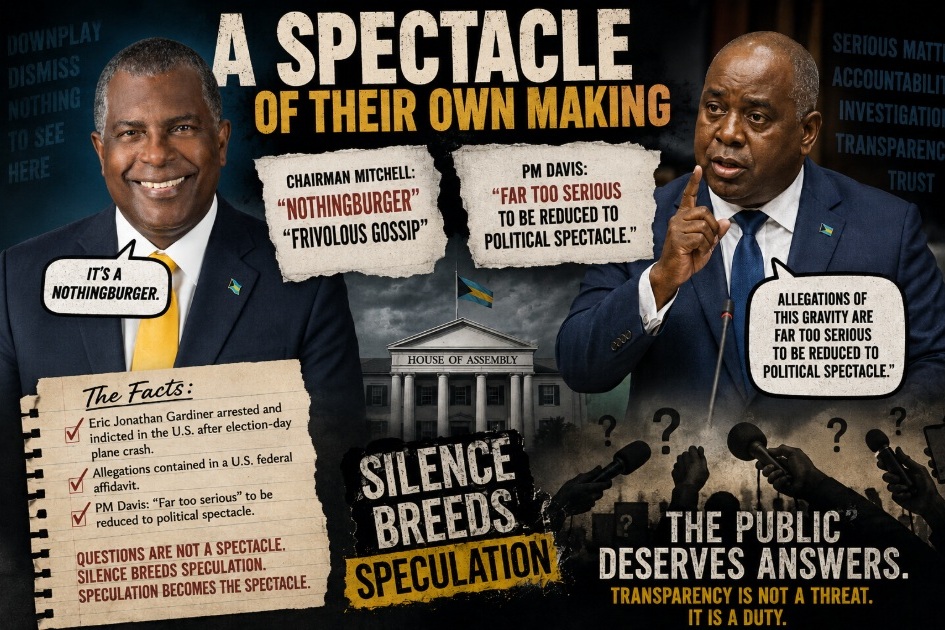
On one hand, PLP Chairman Fred Mitchell has repeatedly sought to dismiss public discussion of the matter, characterizing it as a “nothingburger” and little more than “frivolous gossip.” On the other hand, Prime Minister Philip “Brave” Davis has now publicly declared that the allegations are “far too serious” to be reduced to political spectacle.

So, which is it?

Is it a serious matter deserving national attention, as the Prime Minister now suggests, or is it merely opposition gossip and political mischief, as the PLP Chairman would have Bahamians believe?

According to reporting by The Tribune, the Prime Minister told Parliament that the allegations contained in a United States federal affidavit are “far too serious” to be reduced to spectacle and accused the Opposition Free National Movement (FNM) of attempting to turn the matter into political theatre. He further complained that discussion of the case had distracted from debate on the national budget.

The irony here is difficult to ignore.

The Prime Minister is absolutely correct about one thing: the allegations are serious.

They involve a matter that entered the public domain following the arrest and indictment of Eric Jonathan Gardiner in the United States after an election-day plane crash. Those facts are not speculation. They are matters of public record. What remains unknown are the full details and implications surrounding the allegations.

And that is precisely why questions are being asked.

In every functioning democracy, when serious allegations emerge involving individuals connected to the political environment, the Opposition is expected to ask questions. The press is expected to ask questions. The public is expected to ask questions.

That is not a spectacle.

That is accountability.

The Prime Minister appears frustrated that the Opposition continues to raise the matter. Yet one struggles to understand what alternative he is proposing. Should the Opposition simply pretend the issue does not exist? Should Parliament avoid discussing a matter he himself now acknowledges is serious? Should the public suspend its curiosity until government officials decide enough information has trickled out to satisfy them?

Governments do not get to declare a matter serious while simultaneously condemning anyone who treats it seriously.

The reality is that silence has consequences.

When information is scarce, questions multiply. When answers are withheld, speculation fills the void. When officials refuse to engage directly with legitimate concerns, public confidence begins to erode.

Indeed, if the Prime Minister truly believes these allegations are as serious as he says they are, then one would expect his administration to be leading the charge for transparency rather than chastising those seeking it.

A government confident in the facts does not fear questions.

A government confident in its integrity does not recoil from scrutiny.

A government confident in its innocence does not spend its time lecturing the Opposition for asking what many Bahamians are already asking themselves.

The greatest flaw in the Prime Minister’s argument is that he appears to believe the spectacle comes from the questions.

It does not.

The spectacle comes from the contradiction.

The PLP Chairman tells the country there is nothing to see here while the Prime Minister tells the country the matter is extremely serious.

The government says the allegations are serious yet provides little new information.

The government criticizes speculation while creating the very conditions in which speculation flourishes.

That is the real spectacle.

And until the public receives clear answers, it is unlikely to be the Opposition, the media, or ordinary Bahamians who are responsible for keeping the story alive.

It will be the government’s own silence.

END

My Morning Paper 17th June 2026 – Madam Speaker and the Problem of Perception

The 2026 Budget Debate opened with the usual political fireworks between the Opposition Free National Movement (FNM) and the governing Progressive Liberal Party (PLP). However, what has attracted almost as much attention as the budget itself has been the conduct of the Speaker of the House, Ms. Patricia Deveaux, the Member of Parliament for Bamboo Town, hereby referred to as Madame Speaker.

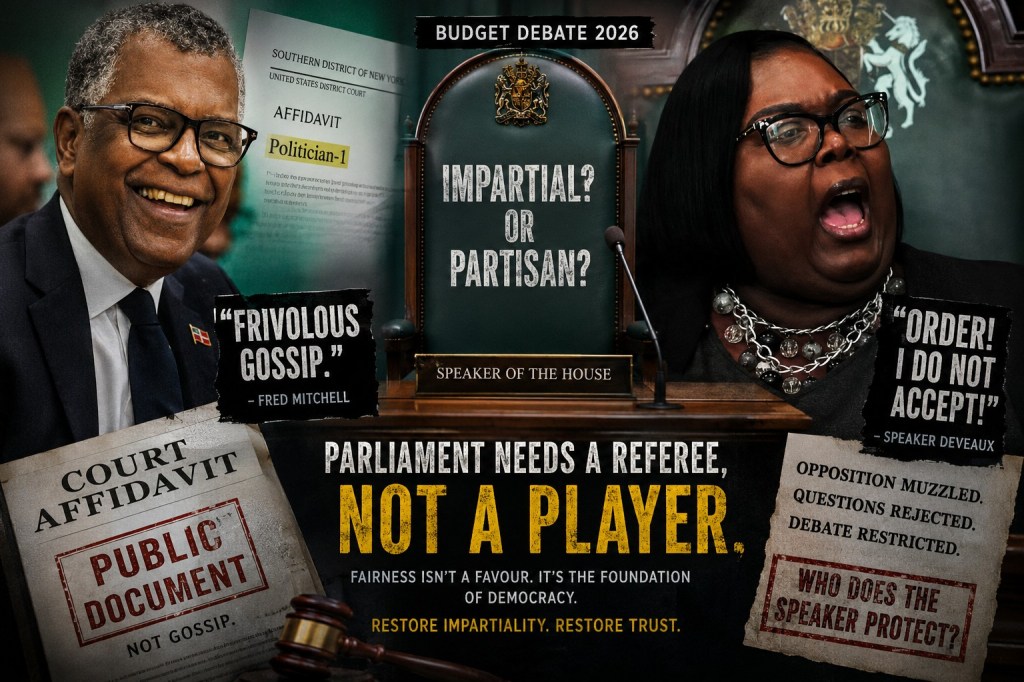
The controversy began when members of the Opposition sought to table an affidavit filed in the United States District Court for the Southern District of New York. The affidavit forms part of a federal case involving allegations of a cocaine-importation conspiracy and references an unnamed Bahamian public official identified only as “Politician-1.”

Contrary to some political rhetoric, the affidavit does in fact exist. It is a public court document. Whether the allegations contained within it are true remains unproven, and no court has convicted any Bahamian politician based on the claims contained therein. Nevertheless, the existence of the document itself is not a matter of speculation or “frivolous gossip.”

The Opposition’s effort to table the affidavit followed comments from Fox Hill MP and Foreign Affairs Minister Fred Mitchell, who publicly dismissed discussion surrounding the document as first he seemed to suggest any knowledge of the existence of the document but then resorting to calling it little more than gossip. It was therefore unsurprising that Opposition members sought to place the actual document before Parliament for examination.

What followed raised serious questions about the Speaker’s understanding of her constitutional role and, more importantly, the appearance of impartiality expected of the office she occupies.

Under the Westminster parliamentary tradition, the Speaker is expected to serve as an impartial guardian of parliamentary procedure. While different jurisdictions handle the office differently, the underlying principle remains the same: the Speaker must be seen as protecting the rights of both the government and the opposition equally. The authority of the Speaker depends not only on fairness, but on the public’s confidence that fairness is being exercised.

Unfortunately, that confidence appears to be eroding.

Throughout the opening exchanges of the Budget Debate, Madam Speaker appeared less like an independent referee and more like an active participant in the government’s political defence. Whether intentional or not, the perception created was that rulings and interventions frequently favoured the government’s position while limiting the Opposition’s ability to make its case.

That perception is particularly damaging because the Speaker’s office derives its legitimacy from neutrality. Once the public begins to view the Speaker as merely another government combatant, the office itself suffers.

The Bahamas has chosen not to adopt the British convention whereby Speakers sever party ties and effectively remove themselves from partisan politics after assuming office. That is a legitimate constitutional choice. However, if a Speaker remains an active political figure associated with a governing party, the burden to demonstrate fairness becomes even greater.

Instead, recent parliamentary sessions have often produced the opposite impression.

Critics argue that too many proceedings have devolved into confrontations between the Chair and Opposition members, creating the appearance that parliamentary procedure is being used as a political weapon rather than a tool for maintaining order. Whether one agrees with the Opposition’s arguments or not, Parliament functions best when all sides believe they are being treated fairly.

The comparison with former Speaker Italia Johnson is therefore unavoidable. Johnson, who made history as the first woman to serve as Speaker of the House of Assembly, generally cultivated a reputation for measured conduct and restraint. Her tenure demonstrated that firmness and impartiality are not mutually exclusive qualities.

That comparison is not intended to diminish Madam Speaker’s accomplishments. Rather, it highlights the standard to which every Speaker should aspire.

What makes the current situation particularly puzzling is that Patricia Deveaux previously served as Deputy Speaker during an earlier PLP administration. She entered the role with experience and firsthand knowledge of parliamentary procedure. For that reason, many expected a steadier and more neutral performance.

Instead, the opening of this year’s Budget Debate has reignited concerns that the Speaker’s chair is becoming increasingly politicized.

The issue is not whether the Speaker agrees with the PLP or the FNM. The issue is whether the Bahamian public can trust that parliamentary rules are being applied consistently regardless of who is speaking.

That trust is essential to the credibility of Parliament itself.

And when the Speaker becomes the story during a Budget Debate, it is usually a sign that something has gone wrong.

END

My Morning Paper June 15th, 2026 – Bahamas-Centric or Accountability-Averse?

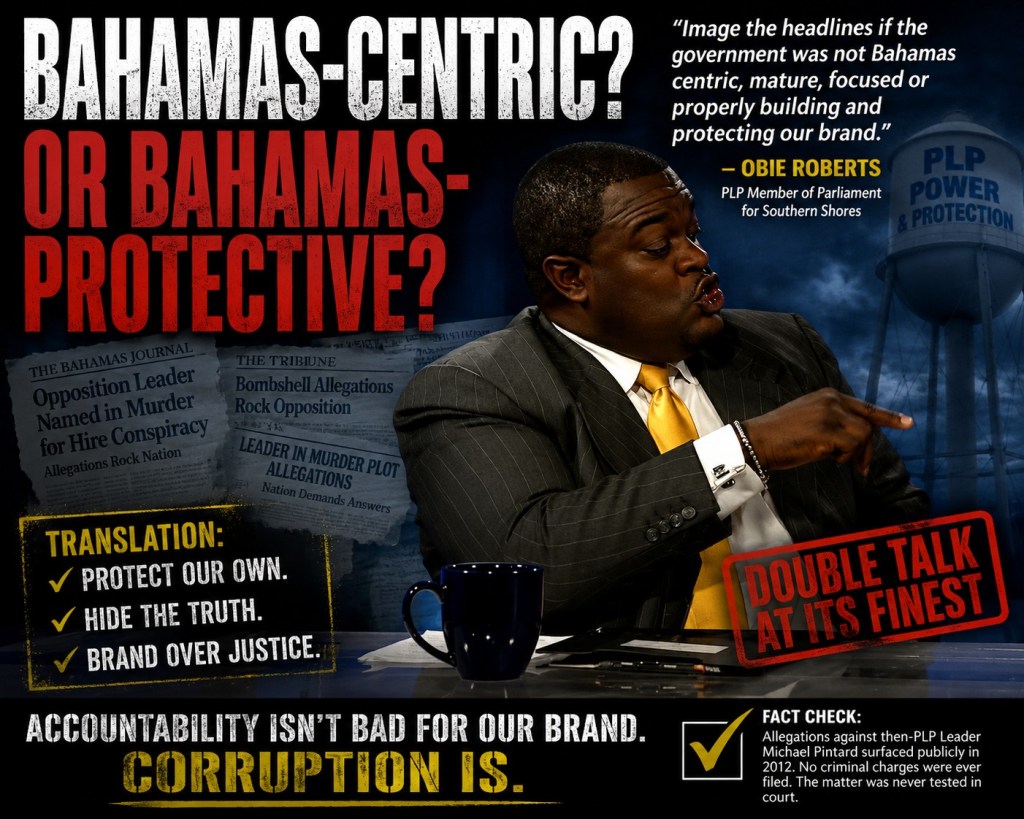
During his contribution to the Budget Debate, Southern Shores Progressive Liberal Party (PLP) MP Obie Roberts offered what may be one of the more remarkable defense of political discretion heard in Parliament this year.

He sought to have taken to the floor like his late father but fell extremely short.

Roberts stated:

“Madame Speaker, what is puzzling to me is that no less than the current leader of the opposition was caught up in a national murder for hire conspiracy, that may have possibly and even probably ended in incarceration if pursued…”

He then suggested that the government’s decision not to publicly amplify the matter was evidence that it was being “Bahamas-centric, mature, focused and properly building and protecting our brand.”

Now, listening to that statement, one might reasonably conclude that Michael Pintard narrowly escaped prison solely because of the restraint and benevolence of the Progressive Liberal Party (PLP). The only problem is that such a conclusion requires a leap of faith so large that it would make an Olympic long-jumper nervous.

Let’s start with a basic fact: allegations are not convictions. Investigations are not guilty verdicts. Political accusations are not evidence. If there was sufficient evidence to support criminal charges, then the proper place for that evidence would have been before the relevant authorities and ultimately the courts—not tucked away in a parliamentary speech years later for dramatic effect during a budget debate.

What Roberts appears to be asking Bahamians to believe is that the government deserves credit for not aggressively publicizing allegations against a political opponent. Yet in the same breath, he proceeds to publicly resurrect those very allegations on the floor of Parliament.

That is a curious definition of restraint.

The circular logic goes something like this:

“We are commendable because we did not publicize this allegation.”

Followed immediately by:

“Allow me to publicize this allegation.”

One almost must admire the efficiency.

But the more troubling aspect of Roberts’ remarks is the implication behind the phrase “Bahamas-centric.”

What exactly does that mean?

Because if being Bahamas-centric means ensuring allegations are properly investigated and due process is respected, then few would object.

If it means protecting the country’s reputation through transparency, accountability, and the rule of law, then most Bahamians would likely agree.

However, if Roberts is suggesting that being Bahamas-centric means political leaders should quietly bury controversies, avoid scrutiny, or shield public officials from uncomfortable questions to preserve some carefully curated image of the country, then we have wandered into dangerous territory.

After all, nations build strong reputations by confronting wrongdoing—not concealing it.

Countries earn credibility when institutions function independently and transparently—not when politicians decide which allegations are too damaging to discuss and which are useful enough to resurrect during parliamentary debates.

Indeed, the greatest threat to “Brand Bahamas” has never been accountability. It has never been transparency. It has never been asking difficult questions.

The greatest threat to any democracy is the belief that protecting politicians is somehow synonymous with protecting the country.

They are not the same thing.

In fact, history repeatedly demonstrates the opposite.

The countries with the strongest international reputations are generally those where public officials are held accountable regardless of political affiliation. Investors trust them. Citizens trust them. International partners trust them.

Why?

Because transparency creates confidence.

Secrecy creates suspicion.

So, when Roberts asks us to imagine the headlines that could have existed had the government not been “Bahamas-centric,” perhaps the better question is this:

Should Bahamians really be celebrating a political philosophy that appears to confuse protecting the nation’s reputation with protecting politicians from scrutiny?

Because if accountability damages the brand, then the problem isn’t accountability.

It’s whatever the accountability is exposing.

And that is a distinction Parliament would do well to remember.

The Bahamas deserves better.

END

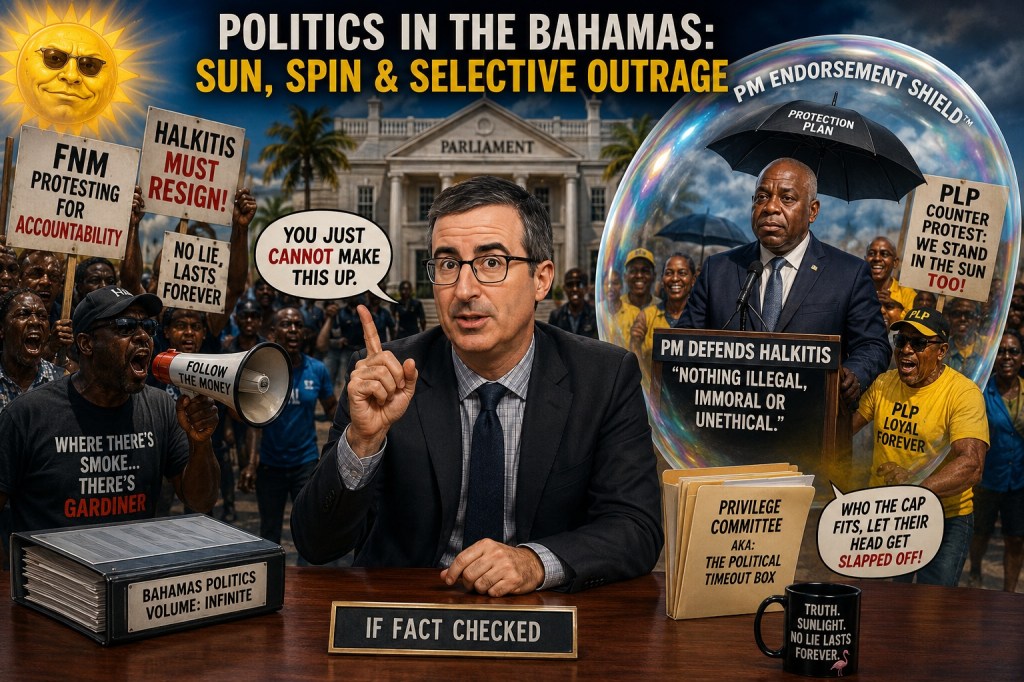
My Morning Paper – June 9th, 2026 – THE HOT SUN, THE HALO, AND THE HUG OF POLITICAL PROTECTION

This past Tuesday gave Bahamians one of those uniquely Bahamian political moments where reality appeared to take a coffee break.

Former Progressive Liberal Party (PLP) MP Leslie Miller was among supporters gathered outside Parliament defending Finance Minister Michael Halkitis while Free National Movement (FNM) supporters protested over questions surrounding Halkitis’ past involvement with Top Notch Builders.

Now, Mr. Miller reportedly took issue with the FNM crowd standing outside in the blazing sun protesting.

Which would have been a devastating criticism had he not been standing outside in the exact same blazing sun.

It is difficult to know what lesson we were supposed to take from this.

Apparently, standing in the heat is foolish when the other side does it, but patriotic when your side does it.

Political science may need a new textbook chapter to explain that one.

The protest itself centered on concerns raised by the opposition regarding Halkitis’ previous role with Top Notch Builders, a company that has become the subject of intense public scrutiny because of reported links to convicted drug smuggler Jonathan Gardiner. Halkitis has acknowledged that he previously served as a director of the company after initially denying involvement when first questioned by the press.

As the PLP likes to remind us, “No Lie Lasts Forever.”

Unfortunately for them, that slogan tends to travel in both directions.

Then came Prime Minister Philip “Brave” Davis, who finally broke his silence.

According to reports, the Prime Minister informed Parliament that he was satisfied there was nothing “illegal, immoral or unethical” about Halkitis’ conduct.

Now ordinarily, that might be considered a powerful endorsement.

Ordinarily.

The difficulty arises when one remembers that Davis has historically been generous with endorsements.

In fact, years ago, while discussing the Christie administration, Davis declared that he was not aware of any of his Cabinet colleagues committing corrupt acts.

That statement has aged about as gracefully as milk left on a Nassau sidewalk in August.

Which creates a fascinating political problem.

If Davis tells you that everything is fine, does that reassure you?

Or does it simply encourage you to ask more questions?

The Prime Minister’s defence also took an interesting detour.

Rather than focusing exclusively on the concerns surrounding Halkitis, attention shifted toward East Grand Bahama MP Kwasi Thompson, whose comments in Parliament were ultimately removed from the record.

Davis argued that Thompson breached parliamentary privilege and suggested the matter be referred to the Privileges Committee.

And there it was.

The great political magic trick.

A controversy emerges.

Questions are asked.

The questions become the problem.

The questioner becomes the bigger problem.

And before you know it, everyone is debating parliamentary procedure instead of the original issue.

It is the political equivalent of a restaurant serving burnt food and then spending twenty minutes explaining why the customer should not have complained so loudly.

Meanwhile, in the background, Golden Isles MP Darron Pickstock found himself attracting attention for remarks that critics viewed as aggressive and unbecoming of parliamentary discourse.

Curiously, calls for outrage seem to depend heavily on which side of the chamber happens to be speaking.

A remarkable phenomenon.

Scientists should study it.

What remains most striking is the Davis administration’s apparent belief that public concern can be neutralized through declarations of confidence.

But confidence is not evidence.

Popularity is not transparency.

And an endorsement, particularly from a politician, is not a substitute for answers.

The Prime Minister appears determined to wrap Halkitis in the warm blanket of his own political credibility.

The challenge is that credibility is not something that can simply be loaned out like a government vehicle.

It must be earned.

And in politics, every unanswered question eventually develops a habit of returning.

Usually at the worst possible time.

For now, this government seems content to insist that nothing is wrong, nothing is improper, and nothing requires further explanation.

Perhaps they are right.

But if that is truly the case, then providing clear answers should be the easiest task in the world.

After all, sunlight remains the best disinfectant.

Even when everyone is standing in the hot sun.

The Commonwealth of The Bahamas deserves better.

END

MY MORNING PAPER – 11th June 2026 – “POLITICIAN-1: FROM “WE HAVE NO IDEA” TO “FRIVOLOUS GOSSIP”

There are moments in politics when a politician’s greatest enemy is not the opposition, not the media, and not even public opinion. Sometimes it is simply the parliamentary record.

This week, Chairman of the Progressive Liberal Party (PLP), Foreign Affairs Minister and Fox Hill MP, Fred Mitchell, appeared determined to demonstrate that very principle.

According to reporting by The Nassau Guardian, Opposition Leader Michael Pintard raised questions in the House of Assembly regarding allegations contained in a publicly circulated affidavit. When the matter was first raised, Mitchell, in a desperate attempt to come off as sassy, reportedly responded that he had no idea what Pintard was talking about. Yet, the government had already issued a public statement on May 19 addressing the allegations contained in that affidavit.

That naturally leaves observers with a simple question: if the government had already publicly addressed the matter, how could a senior government official simultaneously claim not to know what was being discussed?

But the real spectacle began when Pintard indicated he was quite willing to help Mitchell’s sudden lost of memory by tabling the affidavit.

Suddenly, the issue was no longer something nobody knew anything about.

Now it was “frivolous gossip.”

Apparently, in modern PLP political science, an allegation can travel from “we don’t know what you’re talking about” to “it’s frivolous gossip” in roughly the time it takes for a document to be pulled from a folder.

That is quite an evolution.

The larger issue, however, is not whether the affidavit’s claims are true. To date, the allegations remain allegations. No court has determined their validity, and no public evidence has been presented proving the identity of the individual referred to as “Politician-1.”

What is troubling is the government’s apparent inconsistency.

If the affidavit is completely baseless, then one would expect the government to welcome a transparent investigation that conclusively puts the matter to rest.

If the allegations are serious enough for government ministers to issue statements about them, then one would expect Parliament to discuss them openly.

Instead, Bahamians are witnessing what appears to be a strange middle ground where the allegations are supposedly too insignificant to investigate, yet too dangerous to discuss.

That is not transparency.That is political limbo.

For months, PLP officials have insisted they want answers whenever questions arise about public affairs. They regularly demand investigations, commissions, reviews, inquiries and accountability from everyone else.

Yet when uncomfortable questions emerge that could potentially touch the political establishment itself, the response suddenly becomes concern about protecting the country’s reputation.

That argument is particularly curious.

The Bahamas’ reputation is not protected by avoiding questions.

It is protected by answering them.

The existence of a publicly circulated affidavit, media coverage, international attention and parliamentary debate means any reputational damage has already occurred. Pretending the questions do not exist does not restore confidence. It simply creates the impression that someone would rather the questions disappear than be answered.

Which brings us to the obvious question.

Who exactly is being protected?

The government says it is protecting The Bahamas.

The public may reasonably wonder whether the priority is protecting the country’s reputation or protecting the reputation of a particular individual.

If there is no connection between any serving parliamentarian and the allegations, then identifying Politician-1 through an independent and credible process would benefit everyone involved.

The innocent would be cleared.

The guilty, if any wrongdoing were proven, could be held accountable.

Public confidence could be restored.

Instead, the PLP appears increasingly determined to treat curiosity as a crime and scrutiny as an act of national sabotage.

That may work as a political talking point.

It does not work as accountability.

Because in the end, the fastest way to end speculation is not to condemn those asking questions.

It is to answer them.

And until that happens, Bahamians will continue to wonder why some people seem far more interested in suppressing the conversation than resolving it.

The Bahamas deserves better.

END

My Morning Paper- 10th June 2026 – From “Take It Seriously” to “Frivolous

Gossip”: The Curious Evolution of the Government’s Position

The Progressive Liberal Party (PLP) government continues to demonstrate a remarkable ability to change gears at breathtaking speed.

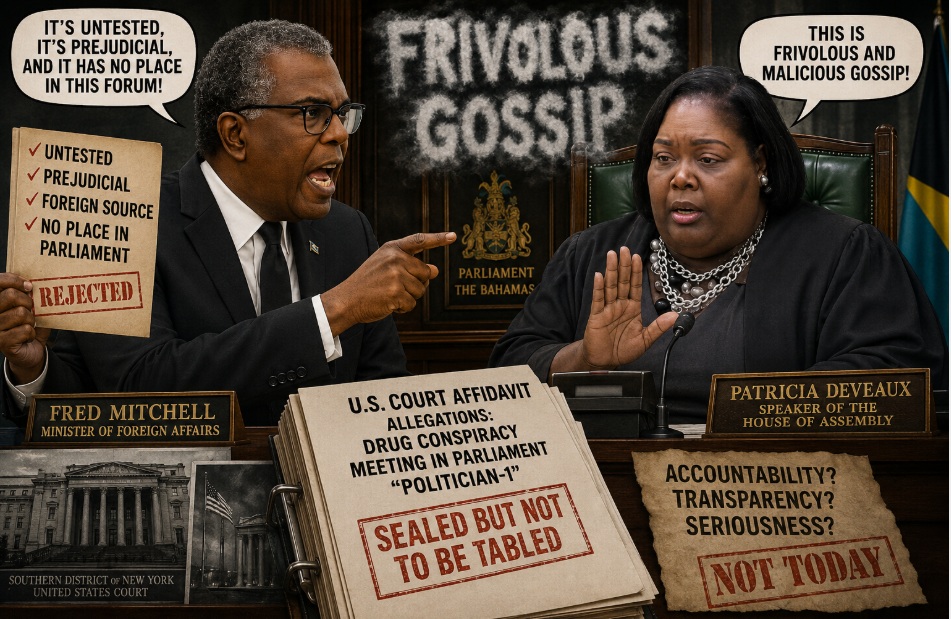
Only weeks ago, the Office of the Prime Minister publicly stated that allegations emerging from a United States Drug Enforcement Administration (DEA) investigation were being taken “extremely seriously” and that information would be sought from American authorities while local inquiries commenced. Yet, when the matter arrived at the doorstep of Parliament, the public was suddenly informed that what had been treated as a serious international law-enforcement matter had somehow transformed into “frivolous gossip.”

One almost has to admire the efficiency of the conversion process.

The controversy centres on allegations contained in U.S. federal court documents involving Jonathan Eric Gardiner, who faces cocaine-importation conspiracy charges in the United States. Those same court filings reference an unnamed “Politician-1” and allege meetings relating to a proposed cocaine shipment. It is important to stress that these allegations remain unproven, and no politician has been charged. Nevertheless, they appear in official federal court filings, not anonymous social-media posts or late-night talk-show rumours.

That distinction appears to have been lost on House Speaker Patricia Deveaux, who dismissed discussion of the matter as “frivolous” and “malicious gossip” while refusing attempts to have the document tabled in Parliament. Foreign Affairs Minister Fred Mitchell similarly argued that the affidavit was an “untested” and “prejudicial” foreign document that had no place in the House of Assembly.

Now, let us consider the logic being presented.

We are asked to believe that allegations involving an unnamed politician, a federal DEA investigation, a suspected cocaine-trafficking conspiracy, an alleged meeting in a Parliament building, and evidence contained in filings before the United States District Court for the Southern District of New York should be treated with the same seriousness as a rumour overheard at a fish fry.

That is quite the proposition.

No reasonable person is suggesting that allegations alone constitute guilt. They do not. Due process matters. Evidence matters. Convictions matter. But serious allegations contained in official court filings also matter. The proper response is neither conviction nor dismissal. The proper response is scrutiny, transparency and investigation.

What has raised eyebrows is not merely the existence of the allegations. It is the eagerness displayed by some government figures to minimise them.

Indeed, if there is one institution that should be deeply concerned by allegations that a meeting concerning a cocaine shipment may have occurred within a Parliament building, it is Parliament itself. One would think the immediate reaction would be outrage and a demand for answers rather than irritation that questions are being asked.

Instead, the country has been treated to a masterclass in political optics. The government first assures the public that the matter is serious. Then prominent officials characterise discussion of the same matter as gossip. The result is not reassurance. The result is confusion.

The unfortunate reality is that every dismissive comment appears only to deepen public suspicion. Bahamians are not demanding a verdict. They are demanding transparency. They are demanding facts. They are demanding that allegations involving the country’s democratic institutions be addressed with the seriousness they deserve.

No one benefits when legitimate questions are waved away.

Certainly not Parliament.

Certainly not the government.

And certainly not the reputation of The Bahamas.

If the allegations are false, then a transparent investigation is the fastest route to clearing the air. If there is substance to them, then the country deserves to know that as well.

Either way, dismissing a federal court affidavit as “frivolous gossip” may prove to be one of the least persuasive public-relations strategies of the year.

The Progressive Liberal Party (PLP) government fails for one reason; it is their nature.

END

My Morning Paper – June 4th, 2026 – The Language of it all – A New Pathway or a New Loophole? Examining the Bahamas Nationality (Amendment) Bill, 2026

Yesterday, much of the political attention was focused on headlines surrounding the Free National Movement’s decision regarding its 2026 convention. Predictably, that story was seized upon by supporters of the governing Progressive Liberal Party (PLP) as evidence of turmoil within the Opposition.

However, buried beneath the political theatre was another headline that arguably deserved far greater scrutiny: proposed amendments to the Bahamas Nationality Act that would create a new pathway to permanent residency.

Unlike convention politics, immigration and nationality laws have consequences that can endure for generations.

So let us examine what the law currently says and what the proposed amendment would change.

Where We Are Now;

Section 7 of the Bahamas Nationality Act deals with persons who are constitutionally entitled to apply for Bahamian citizenship through registration. These include categories such as persons born in The Bahamas to non-Bahamian parents who apply within the constitutional window, certain spouses of Bahamians, and persons born abroad to Bahamian mothers in circumstances recognized by the Constitution.

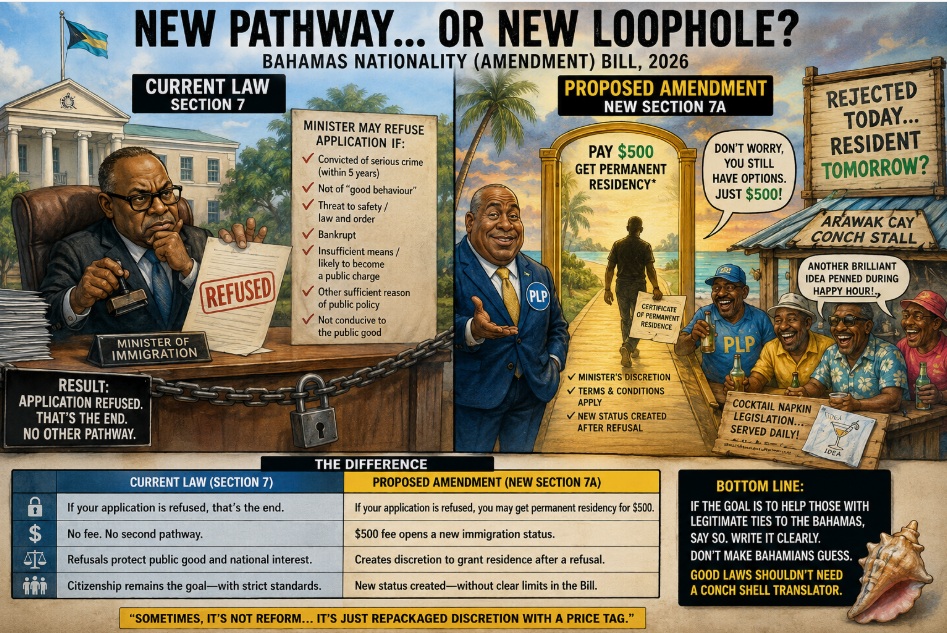
The current law provides that the Minister may refuse an application where there are concerns relating to criminal convictions, public policy, national security, good character, financial self-sufficiency, bankruptcy, or other reasons deemed contrary to the public good.

In other words, while the Constitution may create an entitlement to apply, the Minister retains discretion in certain circumstances to refuse registration where legitimate public interest concerns arise.

What The Amendment Appears to Do;

The Bahamas Nationality (Amendment) Bill, 2026 proposes the creation of a new Section 7A.

The proposed provision would allow the Minister, after refusing a citizenship application under Section 7, to grant the applicant a certificate of permanent residence upon payment of a $500 fee and subject to any terms and conditions the Minister considers appropriate.

That is a significant departure from the existing framework.

Under the current system, a refused citizenship application remains exactly that — refused.

Under the proposed amendment, a refusal could potentially become the gateway to another immigration status entirely.

That is not merely an administrative adjustment. It is a substantive policy change.

Is This Progressive?

Potentially, yes.

If the government’s objective is to assist persons who have legitimate constitutional connections to The Bahamas, but who missed application deadlines or encountered technical barriers, then creating a pathway to permanent residence could be viewed as a practical and humane reform.

For example, there have long been concerns about persons born in The Bahamas to non-Bahamian parents who miss the narrow constitutional application window between ages 18 and 19. Article 7 of the Constitution provides that entitlement, but the deadline is strict.

A carefully drafted permanent residency pathway could help address those situations without automatically conferring citizenship.

Many jurisdictions create intermediate statuses between temporary residence and citizenship.

If that is the policy objective, it could arguably be considered a progressive reform.

The Problem: The Bill Does Not Explicitly Say That

Here is where questions arise.

If the intention is to assist persons who missed constitutional deadlines or who risk becoming long-term residents without status, why does the amendment not expressly state that?

Instead, the wording appears broader.

As currently described, the proposed Section 7A would apply after a citizenship application has been refused under Section 7.

That naturally raises an important question:

If an applicant is refused because of concerns relating to public policy, national security, criminal conduct, insufficient means of support, or other factors deemed contrary to the public good, why should that same refusal immediately qualify the applicant for consideration for permanent residency?

The bill, at least from the language currently reported, does not clearly distinguish between administrative refusals and substantive refusals.

Nor does it appear to specify that the provision is limited to persons who missed constitutional deadlines.

If that limitation exists, it should be clearly stated.

Good legislation should not require citizens to guess at the government’s intentions.

The Constitutional Question

There is another issue.

For decades, many Bahamians have argued that the more pressing nationality reform remains constitutional equality.

The Constitution still contains provisions that prevent Bahamian women from passing citizenship in the same manner as Bahamian men in certain circumstances. These provisions have been the subject of multiple constitutional reform efforts.

If the objective is to resolve long-standing nationality inequities, many would argue that constitutional reform remains the more direct and comprehensive solution.

Permanent residence and citizenship are not the same thing.

Permanent residence allows an individual to live in The Bahamas indefinitely, but it does not confer the full rights and privileges of citizenship.

The Bottom Line

The government may well have identified a genuine problem.

The challenge is that the proposed solution, as currently described, appears broader than the problem it claims to solve.

If the intention is to protect persons who have strong constitutional claims to belong in The Bahamas, then the legislation should say so clearly.

If the intention is to create a discretionary pathway from rejected citizenship applications to permanent residency, then Bahamians deserve a fuller explanation of why that authority is necessary and how it will be exercised.

Because when legislation requires lengthy explanations from ministers, party officials, and social media defenders to explain what it “really means,” that is often a sign that the drafting itself has failed the clarity test.

And once again, the PLP finds itself defending a bill that raises more questions than it answers.

The government insists the amendment is straightforward.

The public is left reading the text and wondering whether the legislation was carefully crafted by policy experts—or hastily scribbled on the back of a cocktail napkin somewhere between happy hour and closing time at Arawak Cay.

The Bahamian people deserve better.

END