
The Iran–Contra affair remains one of history’s more astonishing examples of what happens when governments decide rules are more like “general suggestions.” During the administration of Ronald Reagan, senior U.S. officials secretly facilitated arms sales to Iran—despite public positions and restrictions that made such dealings politically explosive. Proceeds from those sales were then diverted to support the anti-communist Contra rebels in Nicaragua. That part is not conspiracy theory; it is historical fact.
And because apparently one scandal simply wasn’t enough, allegations later emerged that elements associated with the Nicaraguan Contras had links to cocaine trafficking. Multiple investigations followed. Reports—including findings from inspectors general and congressional inquiries— concluded there was evidence that individuals connected to the Contra movement had engaged in drug trafficking activities, though the extent of knowledge or involvement by senior U.S. officials remained heavily disputed and politically contested.
So, to summarize this remarkable chapter of political creativity: weapons moved one direction, money moved another direction, anti-communist rebels were funded, drug allegations surfaced, and for years everyone involved seemed engaged in an Olympic-level relay race of finger-pointing.
Which brings us to the Bahamas—because apparently political discomfort travels internationally.
Recently, a criminal complaint filed in a U.S. court alleged that a Bahamian politician met with a drug trafficker and a cooperating source in Parliament in October 2024 to discuss a possible $30 million drug transaction. Those allegations became even more unsettling after reports surrounding a plane crash and allegations that an individual associated with that matter allegedly had approximately $30,000 on his person on Election Day.
Now before anyone rushes to the nearest podium to scream “misinformation,” a few distinctions matter: allegations are not convictions; criminal complaints are not findings of guilt; and accusations alone do not establish facts. Those distinctions matter in every democracy and something that the PLP and its sycophants should have remembered as they attacked Marvin Dames.
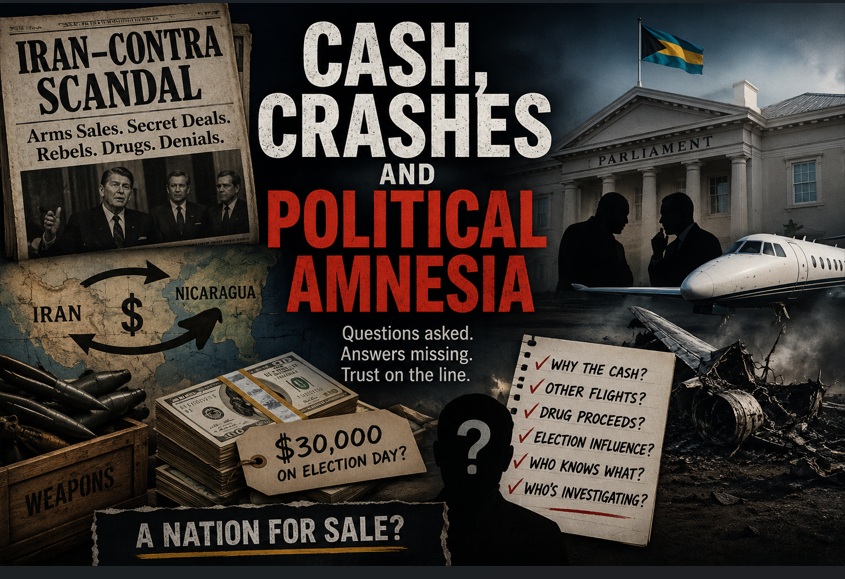
But here is where the political choreography becomes fascinating. Citizens ask questions, and instead of answers they often get what appears to be the governmental equivalent of waving car keys in front of a distracted toddler.
Because right-thinking Bahamians are left asking questions that are neither outrageous nor unreasonable:
Why was someone allegedly traveling with such a large amount of cash on Election Day?
Were there additional flights or movements that escaped detection?
Have investigators fully accounted for what happened?
And perhaps most importantly: have all legitimate concerns been pursued with the seriousness they deserve?
Notice what is not being asked here. No one is claiming proven drug proceeds financed an election. No evidence publicly establishes that conclusion. But when allegations involving politicians, drug traffickers, large sums of money, and Election Day timelines all begin appearing in the same sentence, citizens are not irrational for wanting more than blanket dismissals and offended expressions.
Because history offers an uncomfortable lesson. Public confidence rarely collapses from the scandal itself. It collapses from the suspicion that powerful people seem far more interested in managing perception than confronting facts.
And that leaves a larger concern: what do foreign investors see?
Do they see a country confronting allegations openly and transparently? Or do they see a nation where difficult questions are treated like uninvited guests at a political fundraiser?
Because reputations are fragile things. They take decades to build and moments to damage.
And no country wants old labels revived.
Especially not one as haunting as “A Nation For Sale.”
END

