
There are political pivots, there are political U-turns, and then there is whatever acrobatic event the Chairman of the Progressive Liberal Party (PLP), Fred Mitchell, has just performed. At this point, Olympic judges may need to create an entirely new scoring category: Synchronized Deflection with Advanced Spin Rotation.
In his latest production, Mitchell assures us that criticism from the opposition is proof that democracy is alive and well. Which is true, of course. Criticism in a democracy is normal. But then, in a move so sudden it could cause political whiplash, he immediately abandons discussing the criticism itself and launches into what appears to be an emergency change of subject.
Because apparently concerns over cabinet appointments and the size of government are not really the issue. No, no. The real issue—according to Mitchell—is whether Michael Pintard should continue leading the opposition and why Shanendon Cartwright is “out in the cold.”
Ah yes. The oldest move in the political handbook: “Please ignore the house fire and focus instead on whether the neighbour trimmed his hedges properly.”
And speaking of cabinet size, one almost has to admire the confidence. Not long ago, Prime Minister Philip Davis famously criticized the FNM’s larger cabinet arrangements and invoked the now legendary phrase “Gussie Mae Cabinet,” arguing such expansion represented unnecessary spending and waste of taxpayer money.
Back then, large cabinets were apparently symbols of reckless excess. Today? Apparently, they’re symbols of visionary governance. Somewhere out there, political consistency is sitting alone on a park bench asking itself what it did wrong.
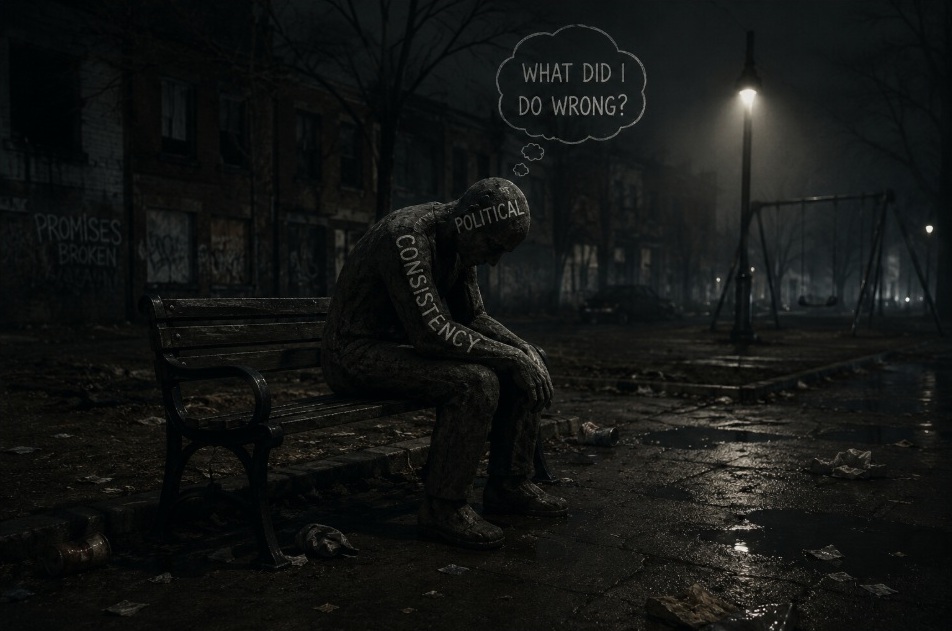
And let’s pause for a moment to appreciate the evolution here. Yesterday: “Too many ministers? Wasteful!” Today: “Too many ministers? Nation-building!” Tomorrow perhaps: “Actually, every Bahamian should receive a ministerial title.”
Then there is the question critics continue to raise regarding the concentration of executive appointments among governing members. Opponents argue that assigning executive roles broadly among elected members can create the appearance of reducing internal dissent or minimizing independent voices. Supporters, naturally, would likely frame it as ensuring broad participation in governance. But it remains a legitimate political question—and one worthy of discussion.
Instead, Mitchell pivots back toward opposition personalities and internal FNM dynamics, appearing to suggest division and dysfunction elsewhere. Yet there remains a rather large topic still hovering over the national conversation—the political equivalent of an elephant standing in the middle of the room wearing a fluorescent vest and setting off smoke alarms.
Because no matter how many side quests are introduced by Mitchell, many people are still asking the same question:
Can we get back to the issue everyone was discussing yesterday the day before and maybe even five minutes ago – WHO IS POLITICAN-1?
The remarkable thing is not disagreement—that’s politics. The remarkable thing is the speed. Less than a week after an election victory, the national conversation somehow already feels like we’ve skipped three seasons ahead and landed directly in the episode titled: “Distraction: The Reboot.”
And perhaps that is the most astonishing thing of all: not that criticism exists, but that the response sometimes appears to be less, “Let’s answer the concern,” and more, “Quick — release another shiny object.”
The Bahamas deserves better.
END
 My Morning Paper