
The Progressive Liberal Party (PLP) would like Bahamians to believe that the Bahamas Power & Light (BPL) liquefied natural gas (LNG) project is one of its great energy achievements.
There’s just one awkward detail.
The country was already headed down the LNG road before the PLP took office.
During the Minnis administration, BPL selected Shell North America through a competitive procurement process to develop a gas-to-power solution at Clifton Pier. The objective was straightforward: replace expensive heavy fuel oil with LNG to lower generation costs, improve efficiency, and reduce emissions.
It wasn’t a perfect project.
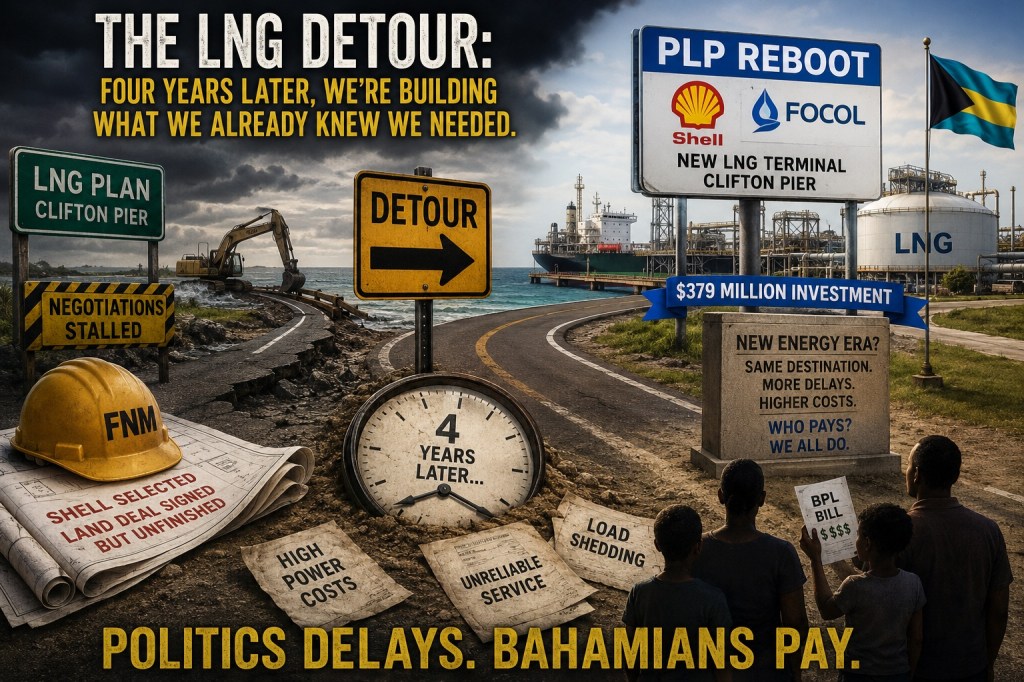
Negotiations between the FNM government and Shell had not been completed before the 2021 general election. Critical commercial terms remained unresolved, and the project had not yet reached financial close. The PLP also criticized the Minnis administration for proceeding with land acquisitions for the proposed site while negotiations were still ongoing, arguing that purchasing land before finalizing the commercial agreement exposed taxpayers to unnecessary risk.
Those were legitimate questions deserving public answers.
But here’s the question that deserves equal attention:
Did those concerns justify effectively resetting the clock?
Instead of building on the work already completed, the Davis administration allowed the previous negotiations and land arrangement to collapse. The project was subsequently restructured into a new public-private partnership involving Shell and FOCOL, with financing arranged through a consortium of Bahamian banks.
Fast forward nearly five years.
We’re still talking about building an LNG terminal at Clifton Pier.
Think about that.
After years of announcements, consultations, ceremonies, press conferences, artist renderings, and enough “New Energy Era” slogans to power a marketing department, the destination remains almost exactly where it was before the PLP entered office.
The difference is the calendar.
To be fair, governments are entitled to improve projects they inherit. If the PLP believed the commercial structure needed strengthening or Bahamian financing should play a larger role, those are reasonable policy decisions.
But improving a project and delaying a project are not the same thing.
Every additional year that BPL remained dependent on expensive heavy fuel oil meant Bahamians continued paying some of the region’s highest electricity costs while enduring unreliable service and repeated load shedding.
That’s the opportunity cost rarely mentioned during ribbon-cutting ceremonies.
The PLP now celebrates the LNG terminal as a transformative investment valued at approximately $379 million.
Wonderful.
But if LNG was the right answer in 2026, wasn’t it also the right answer in 2021?
If the original proposal genuinely had flaws—and every major infrastructure project has some—the obvious question becomes why those deficiencies couldn’t have been negotiated away instead of allowing the entire initiative to unravel before starting over.
This isn’t about giving one political party all the credit or all the blame.
The FNM deserves criticism for not completing negotiations before leaving office.
The PLP deserves scrutiny for whether its decision to abandon the existing framework unnecessarily delayed the country’s energy transition.
The real victims of political resets are ordinary Bahamians.
While successive governments debated who deserved the headlines, families continued opening eye-watering electricity bills, businesses struggled with operating costs, and the national grid lurched from one crisis to another.
Perhaps the greatest irony is this:
After years of insisting the FNM’s approach was fundamentally flawed, the Davis administration has ultimately arrived at the very same conclusion as its predecessor—
The Bahamas needed LNG.
The only question left is whether politics delayed that conclusion by several expensive years.
The Bahamian people deserve better.
END

