My Morning Paper 24th July 2026 – Trust Us… Again? The Surplus That Requires More Faith Than Facts

One of the more refreshing moments in today’s public debate did not come from a politician. It came from Gowon Bowe, Chief Executive Officer of Fidelity Bank & Trust International Limited Group, whose comments in The Nassau Guardian amounted to something many Bahamians have been asking for all along: evidence, transparency and accountability.

That should not be a controversial request. Yet, somehow, it has become one.

Bowe was responding to the Davis administration’s projection that it will end the 2026/2027 fiscal year with a $223.1 million budget surplus. His comments came after Fitch Ratings, one of the world’s leading credit rating agencies, publicly questioned those projections and instead forecast that The Bahamas is more likely to record a fiscal deficit of approximately $64 million rather than a surplus.

According to The Nassau Guardian, Bowe observed:

“None of the international observers have adopted the position that the government has been articulating in their budget communications.”

He added that rather than becoming defensive, the government should ask a simple question:

“Why not?”

Even more importantly, Bowe pointed out that the issue is not necessarily whether the government’s projections are wrong. The real issue is whether the information made available to the public actually supports those optimistic conclusions.

That is a perfectly reasonable position.

In fact, it is the very foundation of responsible governance.

Fool Me Once…

My skepticism has very little to do with political preference and everything to do with recent history.

This is not the first time the Davis administration has projected a budget surplus.

For the past two budget cycles, government officials have repeatedly expressed confidence that they were on track to achieve a surplus or balanced fiscal outcome. Yet the final fiscal results did not fully match those optimistic projections. While the government’s fiscal position has undoubtedly improved compared with the severe deficits experienced during the COVID-19 period, the promised surplus has remained elusive.

That history naturally raises a simple question:

Why should Bahamians simply accept another surplus projection without stronger supporting evidence?

That is precisely the point Bowe appears to be making.

He is not saying the government cannot achieve its target.

He is saying that the public evidence currently available does not sufficiently support the government’s conclusion.

Those are two very different things that the average PLP supporter seems unable to differentiate.
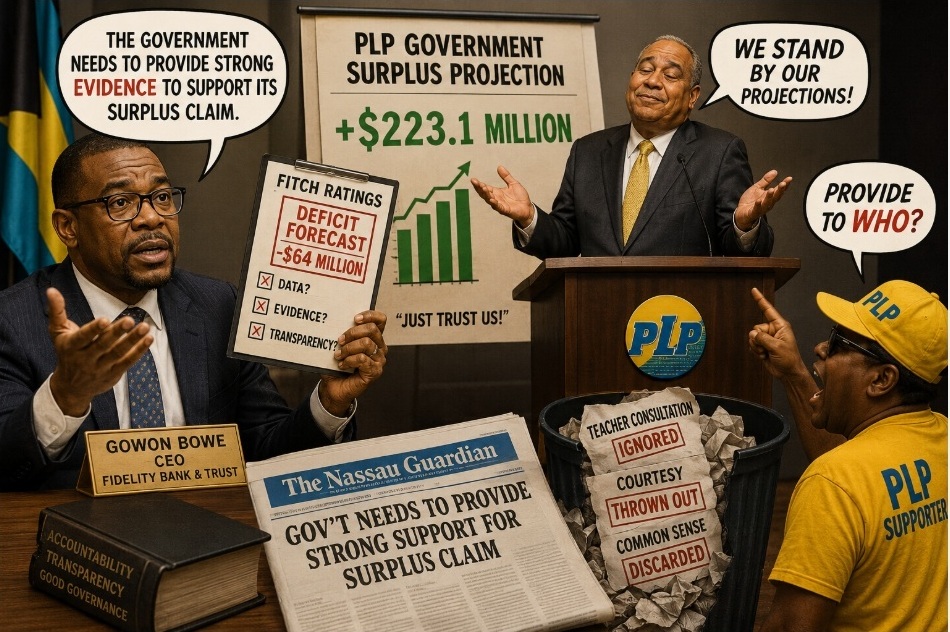
“Provide to Who?”

Perhaps the most astonishing response came not from government officials, but from one of the Progressive Liberal Party (PLP) supporters.

This person question was remarkably simple:

“Provide to who?”

Think about that for a moment.

Provide evidence… to whom?

To the taxpayers?

To the voters?

To Parliament?

To the businesses making investment decisions?

To international credit agencies?

Or perhaps to the Bahamian people who are ultimately paying the bills?

In any healthy democracy, the answer should be obvious.

Governments are accountable to the people.

Transparency is not an optional public relations exercise.

It is a democratic obligation.

When respected financial institutions, independent economists or international credit agencies question government projections, the proper response is not indignation or blind demands for trust.

The appropriate response is evidence.

A Familiar Pattern

Unfortunately, this dismissive attitude toward legitimate public questions is becoming increasingly familiar.

Consider the government’s handling of its plan to recruit hundreds of teachers from Ghana.

Few reasonable people argued that additional teachers were unnecessary. The concern expressed by many educators was the apparent lack of meaningful consultation with local teachers and the Bahamas Union of Teachers before the initiative was announced.

Good governance is not simply about arriving at the right destination.

It is also about respecting the people affected by the journey.

Consultation.

Transparency.

Professional courtesy.

These are not signs of weakness.

They are signs of competent leadership.

Yet increasingly, asking questions seems to be treated as an act of political hostility rather than civic responsibility.

Trust Is Earned

No government—PLP, FNM or otherwise—should expect citizens to suspend critical thinking simply because a minister stands behind a podium and declares that everything is on track.

Trust is earned.

Credibility is built.

And confidence comes from providing evidence that allows independent observers to arrive at the same conclusion as the government itself.

That, incidentally, was exactly the point Gowon Bowe was making.

He was not asking Bahamians to distrust the government.

He was encouraging the government to provide enough information so that trust becomes the natural conclusion—not a compulsory act of faith.

Until then, Bahamians are left with an uncomfortable question:

If even independent international analysts remain unconvinced by the government’s numbers, why should the public be expected to applaud first and ask questions later?

The Bahamian deserves better.

END
My Morning Paper July 23rd 20026 – Whose Numbers Should Bahamians Believe?

In 2016, after The Bahamas was downgraded to non-investment grade (“junk”) by Standard & Poor’s, then-Prime Minister Perry Christie famously declared that it was up to his government to “prove them wrong.” History records the statement. Whether his administration ultimately did is a matter of political debate.

Fast forward to 2026, and Bahamians once again find themselves watching a government insist that the experts simply don’t see the full picture.

This week’s headlines in The Nassau Guardian tell the story:

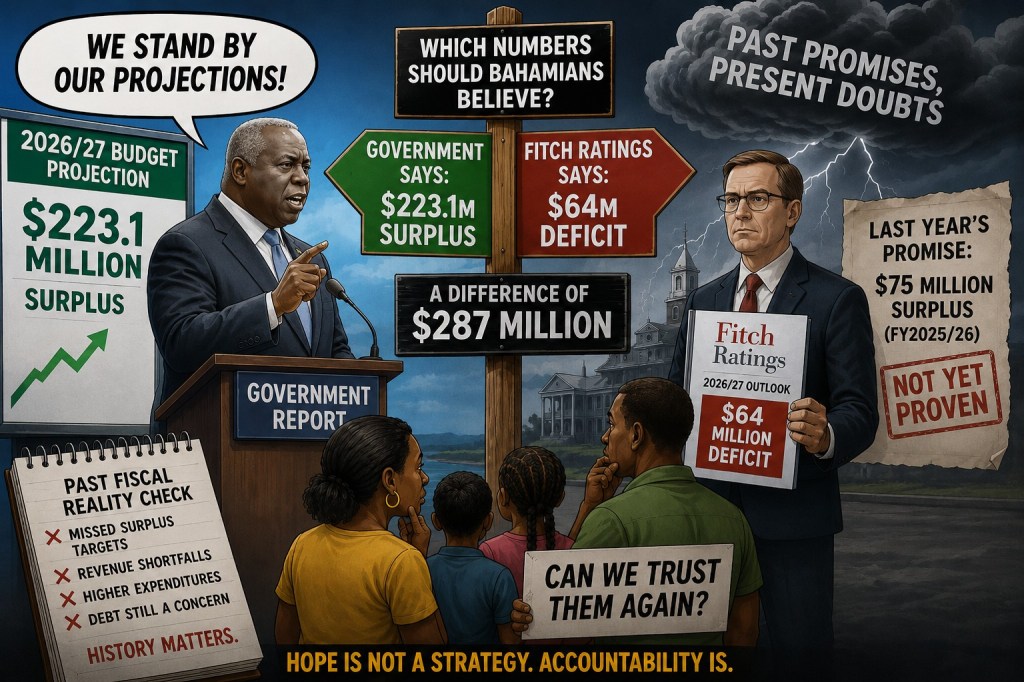
“Rating agency projects deficit — $64 million deficit this year, Fitch says, not $223.1 million surplus government projects.”

The disagreement is not a few million dollars.

It is $287 million.

The Davis administration’s 2026/27 Budget forecasts a $223.1 million surplus, while Fitch Ratings projects a $64 million deficit for the very same fiscal year. That is a swing of nearly $300 million between what the government expects and what one of the world’s leading credit-rating agencies believes is more likely.

To be fair, Fitch did not suggest that The Bahamas is moving in the wrong direction overall. On the contrary, it acknowledged continuing fiscal consolidation and declining government debt. The disagreement is over the pace of that improvement—not whether improvement is occurring. Fitch simply concludes that the government’s timetable for reaching a surplus is too optimistic.

That distinction matters.

Because this is not occurring in a vacuum.

Last year, the government confidently projected a $75 million surplus for FY2025/26. However, as of today, the audited year-end figures have not yet been released, meaning there is still no official confirmation that the projected surplus was actually achieved. Fitch’s latest assessment likewise indicates it does not expect that surplus to have materialized.

Yet despite that uncertainty, the government has responded with confidence.

Finance Minister Michael Halkitis has said:

“We stand by our projections.”

That is certainly the government’s prerogative.

But it also raises a straightforward question.

If last year’s projected surplus has not yet been demonstrated with final results—and Fitch believes it was overly optimistic—why should Bahamians simply assume this year’s projection will prove accurate?

This is not about rooting against the country.

Every Bahamian should hope the government delivers a surplus.

The question is whether hope should replace evidence.

Ironically, the government’s own 2026 Fiscal Strategy Report acknowledges that previous fiscal forecasts have shown a “systematic optimistic bias,” noting that deficits have historically been underestimated because revenues often fall short of expectations while expenditures exceed projections. The report even warns that there remains a meaningful risk that future fiscal outcomes could be weaker than the baseline forecast.

That admission makes Fitch’s caution appear less like pessimism and more like a recognition of the same forecasting risks identified by the government itself.

So, Bahamians are left with two competing stories.

The government says a $223.1 million surplus is coming.

Fitch says a $64 million deficit is more likely.

One side is asking the public to trust its projections.

The other is asking investors to temper their expectations.

Ultimately, only the final audited public accounts will determine who was closer to reality.

Until then, perhaps the better question is not whether the government can achieve a surplus.

It is whether a government that has yet to conclusively demonstrate it met its previous surplus target has earned the public’s confidence that this much larger one is within reach. That is a question for voters, taxpayers, and investors alike.

The Bahamian people deserve better.

END

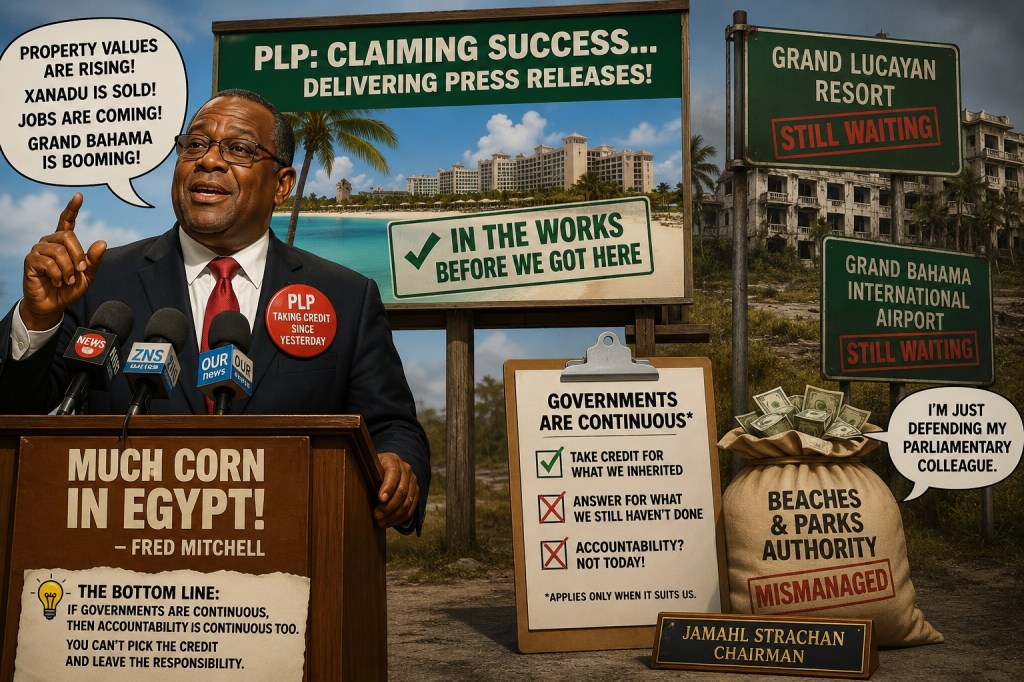
My Morning Paper 20th July 2026 – Governments Are Continuous… Until They Aren’t

There is an old saying that “success has many fathers, but failure is an orphan.” Judging by the Progressive Liberal Party’s (PLP’s) latest political messaging, that saying has never been more appropriate.

PLP Chairman Fred Mitchell recently painted an optimistic picture of Grand Bahama, citing rising property values, positive comments from Grand Bahama Chamber of Commerce President Ralph Hepburn, Carnival Corporation’s economic impact, and reports that Norwegian Cruise Line has completed the purchase of the former Xanadu Beach Resort with plans for redevelopment.

No Bahamian should object to good news for Grand Bahama. Every investment is welcome. Every job created is needed. Every redevelopment is a step in the right direction.

The question is not whether these developments are positive.

The question is: who deserves the credit?

The proposed redevelopment of the former Xanadu property did not suddenly materialize because the PLP discovered it in 2026. Public reports and individuals familiar with the transaction have long indicated that discussions surrounding the Donato family’s property had been underway for years, with negotiations predating the current administration. While the reported purchaser may ultimately complete the transaction during the PLP’s term, that does not mean the government originated or negotiated the private commercial sale.

Yet once again, the PLP appears eager to wrap itself in the ribbon of achievements that were already moving before it arrived.

Ironically, whenever the government is challenged over problems that originated under previous administrations, we are reminded that “governments are continuous.”

Apparently that principle only applies when it is politically convenient.

If governments are indeed continuous—and they are—then continuity works both ways.

It means a government may inherit projects already underway.

It also means a government inherits unresolved problems and is ultimately accountable for addressing them while it is in office.

By that same standard, Bahamians are entitled to ask:

What is the status of the long-promised redevelopment of the Grand Lucayan Resort?

Where does the replacement of the Grand Bahama International Airport now stand?

What measurable progress has been made beyond repeated announcements and photo opportunities?

These are projects the current administration has repeatedly highlighted as priorities. After nearly five years in office, the public is justified in asking for timelines, milestones, and results—not simply promises of what is still to come.

The selective application of “government continuity” raises another interesting question.

Jamahl Strachan, now Chairman of the Beaches and Parks Authority, has publicly defended his predecessor, McKell Bonaby, amid continuing public criticism regarding the Authority’s financial management.

But if governments—and by extension, public institutions—are continuous, then leadership carries more than the privilege of inheriting the office. It also inherits the responsibility to answer legitimate questions from the public.

Defending previous management is one thing.

Providing transparency and accountability is another.

The Bahamian people deserve explanations—not simply political solidarity.

Perhaps that is the lesson Mr. Mitchell unintentionally taught us.

If the PLP wishes to celebrate investments that began before it took office because “governments are continuous,” then it cannot suddenly abandon that philosophy whenever difficult questions arise about projects that have stalled, public agencies under its control, or controversies inherited—or continued—under its own watch.

Continuity is not a political buffet where governments select only the accomplishments they like and leave the responsibility behind.

It is an obligation.

And that obligation belongs to whoever occupies the office today.

The Commonwealth of The Bahamas deserves better.

END

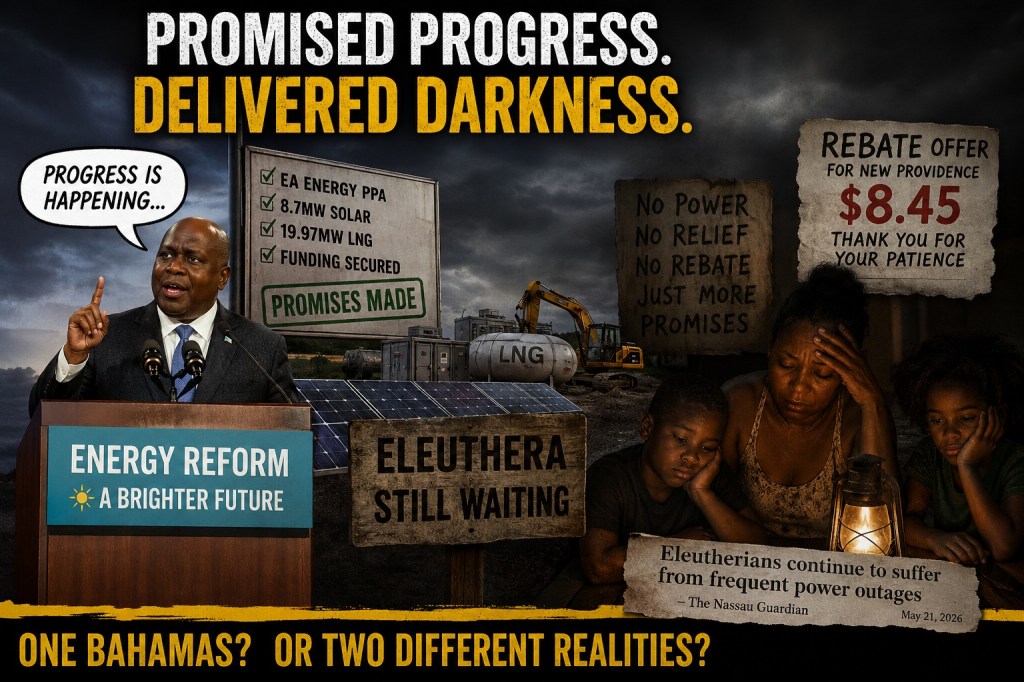
My Morning Paper – 17th July 2026 – The Price of a Promise: Eleuthera Was Told Progress Was Coming. Instead, It Got Another Promise.

When the Davis administration assured Bahamians that it was prepared for the demands of the 2026 summer season, many expected that preparation would be reflected in a stable electricity supply. Instead, residents across the country have endured repeated power outages, while affected customers on New Providence have been offered an $8.45 electricity bill rebate—a gesture that has been criticized by many as symbolic rather than substantive.

For the people of Eleuthera, however, there has not even been a rebate. Instead, they have once again been offered something they have heard before another promise that relief is on the way.

Speaking this week, Minister of Public Works and Utilities and Central and South Eleuthera MP Clay Sweeting expressed optimism that a power purchase agreement signed with EA Energy Limited would eventually stabilize electricity on the island.

As reported by The Nassau Guardian, Minister Sweeting stated:

“We’re excited about what EA Energy will bring to Eleuthera because along with development comes the need for power production… The equipment is on site… to commence the solarization there, as well as the LNG project.”

The facts surrounding the project are largely undisputed.

The Davis administration signed a Power Purchase Agreement (PPA) with EA Energy Limited for the construction, ownership and operation of an 8.7-megawatt solar generation facility together with a 19.97-megawatt LNG-powered generating facility on Eleuthera. The project forms part of the government’s wider energy reform programme, which it has repeatedly described as one of its signature accomplishments.

Site clearing was publicly announced in 2025, and government officials have consistently maintained that financing for the project is secured. Yet, nearly a year after those announcements, there remains no publicly confirmed completion date for the project, while Eleutherians continue to experience significant power interruptions.

That naturally raises a question.

If the project was intended to provide meaningful relief, why are residents still being asked to wait?

Even more importantly, why should Bahamians simply accept yet another assurance that “progress is happening” without being given a clear timeline for completion?

This is not the first time the government has announced measures intended to stabilize Eleuthera’s electricity supply.

In late 2024, the government announced the installation of approximately one megawatt of rental generation on Harbour Island following persistent complaints from residents and businesses about unreliable electricity. That temporary generation was presented as an immediate solution while longer-term infrastructure was developed.

Today, the public deserves an update.

Is that rental generation still operating?

Has it delivered the level of stability that was promised?

If not, what became of that initiative?

These are not unreasonable questions. They are questions of accountability.

Instead, the public is once again being asked to focus on what is coming rather than what has—or has not—already been delivered.

The government’s political messaging has consistently portrayed its energy policy as proactive. Yet the lived experience of many Bahamians tells a different story. Residents on New Providence continue to endure outages despite assurances that the country was prepared for the summer peak demand period. Family Islands such as Eleuthera continue to face recurring disruptions while being told that relief is just around the corner.

Governments are not judged solely by the number of agreements they sign or the announcements they make. They are judged by results.

This administration has frequently pointed to inherited challenges within Bahamas Power and Light. There is no dispute that BPL’s infrastructure required significant investment long before 2021. However, after nearly five years in office, the Davis administration must increasingly answer for its own record rather than simply the record it inherited.

The question is no longer what was inherited.

The question is what has been delivered.

Perhaps the most uncomfortable political reminder comes from the 2021 general election campaign.

During that campaign, Prime Minister Philip Davis repeatedly argued that meaningful progress for constituencies like Eleuthera required electing PLP representatives and supporting a PLP government. The implication was unmistakable: political alignment with the government would accelerate development and improve public services.

Five years later, many Eleutherians may reasonably ask whether those expectations have been fulfilled.

Instead of dependable electricity, they continue to receive explanations.

Instead of clear completion dates, they receive optimism.

Instead of measurable progress, they are offered another promise.

Meanwhile, customers on New Providence are being asked to appreciate an $8.45 rebate—an amount many believe falls far short of compensating households and businesses for spoiled food, damaged appliances, disrupted commerce, and the inconvenience caused by repeated outages.

Eleutherians are not even being offered that.

They are simply being told to wait.

And after years of waiting, it is entirely reasonable for Bahamians to ask whether the government underestimated the scale of the problem, overpromised during the campaign, or failed to deliver the urgency that the situation demanded.

Because at some point, “progress is happening” must become “progress has happened.”

For the people of Eleuthera, that day cannot come soon enough.

The Bahamian people deserve better.

END

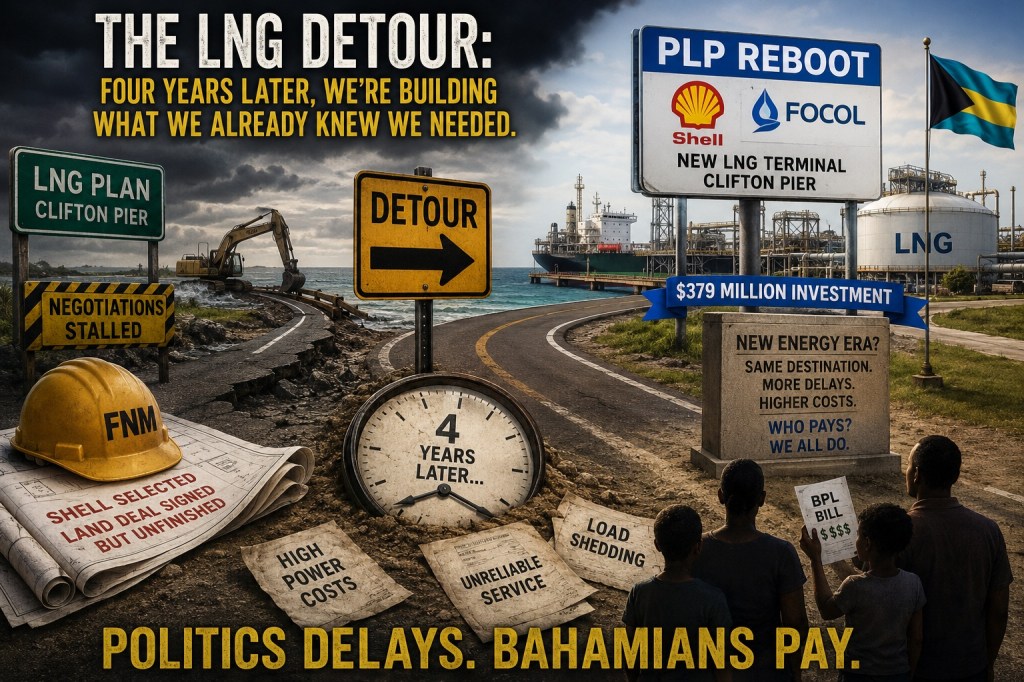
My Morning Paper 14th July 2026- The LNG Detour: Four Years Later, We’re Building What We Already Knew We Needed

The Progressive Liberal Party (PLP) would like Bahamians to believe that the Bahamas Power & Light (BPL) liquefied natural gas (LNG) project is one of its great energy achievements.

There’s just one awkward detail.

The country was already headed down the LNG road before the PLP took office.

During the Minnis administration, BPL selected Shell North America through a competitive procurement process to develop a gas-to-power solution at Clifton Pier. The objective was straightforward: replace expensive heavy fuel oil with LNG to lower generation costs, improve efficiency, and reduce emissions.

It wasn’t a perfect project.

Negotiations between the FNM government and Shell had not been completed before the 2021 general election. Critical commercial terms remained unresolved, and the project had not yet reached financial close. The PLP also criticized the Minnis administration for proceeding with land acquisitions for the proposed site while negotiations were still ongoing, arguing that purchasing land before finalizing the commercial agreement exposed taxpayers to unnecessary risk.

Those were legitimate questions deserving public answers.

But here’s the question that deserves equal attention:

Did those concerns justify effectively resetting the clock?

Instead of building on the work already completed, the Davis administration allowed the previous negotiations and land arrangement to collapse. The project was subsequently restructured into a new public-private partnership involving Shell and FOCOL, with financing arranged through a consortium of Bahamian banks.

Fast forward nearly five years.

We’re still talking about building an LNG terminal at Clifton Pier.

Think about that.

After years of announcements, consultations, ceremonies, press conferences, artist renderings, and enough “New Energy Era” slogans to power a marketing department, the destination remains almost exactly where it was before the PLP entered office.

The difference is the calendar.

To be fair, governments are entitled to improve projects they inherit. If the PLP believed the commercial structure needed strengthening or Bahamian financing should play a larger role, those are reasonable policy decisions.

But improving a project and delaying a project are not the same thing.

Every additional year that BPL remained dependent on expensive heavy fuel oil meant Bahamians continued paying some of the region’s highest electricity costs while enduring unreliable service and repeated load shedding.

That’s the opportunity cost rarely mentioned during ribbon-cutting ceremonies.

The PLP now celebrates the LNG terminal as a transformative investment valued at approximately $379 million.

Wonderful.

But if LNG was the right answer in 2026, wasn’t it also the right answer in 2021?

If the original proposal genuinely had flaws—and every major infrastructure project has some—the obvious question becomes why those deficiencies couldn’t have been negotiated away instead of allowing the entire initiative to unravel before starting over.

This isn’t about giving one political party all the credit or all the blame.

The FNM deserves criticism for not completing negotiations before leaving office.

The PLP deserves scrutiny for whether its decision to abandon the existing framework unnecessarily delayed the country’s energy transition.

The real victims of political resets are ordinary Bahamians.

While successive governments debated who deserved the headlines, families continued opening eye-watering electricity bills, businesses struggled with operating costs, and the national grid lurched from one crisis to another.

Perhaps the greatest irony is this:

After years of insisting the FNM’s approach was fundamentally flawed, the Davis administration has ultimately arrived at the very same conclusion as its predecessor—

The Bahamas needed LNG.

The only question left is whether politics delayed that conclusion by several expensive years.

The Bahamian people deserve better.

END

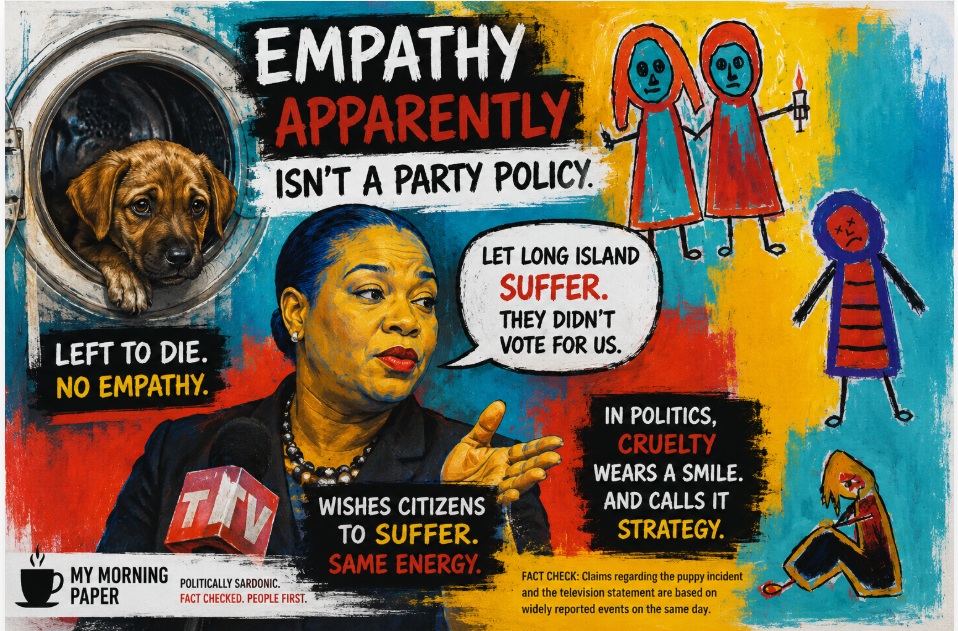
My Morning Paper – 11th July 2026 – When Empathy Isn’t Apparently Party Policy

Mahatma Gandhi: “The greatness of a nation and its moral progress can be judged by the way its animals are treated.”

Sometimes the news writes its own satire.

On the very same day that Bahamians were horrified by reports of a helpless puppy being deliberately trapped inside an abandoned washing machine and left to die, viewers were treated to another display of cruelty—this time on national television.

A pro-PLP television panellist suggested that the people of Long Island should simply be left to “suffer” because they did not vote for the Progressive Liberal Party (PLP).

Think about that for a moment.

One story involved a defenceless animal allegedly abandoned without compassion. The other involved a fellow Bahamian openly suggesting that citizens should endure hardship because they exercised their democratic right to vote differently.

The comparison isn’t about equating people with animals. It’s about asking what kind of mindset allows someone to view suffering as an acceptable consequence of political disagreement.

Whether the comment was aimed at Long Islanders because of their choice of political party, the candidate they supported, or both, is almost beside the point. The truly disturbing part is the apparent absence of empathy.

In a democracy, governments are elected to serve everyone—not just those who voted for them. Roads do not ask who you supported. Hospitals do not check your ballot before treating you. Disaster relief should not depend on the colour of your campaign shirt.

Yet here we are, listening to someone casually suggest that an entire island should be left to suffer because its residents made a different political choice.

The irony is difficult to ignore. The panellist’s own home island has faced significant challenges over the years and has itself needed the attention, resources, and support of successive governments. One would imagine that experience would produce greater compassion, not less.

Perhaps this is just one individual’s opinion. If so, it deserves to remain exactly that—an isolated opinion.

Because if this reflects a broader political culture where public services are viewed as rewards for loyal supporters and hardship is considered an appropriate punishment for dissenters, then we have drifted a very long way from representative democracy.

A mature democracy accepts election results. It does not celebrate the suffering of fellow citizens because of them.

Long Islanders are Bahamians.

Their taxes spend the same.

Their votes count the same.

Their children deserve the same opportunities.

And their government has exactly the same obligation to serve them, whether they voted red, yellow, blue, or stayed home altogether.

Politics should be about improving lives—not deciding whose lives are worth improving.

END

My Morning Paper – 8th July 2026 – Five Years Later… and PMH Is Still Looking for Reliable Power?

This morning, I had every intention of addressing the latest political fiction being circulated by Progressive Liberal Party (PLP) Chairman Fred Mitchell. According to Mr. Mitchell, Bahamians should apparently be preoccupied with rumours of leadership intrigue inside the Opposition Free National Movement (FNM).

But then reality interrupted the script.

While the PLP Chairman was busy trying to manufacture political drama elsewhere, a far more consequential story emerged—one that should concern every Bahamian regardless of political affiliation.

The headline read:

“Darville: Govt looking to improve reliable power for PMH.”

Think about that for a moment.

Not “completed improvements.”

Not “the upgraded system functioned as designed.”

Not “our investment protected patients.”

Instead…

“Looking to improve reliable power.”

After nearly five years in office.

According to reports in The Nassau Guardian, a recent island-wide power outage resulted in the malfunction of a generator serving Princess Margaret Hospital’s Medical Ward. Health and Wellness Minister Dr. Michael Darville acknowledged that while newer backup generators exist at parts of the hospital, older infrastructure was more severely affected. He said government officials are now implementing corrective measures to improve the reliability of backup power should another outage occur.

No one doubts that officials worked to restore services as quickly as possible.

The real question is:

Why was the country’s premier public hospital still vulnerable to this type of failure after almost five years of PLP governance?

Reliable electrical power at a tertiary hospital is not a luxury.

It is not an optional capital project.

It is a life-support system.

Operating theatres, dialysis units, intensive care equipment, ventilators, laboratory services and countless other critical medical functions depend upon uninterrupted electricity. Backup generation is supposed to provide confidence—not headlines.

Yet today, Bahamians are being told that government is now “looking to improve” reliability.

One cannot ignore the obvious timeline.

The Davis administration took office in September 2021.

That is almost five years ago.

During that period, the government has repeatedly argued that it inherited challenges. Every administration inherits challenges. The question voters eventually ask is not what you inherited—it is what you accomplished after inheriting it.

This discussion also revives another uncomfortable chapter.

One of the Davis administration’s earliest healthcare decisions was to halt the Princess Margaret Hospital redevelopment plan advanced under the previous FNM administration. The government subsequently abandoned the financing package secured for that project and instead pursued financing for a new specialty hospital. Those decisions have been publicly acknowledged by both the government and the Opposition, although each side continues to defend its respective approach.

That naturally raises a question deserving public debate:

Had the PMH redevelopment proceeded instead of being stopped and redesigned, how much further along would Princess Margaret Hospital be today?

Would its electrical infrastructure already have been modernized?

Would vulnerable sections of the hospital already have benefited from upgraded backup power?

No one can answer those questions with certainty.

But they are legitimate questions because the government itself is now acknowledging that improvements to reliable power are still needed.

This is not merely about politics.

It is about priorities.

The government chose to cancel one course of action in favour of another. After nearly five years, Bahamians are entitled to evaluate the results of those decisions.

Ironically, this announcement exposes something larger than a generator problem.

It exposes a planning problem.

Government ministers often tell the public that they are “moving swiftly” once a crisis occurs. Yet citizens increasingly wonder why so many critical systems seem to receive urgent attention only after they fail in public.

Being reactive is not the same as being prepared.

And preparedness is exactly what citizens expect when it comes to the country’s principal public hospital.

Dr. Darville deserves credit for acknowledging the problem and for committing to corrective measures.

But acknowledgement is not achievement.

The larger responsibility rests with the Davis administration, which has governed long enough that ongoing deficiencies at PMH are no longer simply inherited problems—they are now part of its own record.

Perhaps Fred Mitchell should spend less time searching for imaginary political battles inside the Opposition and more time asking difficult questions within his own government.

Because while the PLP was busy talking about “Progress,” Bahamians have now learned that the country’s most important hospital is still looking for reliable power.

That is not the kind of progress patients—or taxpayers—were promised.

The Bahamian people deserve better.

END

My Morning Paper – 7th July 2026 – Power Promises vs. Power Reality

The latest statement from Minister of Energy, Utilities and Aviation JoBeth Coleby-Davis regarding the widespread power outages across New Providence raises more questions than it answers.

The Minister acknowledged the hardship experienced by residents, businesses, medical facilities, and public services and explained that, according to Bahamas Power and Light (BPL), severe weather and intense lightning activity triggered a major fault at the Blue Hills Power Station. She also assured the public that the Government is working to strengthen generation, transmission, grid stability, renewable energy integration, and the long-term resilience of the country’s electricity system.

Those are reassuring words. The problem is that Bahamians have been hearing reassuring words since she took over as the minister.

The Progressive Liberal Party came to office promising to fix the country’s energy crisis and improve the reliability of electricity. Minister Coleby-Davis has repeatedly spoken about modernizing the grid, increasing resilience, and preparing BPL for periods of peak demand and severe weather. Yet after another widespread blackout, Bahamians are once again being told that bad weather exposed the system’s vulnerabilities.

That naturally leads to an obvious question: weren’t those vulnerabilities precisely what the Government said it was addressing?

If strengthening grid resilience, improving system stability, and protecting critical infrastructure from failures caused by severe weather are already underway, then where exactly does that work stand? How many of the promised upgrades have been completed? Which projects remain outstanding? What measurable improvements have been delivered since these commitments were first announced?

The Minister herself said that Bahamians “want to know why the system remains vulnerable” and “what work is being done to strengthen the grid.” She is absolutely right. Those questions deserve more than carefully crafted press releases—they deserve detailed, transparent answers.

One point also deserves clarification. The Minister’s statement attributes the incident to severe weather and lightning activity that triggered a major fault. Meanwhile, public comments from BPL’s CEO referred to an explosion in the generator room. Those explanations are not necessarily inconsistent—equipment faults caused by lightning can lead to explosions—but the public would benefit from a clear technical explanation of exactly what occurred and whether the failure exposed weaknesses that should already have been addressed.

The PLP Government cannot continue to campaign on promises of modernization while governing with explanations that sound remarkably similar to those Bahamians have heard after previous blackouts. Every major outage is followed by assurances that improvements are coming, resilience is being strengthened, and reliability will soon improve. At some point, the public is entitled to ask a simple question: when do these promises become measurable results?

If the Government is indeed advancing improvements to generation, transmission, grid stability, renewable energy integration, and long-term resilience, then it should have no difficulty providing a comprehensive progress report. Which milestones have been achieved? Which remain incomplete? What timelines should Bahamians expect?

After years of promises, “we’re working on it” is no longer an adequate response.

The Bahamian people are not asking for perfection. They understand that storms happen and equipment can fail. What they expect is accountability, transparency, and evidence that the investments and reforms repeatedly promised are making the electricity system less—not more—vulnerable to foreseeable events like severe weather.

Because if resilience was the promise, another island-wide blackout naturally invites the question: how much progress has really been made?

The people of The Bahamas deserve better.

END

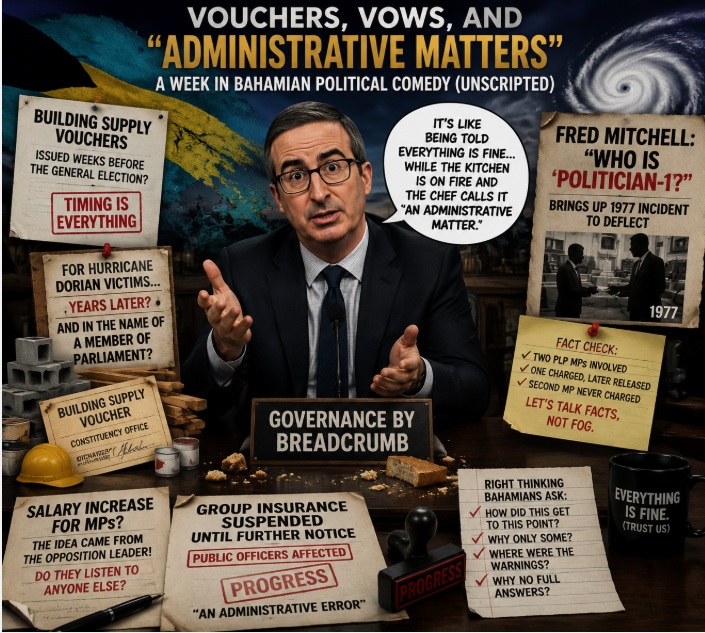
My Morning Paper – 4th August 2026 -Vouchers, Vows, and “Administrative Matters”: A Week in Bahamian Political Comedy

If politics in The Bahamas were a streaming series, this week’s episode would be titled:

“We Have Investigated Ourselves and Found an Administrative Error.”

Let’s unpack.

The Voucher Question That Keeps Reappearing Like Bad Wi-Fi

This past week, reports circulated that building supply vouchers were issued in the lead-up to the most recent general election period, with claims that they were linked to assistance efforts for persons affected by Hurricane Dorian.

The government position, as previously stated in various forms, is that such assistance falls under ongoing recovery and social support measures.

But critics — or as they are often known in Bahamian politics, “people asking inconvenient questions in public” — raised a few simple issues:

Why now, years after Hurricane Dorian, are these interventions still appearing in politically sensitive timeframes?

And why do some of the vouchers appear, according to reports, to be associated with specific parliamentary offices or representatives?

Now, to be clear, there is no publicly verified finding of wrongdoing established by a court or independent investigation in relation to these voucher reports. What exists in the public space is political dispute, competing narratives, and a lot of side-eyes in capital letters.

Still, as many might say: when government assistance programs and election cycles start overlapping like badly aligned floor tiles, people tend to notice the cracks.

The Fred Mitchell “Historical Memory Challenge”

Then came the Chairman of the Progressive Liberal Party (PLP), Fred Mitchell, entering what can only be described as the “and what about 1977?” segment of the national discourse.

According to his remarks, opposition criticism was framed as damaging to The Bahamas’ reputation, particularly regarding ongoing international allegations involving parliamentary conduct and references to a figure described in reporting as “Political-1” in a broader legal context.

At the same time, he referenced historical incidents involving alleged exchanges of cash in Parliament dating back to 1977, suggesting the opposition should account for past events as well.

Here is where fact and Fred Mitchell’s “facts” politely shake hands and walk in opposite directions:

Because if we were to look past the fact of how long ago this was and take it seriously then we would uncover these facts.  It was two PLP members of parliament that we caught exchanging the money. One was charged and later released, while the second PLP member of parliament was never charged.

In short: history is being used at the convenience of the questionable memory of the Chairman of the PLP.

 Salaries, Suggestions, and Selective Memory

Another strand of the week’s discussion involved proposals regarding increases in parliamentary salaries.

Critics pointed out what they saw as inconsistency: on one hand, political leadership suggesting adjustments to compensation; on the other, referencing similar ideas as if they originated elsewhere depending on the audience.

Supporters counter that remuneration reviews are standard governance practice and part of periodic public sector adjustments.

So, what do we have?

A policy discussion that somehow always manages to feel like a personality dispute.

The Insurance “Administrative Matter”

And then came the line that has quietly become the most politically dangerous phrase in the English language:

“An administrative matter.”

Reports indicated that group insurance coverage involving Colina Insurance and government employees had been disrupted or suspended, prompting concern among public officers.

Subsequently, the Office of the Prime Minister stated that “progress” had been made in resolving the issue for some public officers.

Some.

Not all.

Just… some.

Which immediately triggered the obvious questions:

How does a government-wide insurance arrangement become partial coverage?

How does a breakdown reach the point of suspension before resolution?

And how is the public expected to interpret “progress” that still includes uncertainty for affected workers?

Now, to be precise: the government has described the matter as administrative, and there is no public evidence presented that this was anything other than a processing or contractual issue.

But from a communications standpoint, it lands somewhere between:

“Everything is fine”

and

“We are currently investigating why everything was not fine.”

If we zoom out, the pattern is familiar:

A controversy emerges.

Details are partial.

Political actors respond with competing narratives.

And the public is left doing the least efficient job imaginable:

trying to assemble a full picture from intentionally fragmented information.

It is governance by breadcrumb.

Or as right-thinking Bahamians might put it:

“It’s like being told dinner is ready, but the chef also admits the kitchen is on fire and insists this is just a ventilation issue.”

Final Thought

Whether it’s vouchers, historical references, salary debates, or insurance disruptions, the recurring theme is not necessarily scandal — it is opacity meeting urgency and calling itself normal.

And that, more than any single allegation, is what keeps turning routine governance into weekly political theatre.

Because at some point, the question stops being what happened?

and becomes:

Why does every explanation feel like it’s still buffering?

The Bahamas deserves much better than a government that treats its citizens as an after though.

END

My Morning Paper- 2nd July 2026 – From “Think   of the Poor Bahamians” to “Think of the Poor Parliamentarians”

Yesterday, The Nassau Guardian carried the headline:

“PM mulling MP increases – ‘It’s alright for us to continue being paid what we are compared to what others are?’”

According to the report, Philip Brave Davis believes a review of salaries and allowances for parliamentarians is long overdue and is considering providing annual allowances of $32,000 for Members of Parliament and $16,000 for Senators in addition to their salaries. He says a decision will come after Parliament’s summer recess.

And so, naturally, a few questions arise.

The first is simple enough:

What changed?

Because this sounds remarkably different from the position taken by the very same man in 2017 when the then-Hubert Minnis administration proposed increasing parliamentary compensation.

Back then, the leader of the opposition, one Philip Brave Davis, argued that the “personal needs of well-off politicians” should not come before helping struggling Bahamians. He suggested that if parliamentarians could not survive on their salaries, they should place themselves in the shoes of Bahamians living from hand to mouth.

It was, at the time, a compelling argument.

Apparently, however, arguments age differently once they move from the opposition benches to the Cabinet table.

In 2017, the slogan was essentially:

“The people need help first.”

In 2026, the revised edition appears to read:

“The people still need help, but perhaps Parliament needs an allowance package while we work on that.”

Again, what changed?

Did the cost of living suddenly discover Parliament and skip everyone else?

Because teachers, nurses, police officers, clerical staff, customs officers, immigration officers and countless junior public servants might be forgiven for wondering when their own “long overdue review” reaches the front of the line.

After all, many essential workers continue to struggle with wages that have not remotely kept pace with inflation, housing costs, insurance premiums and utility bills.

Is this really the moment?

That question becomes even more interesting when the Prime Minister suggested that the conversation was sparked by comments from Opposition Leader Michael Pintard.

There is only one problem with that explanation.

Mr. Pintard publicly rejected the suggestion that he supported a parliamentary pay increase at this time, stating clearly that while compensation reviews may be worth discussing in principle, “right now” the answer is “a hard no.”

In other words, his publicly stated position today sounds remarkably similar to the position taken by both the PLP and Mr. Davis himself back in 2017:

“There may be merit in reviewing salaries one day, but now is not the time.”

One can disagree with Mr. Pintard on many issues, but on this particular matter his position appears to have remained largely consistent while others have discovered new economic realities somewhere between Opposition Square and Cabinet Office.

Perhaps that is one of the hidden benefits of becoming government: the view changes.

To be fair, there is a legitimate conversation to be had about parliamentary compensation.

Many democracies periodically review salaries to ensure public office is accessible to people who are not independently wealthy.

That is a reasonable debate.

The question, however, is one of timing and priorities.

If the government believes the economy is improving and a surplus is on the horizon, perhaps the wiser course would be to first ensure that ordinary Bahamians feel that prosperity before asking them to finance additional benefits for politicians.

Because the average Bahamian hearing this debate while juggling groceries, rent, electricity bills and insurance premiums may reasonably conclude that Parliament has once again managed to discover the one constituency in desperate need of immediate relief:

Parliament itself.

And that is unlikely to be the campaign slogan anyone expected from the party that once told politicians to put themselves in the shoes of struggling Bahamians.

The obvious question remains:

If it was not the right time in 2017 because ordinary Bahamians were hurting, what exactly makes it the right time now?

The Bahamas deserves better.

END