
This past week was not exactly Prime Minister Philip “Brave” Davis’s finest week at the witness stand of public opinion.
One might have thought, listening to the Prime Minister respond to a reporter’s perfectly legitimate question about perception, that the reporter had committed some great constitutional offence by asking it.
The question was simple: could a photograph of Warren “Spy” Ellis and North Abaco MP Kirk Cornish, both wearing PLP paraphernalia, create the perception that there was some relationship between Ellis and the party?
The Prime Minister’s response was considerably more complicated.
Rather than simply saying, “No, there is no relationship,” or explaining precisely what the relationship was, Mr Davis embarked upon a philosophical expedition into the Westminster system, representative government and the inherent right of politicians to be photographed with constituents.
According to reports, Mr Davis said that politicians are obliged to hear constituents who approach them and argued that there was nothing inherently wrong with taking a photograph with someone. He then essentially asked: What is wrong with a picture?
Fair enough.
But nobody was asking whether it is illegal for a politician to take a photograph with somebody.
The question was whether the photograph could create a perception.
And that is where the Prime Minister’s response becomes rather curious.
Because, Mr Prime Minister, if there is one thing politicians should understand, it is perception.
Indeed, perception is practically the currency of politics.
Political campaigns are designed to create perceptions: perceptions of leadership, competence, trustworthiness, strength, progress and—most importantly—who should be trusted with the keys to the Treasury.
And the 2026 campaign was certainly not shy about putting Philip Davis front and centre. The PLP’s campaign material prominently featured the Prime Minister and sought to associate his leadership with the party’s message and electoral appeal.
So, when a reporter asks whether a photograph might create a particular perception, perhaps the appropriate response is not to lecture the reporter about how the Westminster system works.
Perhaps the appropriate response is simply to answer the question.
After all, if perception did not matter, why spend millions of dollars and countless hours trying to shape it?
The Prime Minister cannot reasonably have it both ways.
He cannot spend an election campaign carefully cultivating a public perception of himself as the leader who represents “progress”, “competence” and a “new day,” and then suddenly declare that perception is somehow irrelevant when a journalist asks an uncomfortable question.
That is a rather convenient understanding of perception:
Useful when the PLP is creating it. Dangerous when somebody else is examining it.
And therein lies the problem with the Prime Minister’s response.
Nobody is suggesting that a photograph, by itself, proves a political relationship.
It doesn’t.
A photograph is not a contract. It is not a bank transfer. It is not a government procurement document. It is not evidence of criminal conduct.
But neither is a photograph meaningless.
It can create questions.
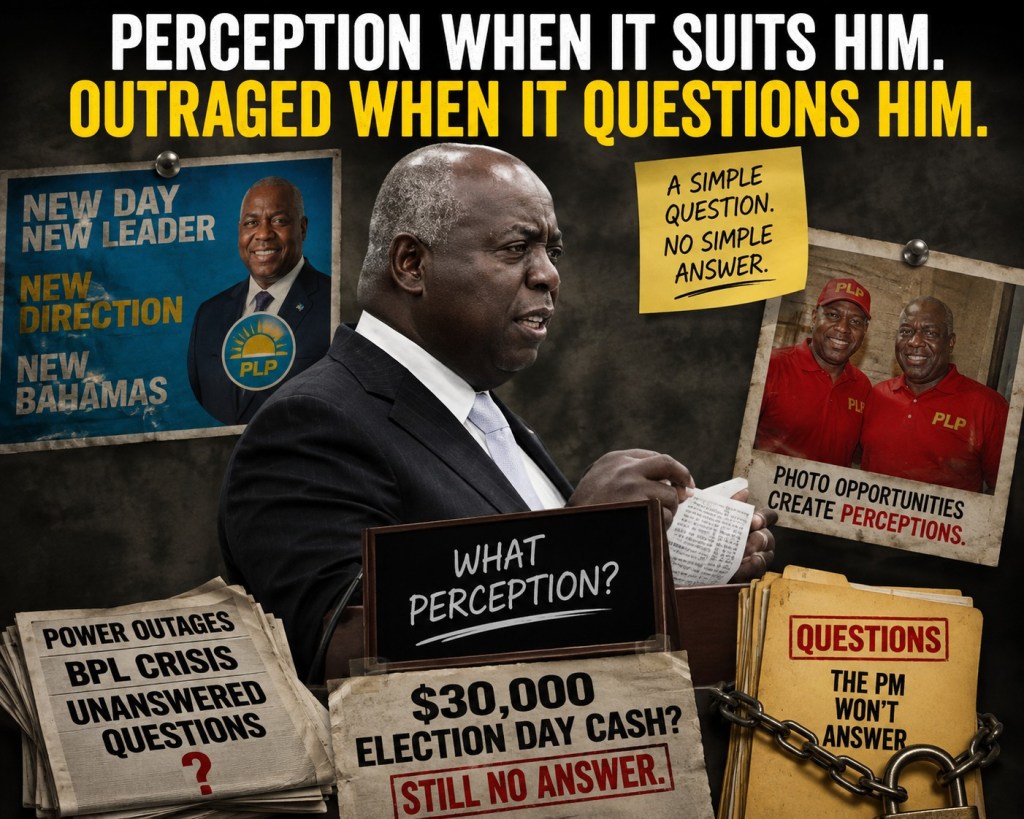
And when those questions involve a public official, a political party and a person whose killing has generated public scrutiny about his alleged connections, asking the question is precisely what journalists are supposed to do.
The Tribune has subsequently reported that sources linked Ellis to housing work in Central Pines, Abaco, in 2022, although those reported government-contract links have not been publicly confirmed by the government. Housing Minister Keith Bell reportedly neither confirmed nor denied the reports when contacted.
That makes the questions surrounding association and government dealings even more reasonable—not less
And it brings us to the question that Mr Davis’s elaborate answer failed to answer:
Did Warren “Spy” Ellis ever approach the Prime Minister in his capacity as a constituent seeking representation or advocacy?
If the answer is yes, then what did he ask the Prime Minister to advocate for?
And if the Prime Minister’s answer is that he had no personal relationship with Ellis, as he has stated publicly, then perhaps the public would benefit from a straightforward explanation of the nature and extent of any official interaction.
That would be considerably more useful than a dissertation on Westminster government.
Because, Mr Prime Minister, sometimes a simple question really does require a simple answer.
And the more complicated the answer becomes, the more questions people naturally begin to ask.
And then there is that other $30,000 question.
The Prime Minister may wish that particular issue would quietly disappear into the political Bermuda Triangle.
Unfortunately, it has not.
In May, US authorities alleged that Jonathan “Player” Gardiner, a convicted drug trafficker, was rescued after the May 12 election-day plane crash carrying approximately $30,000 in Bahamian currency. US court documents referred to an envelope bearing the handwritten name of an unidentified “Politician-1.” The identity of that politician was redacted.
In June, Gardiner’s lawyer filed a court document arguing that some of the money was campaign-related cash. That is an assertion made in a US court filing—not a proven fact—and it should be treated as such.
When asked directly about those claims, Mr Davis declined to address them.
So, no, Mr Prime Minister, nobody is saying that a photograph proves something sinister.
Nobody should.
But neither should the government behave as though asking questions about photographs, associations, contracts or unexplained money is somehow an act of political persecution.
Questions are not allegations.
Perception is not proof.
But perception is also not irrelevant.
And perhaps that is the inconvenient little lesson here.
The same political world that spends enormous amounts of time, money and effort creating perceptions cannot suddenly become offended when journalists examine the perceptions those images create.
So rather than appearing irritated that the question was asked, perhaps the Prime Minister should simply answer it.
Because every time a straightforward question receives a complicated answer, the public is left wondering whether there was actually a straightforward answer available in the first place.
And that, Mr Prime Minister, is how a question about a photograph becomes a story about why there are so many questions surrounding the photograph.
As for that $30,000 question?
Well, apparently it is still waiting for its simple answer too.
The Commonwealth of The Bahamas deserves so much better.
END
 My Morning Paper