
A word of advice to the Minister of Energy and, for that matter, to the entire Progressive Liberal Party government:
Applause from people who are impressed by failure is not evidence of success.
And when the lights are going out across the country, Bahamians are sweating in their homes and businesses are losing money, the government’s job is not to congratulate itself for being technically prepared. Its job is to keep the electricity on.
Minister of Energy, Utilities and Aviation JoBeth Coleby-Davis initially assured the country that Bahamas Power and Light was ready for the summer demand. In June, she told Parliament that BPL had sufficient generation capacity for anticipated summer peaks, citing 300MW of expected demand in New Providence against 340MW of installed capacity at the time.
Then came the summer.
And apparently, somewhere between the minister’s assurance and reality, summer changed the rules.
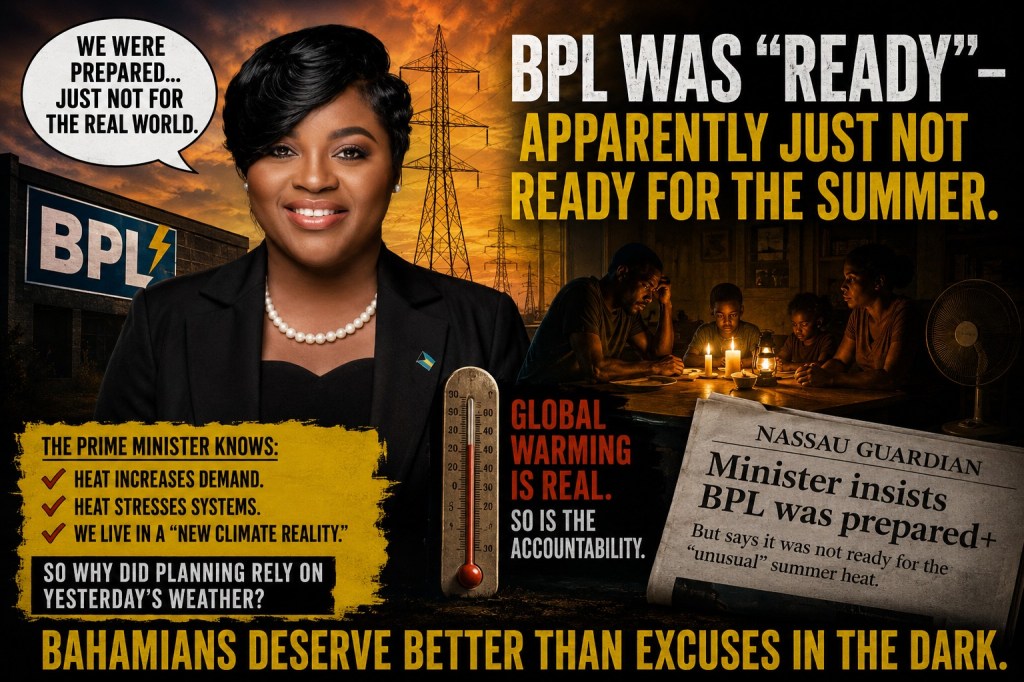
By August 31, after months of outages, the Minister conceded that officials had underestimated the impact of unusually high temperatures. She now says she has learned not to give “too much assurances.” A review is being prepared to examine peak demand, substations and the capital works required to strengthen the network.
Well, there is certainly one lesson the Bahamian people have learned:
When the Minister tells us the system is ready, perhaps we should bring a flashlight.
So, what exactly happened to the “technical advice”?
The Minister has explained that BPL’s annual summer-readiness programme was based upon historical system information.
She said June normally produced approximately four days above 90 degrees. This year, she said, there were approximately 18 such days.
She also said that the heat placed additional pressure on the system while foundational infrastructure work was taking place.
That explanation raises a rather inconvenient question:
What exactly is the purpose of preparing an electricity system for the future if the preparation is based primarily on the climate of the past?
Because this is where the government’s own rhetoric comes back to haunt it.
Prime Minister Philip Davis has spent years telling the world that The Bahamas is on the front line of climate change.
He has called climate change an “existential threat.”
He has warned internationally that The Bahamas faces a warming planet, stronger storms, rising seas and increasing climate impacts. In 2024, he told the United Nations (UN) that global temperatures had crossed the 1.5°C threshold for an entire year and argued that The Bahamas must adapt to this new reality.
And in his August 2026 national address, the Prime Minister made the connection even more directly: heat increases electricity demand, increases stress on equipment and accelerates its deterioration. He described the country as operating an old system in a “new climate reality.”
So here is the rather simple question for the Energy Minister:
If the Prime Minister understands that The Bahamas is operating in a new climate reality, why did the government’s summer-readiness planning apparently rely so heavily on the old climate reality?
Was the Prime Minister speaking about climate change to the international community while the Ministry of Energy was preparing BPL as though climate change had politely decided to take the summer off?
Because that is the contradiction Bahamians are entitled to have explained.
And then there is the matter of “assurances.”
The Minister now says:
“Don’t give too much assurances.”
That is an extraordinary lesson to arrive at after the assurances have already been given.
The public did not ask the Minister to guarantee that nothing could possibly go wrong.
They expected the government to make a competent assessment of the risks, prepare accordingly and communicate honestly.
If the Minister relied on technical advice when she assured Bahamians that BPL was ready, then the obvious question is:
Was the technical advice wrong, was the interpretation of it wrong, or was the preparation itself inadequate?
And if the answer is that the weather was simply unprecedented, then surely the next question must be:
What contingency planning existed for an unprecedented event?
That is what preparation is supposed to mean.
Otherwise, “we were prepared for normal conditions” is rather like saying a hurricane shelter was fully prepared—as long as no hurricane actually came.
Don’t throw BPL’s employees under the bus
There is another danger here.
The Minister’s explanation can easily leave the impression that BPL’s technical personnel somehow failed to appreciate what was happening.
But that would be an unfair conclusion without evidence.
The public needs to distinguish between technical staff executing an approved plan and the political leadership setting the assumptions under which that plan was developed.
The Minister herself said the summer-readiness programme was based on historical system information.
So, the proper question is not:
“Why didn’t BPL employees predict everything?”
The proper question is:
Who was responsible for ensuring that the planning assumptions reflected the climate and electricity-demand realities that this government itself has been warning the world about?
That responsibility ultimately belongs to management and political leadership—not to ordinary BPL employees who are trying to keep an aging system functioning.
The Prime Minister knows. Does the Minister?
This is perhaps the most politically awkward part of the entire episode.
Prime Minister Davis says we are living in a “new climate reality.”
The Energy Minister says BPL prepared for the summer using what had been considered normal historical conditions.
The Prime Minister says heat increases demand and accelerates equipment deterioration.
The Energy Minister says the system was prepared for what was “normally captured here,” but that the heat was unusually severe.
So which version of climate reality is the government actually planning for?
The one the Prime Minister talks about at COP conferences, or the one BPL uses when preparing its summer-readiness programme?
Because Bahamians cannot afford two climate policies—one for international speeches and another for the electrical grid.
And perhaps the most revealing development is that the government is now preparing a review to determine what went wrong, while the Minister says September is normally the system’s peak and that the lessons will be presented to Cabinet after that peak.
In other words, after the summer has already demonstrated the weaknesses of the system, we are now going to study the summer to learn how to prepare for the summer.
That would be funny if Bahamians weren’t sitting in the dark sweating.
The people deserve more than another explanation
Nobody expects BPL’s aging infrastructure to be transformed overnight.
Nobody expects the Minister to control the weather.
But the public is entitled to expect something much less ambitious:
competent planning, realistic assumptions, accountability and honesty.
The government cannot spend years telling the world that climate change is an existential threat to The Bahamas and then act surprised when extreme heat affects electricity demand.
It cannot tell Bahamians that BPL is ready and then, after months of outages, explain that the summer was simply more unusual than expected.
And it certainly cannot respond to legitimate questions about planning by allowing responsibility to drift downward onto the technicians and employees who were working within the system they were given.
The real issue is not whether anyone could have predicted the exact number of 90-degree days.
The issue is whether the government planned for a range of increasingly severe conditions consistent with the climate reality it has repeatedly told us is already here.
Because if the answer is no, then perhaps the lesson from this summer is not merely:
“Don’t give too much assurances.”
Perhaps the lesson should be:
Don’t give assurances until you have actually prepared for the reality you spent five years telling everyone else was coming.
The Bahamian people deserve better than political applause for promises that the power grid itself cannot keep.
END

