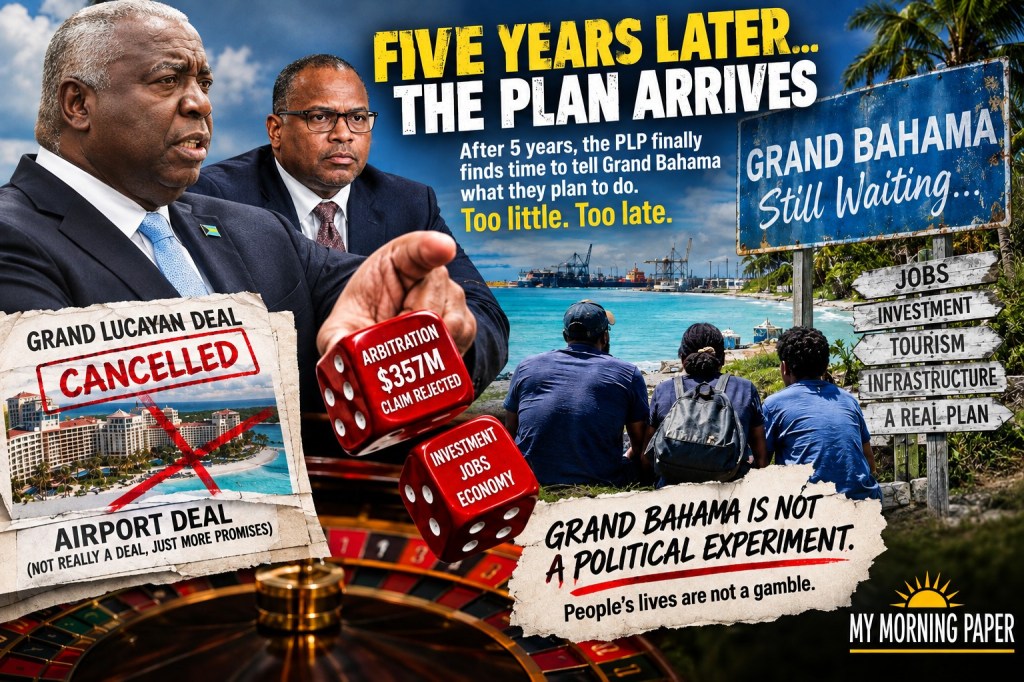
Apparently, the people of Grand Bahama must now pass a patriotism test before asking what their government has accomplished.
In his published national address on the GBPA arbitration, Prime Minister Philip Davis declared:
“I invite you to seriously rethink your priorities. There is no honour in hoping your country loses so you can score political points.”
He added:
“The Tribunal rejected the Port Authority’s arguments — and you should have, too.”
There is, of course, a difference between hoping The Bahamas loses and questioning whether the government has delivered. A prime minister should understand that distinction without requiring a tribunal to explain it unless he is hoping the average Bahamian does not.
The government is not the country. The PLP is not the country. And asking uncomfortable questions about either is not an act of national betrayal, it is simply asking for the accountability and transparency that the government promised.
Grand Bahamians can want their island to prosper while doubting the administration’s performance. They can disagree with the GBPA and still question the government’s legal strategy. Citizenship does not require anyone to applaud on cue.
What, exactly, did the government win?
The arbitration produced a mixed outcome—not the uncomplicated victory suggested by the political victory lap.
The tribunal rejected the government’s $357 million reimbursement claim under the contractual provision on which it relied. According to Davis’s parliamentary statement and reporting on the ruling, the tribunal found that a 1994 agreement had replaced that provision with a different annual-payment mechanism.
That matters. The government did not emerge from this ruling with an award ordering the GBPA to hand over $357 million.
However, it did secure meaningful legal findings. The tribunal confirmed that the GBPA’s annual-payment obligation and the contractual review mechanism remain enforceable until 2054. What additional sums might be payable through that mechanism remained to be determined; the ruling did not establish the government’s advertised recovery.
The tribunal also rejected seven of the GBPA’s eight counterclaims, rejecting its challenges to important areas of central-government authority. That was a substantial defensive success.
But the GBPA succeeded on the narrower issue of government delay in dealing with proposed environmental byelaws. Davis acknowledged that finding.
So, what did the administration gain? Confirmation of enforceable payment arrangements and important protection of governmental authority—not a $357 million payout, not ownership of the GBPA, and certainly not an automatic economic revival for Freeport.
Those are real legal gains. They are not interchangeable with jobs, functioning infrastructure or money already collected.
A tribunal ruling is not an airport terminal. A rejected counterclaim does not reopen a hotel. And “liability established” is not a deposit slip.
Consultation—or another announcement with an audience?
Now comes the promise of a “major” announcement.
The Nassau Guardian’s report, “PM expected to outline plans for GB,” quotes PLP Chairman Fred Mitchell saying Davis intends to convene a civil-society meeting involving the GBPA, its licensees and other stakeholders to discuss Freeport’s future.
But Grand Bahama Chamber of Commerce President Ralph Hepburn said the chamber had not yet been made aware of plans to meet with it.
His response deserves more attention than the promotional language:
“You’re coming to Freeport to have meetings and discussions with the stakeholders, and the chamber is not aware of it.”
An interesting approach to stakeholder engagement: announce that the stakeholders will be engaged, then allow the stakeholders to discover the engagement in the news.
To be accurate, this is not the government’s first meeting or consultation concerning Freeport. There have been earlier engagements, including a post-arbitration town hall. The criticism is therefore not that Davis has never met Grand Bahamians. It is that another promised consultation and major announcement still leave residents asking for a clear, credible programme of delivery.
Hepburn put it plainly:
“The business community in Grand Bahama is tired of announcements and pronouncements, and we just want to see things happen.”
That is not rooting against the country. That is requesting evidence.
Where is the delivery plan?
Grand Bahama’s difficulties predate this administration, and it would be inaccurate to pretend that nothing positive has happened. Major investments and reported employment improvements deserve recognition.
But inherited problems do not provide a government with an unlimited exemption from accountability. Nor does progress in some areas erase persistent questions about the airport, the Grand Lucayan and Freeport’s wider revival.
A responsible administration should prepare for the practical consequences of litigation while the litigation is underway: what happens if it wins, what happens if it loses, and what happens if—as here—the result is mixed.
The public record does not prove that the government had no internal plan. It does justify asking why residents are still awaiting a sufficiently clear public roadmap.
What will be collected from the GBPA? Through which process? On what timetable? What will it cost to pursue? And how will the legal findings translate into measurable improvements for residents?
Those are governance questions, not loyalty offences.
The prime minister need not enjoy criticism. But he should resist treating skepticism as evidence of defective priorities. Grand Bahamians have heard enough promises to know that an announcement and an accomplishment are two very different things.
The question is not whether residents will cheer the government’s claimed victory. It is what that victory actually delivers—and why they are still being asked to wait for the answer.
The people of the people of The Bahamas deserve better.
END