
Today, Fred Mitchell invokes the venerable legal maxim that one cannot approbate and reprobate at the same time — in plain English, you cannot embrace contradictory positions simply because each one happens to be politically convenient.
Well, fine, Fred.
But perhaps we should apply that same wonderfully useful principle to the Davis administration.
Because if “you can’t have it both ways” is today’s governing philosophy, then the National Investment Fund (NIF)— or, more accurately, the Government’s handling of it — would seem to deserve a seat at the front of the class.
The facts surrounding the NIF are no longer simply Opposition talking points.
Central Bank Governor John Rolle confirmed that the NIF Board of Governors had never formally convened, despite an account in the Fund’s name being maintained at the Central Bank and hundreds of millions of dollars moving through it.
The NIF Act itself assigns significant responsibilities to the Board, including responsibility concerning the Fund’s banking arrangements and its overall management.
And yet the Government says the transactions were lawful.
Finance Minister Michael Halkitis has argued that the Government was operating under parliamentary borrowing authority and the Public Finance Management Act while the NIF’s governance arrangements were still being developed.
So here is the rather inconvenient question:
If the Government insists that Pintard cannot simultaneously hold two positions on the foreign-agent issue, can the Government simultaneously say the NIF was functioning as intended while acknowledging that the statutory Board responsible for its governance had never actually convened?
That is not an accusation of fraud.
It is not an assertion that the Government has been found guilty of breaking the law.
It is a question about consistency, statutory governance and accountability.
And the numbers make the question rather difficult to sprinkle with political seasoning and serve as another bowl of word salad.
Government records showed the NIF holding approximately $265.3 million at the end of December 2025, but only about $200,000 by the end of March 2026.
The Government subsequently explained that money had been used for infrastructure projects and maintained that the transactions were authorized.
But even after the Government’s explanations, questions remained about the broader flow of funds. The Tribune reported that Halkitis accounted for approximately $310.9 million of roughly $700 million previously described as transferred to the NIF, leaving Opposition questions about the remainder. Prime Minister Davis rejected allegations of fraud but did not, in that report, address the outstanding accounting demand.
And therein lies the delicious irony.
Mitchell’s argument is essentially:
Don’t contradict yourself.
Agreed.
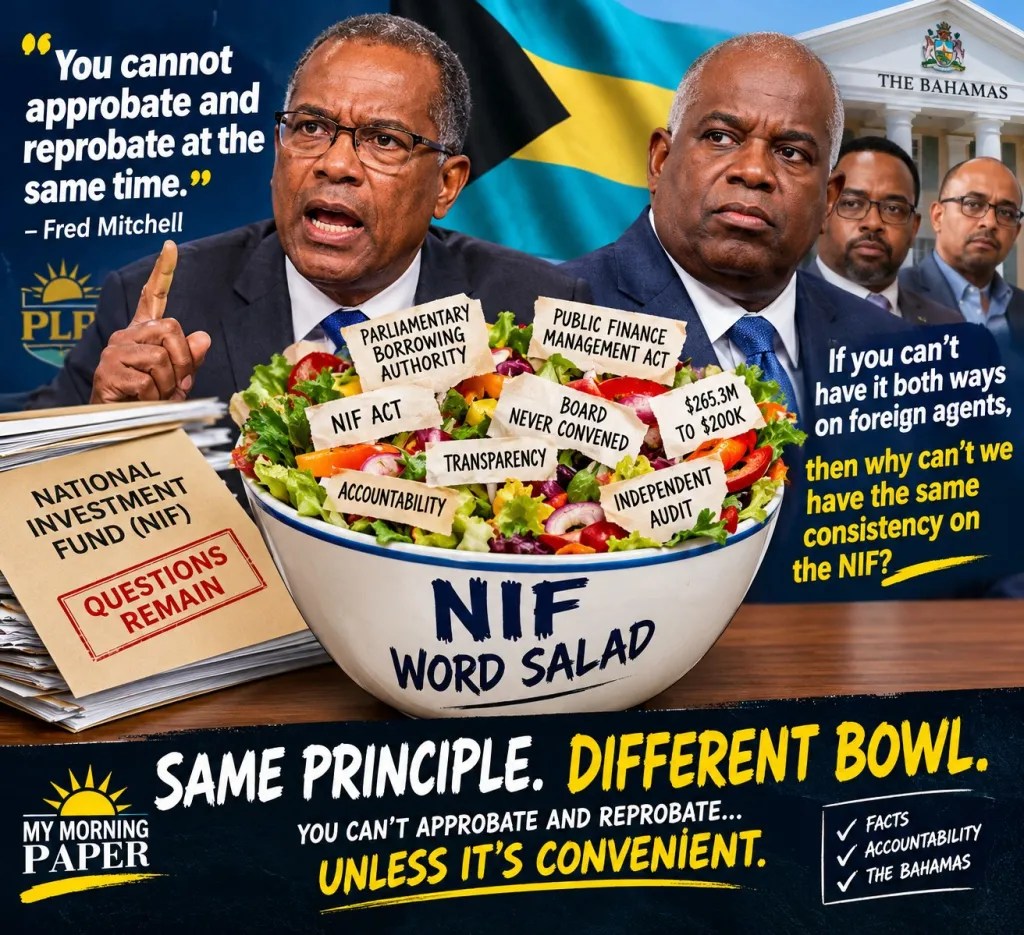
But that principle does not come with a PLP exemption clause.
If the Government demands evidence before conclusions are reached, the public should demand evidence from the Government.
If the Government says the law matters, then the public is entitled to ask how the statutory governance provisions were applied.
If the Government says the money was properly authorized, then show the authority.
If the Government says the transactions were transparent, then provide the complete accounting.
And if the Government says everything was perfectly above board, then an independent audit should hardly be treated as an act of political terrorism.
Indeed, senior banker Gowon Bowe publicly called for a full independent audit and reconciliation of NIF transactions after the Central Bank Governor’s disclosure about the Board.
So perhaps Fred Mitchell has accidentally stumbled upon a principle that is considerably more useful than he intended.
You cannot approbate and reprobate at the same time.
You cannot demand that Michael Pintard choose one side of an argument while the Government simultaneously asks Bahamians to accept one explanation concerning parliamentary authority, another concerning the NIF Act, and yet another concerning a Fund whose statutory Board had not even formally convened.
That doesn’t mean the Government has been proven guilty of wrongdoing.
It means the Government has some explaining to do.
And explaining is not persecution.
It is called accountability.
So, Mr. Mitchell, by all means, keep the legal Latin coming.
Just remember that Latin is not a substitute for an audit.
And approbate and reprobate is a principle that works rather poorly when it is applied to the Opposition but mysteriously disappears when the Government is asked to explain its own conduct.
The salad bowl, it appears, has more than one chef.
The Progressive Liberal Party (PLP) fails for one reason; it is their nature.
END

