
Attorney General Wayne Munroe essentially presents the hypothetical this way:
If a Bahamian police officer went to South Florida and secretly proposed moving 1,000 kilos of cocaine into The Bahamas, wouldn’t that officer be committing a crime under U.S. law?
Of course, the answer is potentially yes.
But that is not necessarily the proposition that the United States is advancing.
The real issue is not whether Bahamian law applies to conduct occurring in The Bahamas. It does. The issue is whether a DEA agent participating in an undercover investigation, potentially using a criminal informant and discussing a prospective drug transaction, thereby becomes guilty of the substantive Bahamian drug offence merely because the proposed transaction would violate Bahamian law.
Those are very different propositions.
The Bahamian Dangerous Drugs Act does expressly criminalize conspiracy. Section 30 provides that where two or more persons agree or act together with a common purpose in committing or abetting an offence under the Act, each can be guilty of conspiracy.
So, Munroe is not inventing the existence of a conspiracy offence.
But the government’s leap is from “the conduct described resembles conduct prohibited by the Act” to “therefore the DEA agent committed a Bahamian crime.”
That conclusion requires considerably more legal analysis than Munroe’s rhetorical question provides.
The government’s analogy is backwards
Munroe asks:
What if Bahamian officers went to Florida and secretly investigated people smuggling guns or drugs into The Bahamas?
That’s a perfectly legitimate sovereignty question.
But it doesn’t establish the government’s conclusion.
A foreign police officer conducting an investigation without authorization and a foreign police officer personally becoming a member of a criminal conspiracy are not necessarily the same thing.
Undercover policing routinely involves officers or informants discussing, facilitating or even appearing to participate in criminal conduct as part of an investigation. The legal question is whether the officer’s conduct is authorized, privileged, exempted, justified or otherwise lawful—not simply whether the words spoken resemble the elements of a criminal offence.
And that distinction becomes particularly important here because The Bahamas and the United States have an established framework for cooperation on precisely these crimes.
Here’s the inconvenient part for the government’s argument
The United States and The Bahamas have had a Mutual Legal Assistance Treaty since 1990. The treaty expressly exists to facilitate cooperation in the investigation, prosecution and suppression of serious crimes, including narcotics trafficking. It provides for the exchange of information and evidence and requires assistance to be carried out subject to the laws of the requested state.
There is also a much older and broader history of joint narcotics enforcement.
OPBAT—Operation Bahamas, Turks and Caicos—is a longstanding partnership involving U.S. agencies and Bahamian law enforcement. U.S. government records describe the program as integrating U.S. agencies with the Royal Bahamas Police Force (RBPF) to gather intelligence, conduct investigations and execute drug interdictions.
Indeed, as recently as March 2024, the U.S. Coast Guard reported a cocaine seizure in The Bahamas involving the RBPF Drug Enforcement Unit, DEA agents and other OPBAT partners.
So, the historical relationship isn’t:
America comes here and does whatever it wants.
Nor is it:
Nothing American agents do in The Bahamas can possibly implicate Bahamian law.
It is a longstanding system of cooperative law enforcement between two sovereign states.
That makes the government’s actual complaint much narrower—and much more serious:
Were these particular DEA activities authorized under the existing bilateral arrangements, and if not, what legal authority permitted them to occur?
That is the question the government needs to answer.
And this is where Munroe’s argument becomes vulnerable
The Attorney General says:
“Generally, what happens is you get the buy-in from the local law enforcement, and there is an understanding and an agreement that you will not prosecute the undercover agent.”
That statement actually exposes the real issue.
If there is normally an understanding between the two governments that undercover officers participating in controlled drug operations are protected from prosecution, then the critical question isn’t simply:
“Did the agent talk about cocaine?”
It is:
“Was this operation authorized within the bilateral law-enforcement framework, and if it wasn’t, why wasn’t it?”
That’s a considerably more sophisticated legal question than the government’s public presentation of the matter.
And interestingly, there is historical evidence that disagreements over DEA activity inside The Bahamas are hardly unprecedented. U.S. archival records from the late 1970s document Bahamian government concerns that DEA was using residents of The Bahamas as informants or agents without keeping the Bahamian government sufficiently informed. The two governments subsequently discussed the problem and sought to remedy shortcomings in cooperation.
So there really is a legitimate sovereignty issue here.
But that doesn’t automatically prove the criminal-law conclusion Munroe is suggesting.
The government also seems to be fighting the wrong battle
The most powerful argument available to the Davis administration isn’t:
“The DEA committed a crime because its agents discussed importing cocaine.”
It is:
“The United States and The Bahamas have a longstanding law-enforcement partnership governed by agreements and established protocols. If American agents conducted operations outside those arrangements without Bahamian authorization, the United States needs to explain what authority they were acting under.”
Now that is a serious diplomatic and sovereignty argument.
It doesn’t require pretending the DEA is equivalent to an ordinary drug trafficker.
And there is another uncomfortable fact the government has to confront.
The 2024 U.S. indictment doesn’t merely allege that Americans were investigating innocent Bahamians. The U.S. Department of Justice alleged that Bahamian police and other officials were actively assisting cocaine traffickers, accepting bribes and interfering with DEA investigations. The indictment specifically alleges that corrupt officials provided information about law-enforcement operations and even identified certain trafficking targets as “off limits.” Those are allegations, not established facts merely because they appear in an indictment, but they explain why U.S. investigators might have had concerns about relying exclusively on local authorities.
That doesn’t give the DEA carte blanche.
But it provides an important piece of context that the government’s argument should address rather than rhetorically bypass.
The delicious irony
Munroe says:
“If they’re only telling you that after you catch them, it’s kind of awkward.”
Exactly.
But that principle cuts both ways.
If the government believes American agents actually committed offences under Bahamian law, then the natural next question is:
Where is the prosecution?
If the government believes they violated a treaty or bilateral agreement, then:
Which provision was violated?
If the government believes they operated without Bahamian authorization, then:
What authorization was required, who was supposed to provide it, and what evidence establishes that it was absent?
And if the government believes the agents were simply operating outside normal diplomatic protocol:
Why is the matter being characterized publicly as criminal conduct rather than as a breach of an intergovernmental law-enforcement arrangement?
Those are the questions that turn a political complaint into a legally testable case.
And then there is the elephant in the room
The United States isn’t claiming that drug trafficking is somehow permissible because it occurred in The Bahamas.
The U.S. government’s position, as expressed through Ambassador Herschel Walker in the remarks you supplied, is essentially that the two countries should work together because drug trafficking threatens both countries.
That position is consistent with the longstanding bilateral narcotics relationship.
Meanwhile, the Bahamian government is saying, in effect:
“We are sovereign. You cannot conduct unauthorized operations here.”
That is a legitimate proposition.
But then comes the strawman:
“If a Bahamian officer went to Florida and conspired to import cocaine into The Bahamas, wouldn’t that be illegal?”
Yes.
But nobody needs to answer that question to resolve the actual dispute.
The actual question is whether an undercover DEA operation authorized by U.S. law but allegedly conducted without Bahamian authorization constitutes a Bahamian criminal conspiracy, a violation of a bilateral agreement, an unauthorized exercise of foreign law-enforcement authority, or some combination of those—or none of them.
Those aren’t interchangeable propositions.
And until the Davis administration identifies the precise law, treaty provision, protocol or authorization requirement allegedly breached, declaring that DEA agents “committed a crime” is more political rhetoric than demonstrated legal conclusion.
The sharper editorial point
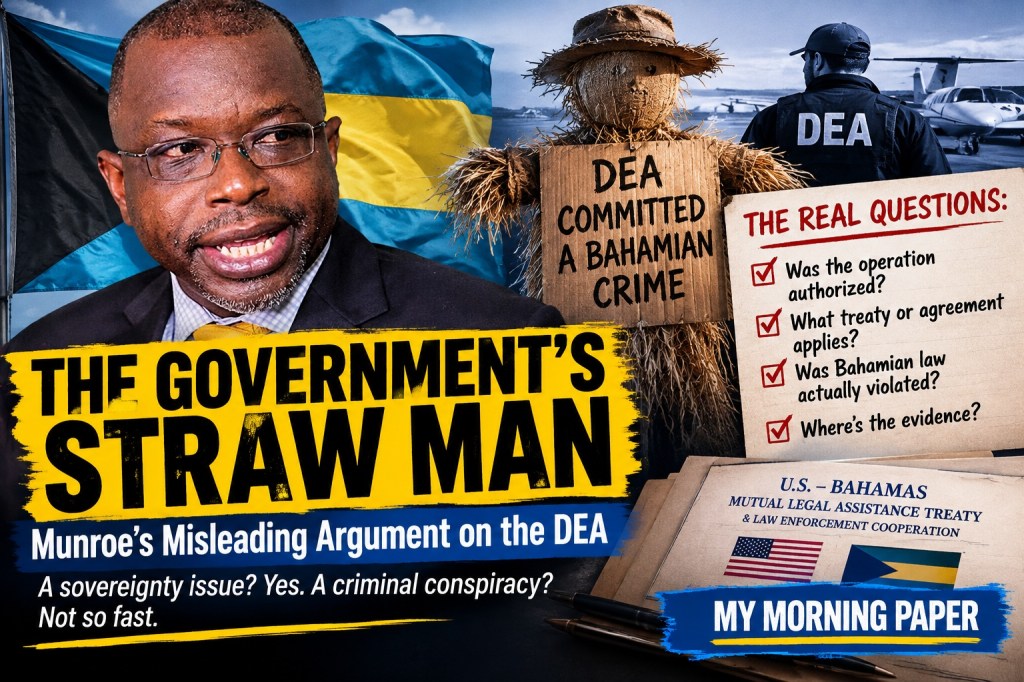
The government’s argument essentially builds a criminal straw man:
“The DEA agent talked about importing cocaine, therefore the DEA agent conspired to import cocaine.”
But an undercover investigator’s participation in an investigation cannot be analyzed solely by repeating the words spoken during the investigation. Otherwise, every undercover police officer who agrees to buy drugs has just become a drug dealer.
The real question is authority.
And that is where the Davis administration should put its evidence on the table.
Because sovereignty is not strengthened by exaggerating the opposing argument.
It is strengthened by demonstrating, precisely and legally, what authority the Americans had, what authority they didn’t have, what agreement governed the operation, what Bahamian law was allegedly violated, and what remedy the government is actually seeking.
Otherwise, the government’s argument risks becoming the political equivalent of knocking down a cardboard version of the DEA while leaving the actual legal question standing untouched.
END

