
There are moments in our politics when you have to stop, take a deep breath and ask yourself:
Haven’t we seen this movie before?
Only the actors have changed.
Today, the Davis administration, through Bahamian Ambassador to the United States Wendall Jones, is accusing so-called “rogue” DEA agents of operating in The Bahamas without the permission of the Bahamian government and of “destabilizing” the government and good governance in the country.
That is an extraordinarily serious allegation.
And, quite frankly, the Bahamian people deserve considerably more than the political equivalent of smoke signals.
Ambassador Jones reportedly told U.S. officials that the DEA does not possess independent extraterritorial police powers and that American agents cannot simply operate in The Bahamas without the appropriate legal authority.
Fine.
Then tell us precisely what they did.
Not the political version.
Not the diplomatic version.
Not the carefully polished version designed to make the government sound like the defender of Bahamian sovereignty.
The legal version.
Which agents?
What operations?
When did they occur?
Where did they occur?
What Bahamian law was violated?
What treaty provision was breached?
What agreement was ignored?
What authorization was required?
Who was supposed to authorize it?
Was authorization requested and refused?
Were Bahamian police officers deliberately excluded?
Were Bahamian government officials deliberately deceived?
Were arrests or seizures actually conducted by American personnel on Bahamian territory?
And, most importantly:
What exactly does the Davis administration mean when it says these operations were “destabilizing” the government?
Because that word has a rather interesting history in PLP politics.
Back in 2016, during the Christie administration, the PLP itself was using remarkably similar language.
Education Minister Jerome Fitzgerald accused Save the Bays (STB) of being part of a scheme to “destabilise” and “overthrow” the Bahamian government, alleging that foreign money was being used against the Christie administration. The government also sought scrutiny from the FBI, IRS and U.S. State Department into the alleged activities.
And what was at the centre of that political firestorm?
The increasingly bitter battle involving environmental group Save the Bays (STB), billionaire Louis Bacon and fashion mogul Peter Nygard.
The Tribune reported at the time that Fitzgerald accused Save the Bays (STB) of working toward the government’s downfall, while Fred Mitchell questioned whether the organisation was a legitimate environmental group or an attempt to “subvert” parliamentarians.
Save the Bays (STBs), naturally, denied the allegations and called the suggestion that it was plotting to overthrow the government “totally untrue.” The organisation actually welcomed an FBI investigation.
So here we are, roughly a decade later.
Different government.
Different controversy.
Different alleged foreign actors.
But somehow the vocabulary has come full circle:
Foreign activity.
Sovereignty.
Government destabilisation.
Outside interference.
National security.
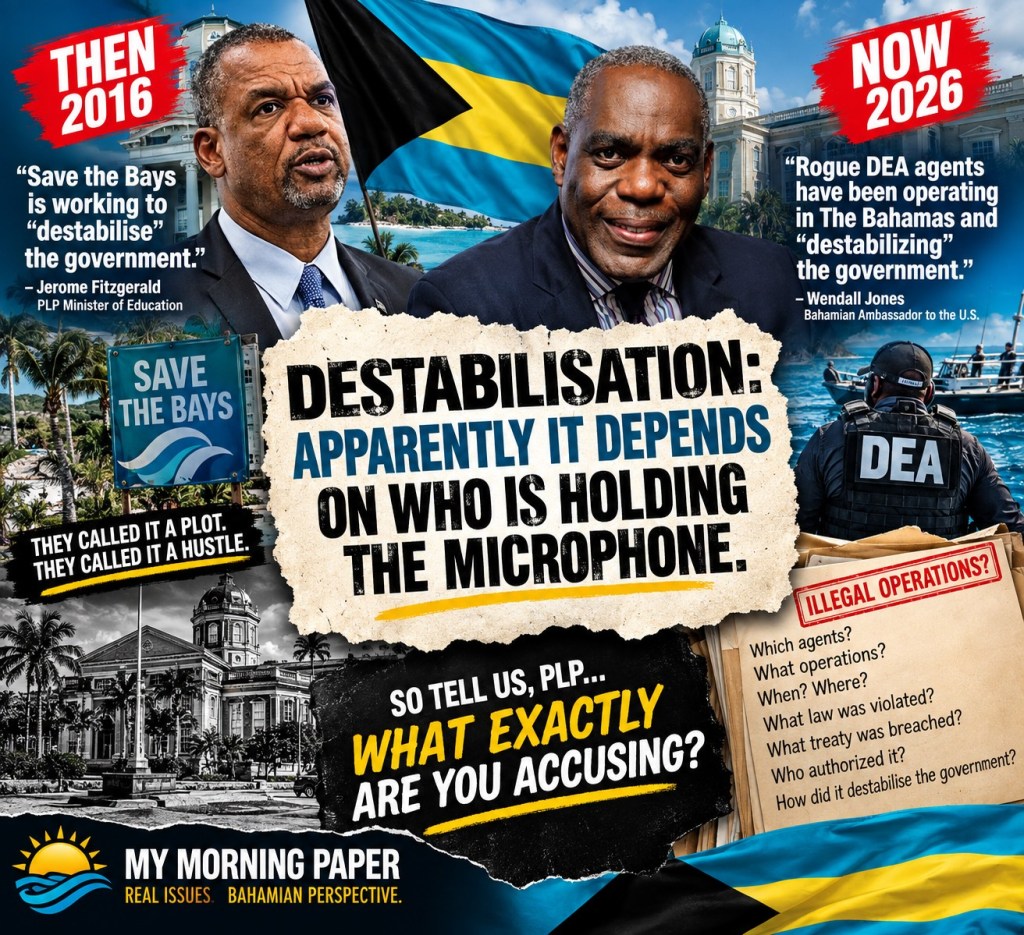
Apparently, “destabilisation” is one of those wonderfully elastic Bahamian political words.
When the PLP is accusing somebody else of doing it, it is apparently a national emergency.
When the PLP is accused of something, suddenly we need to have a seminar on context, jurisdiction and sovereignty.
This is where the Davis administration needs to be very careful.
Because there is a perfectly legitimate national-security argument available to the government.
If foreign law-enforcement personnel actually operated inside The Bahamas without the consent required under the applicable agreements, then that is a serious sovereignty and jurisdictional question.
No serious Bahamian should object to the government asking Washington to explain itself.
But the same standard of seriousness has to apply in reverse.
The government’s allegation does not become established fact simply because a Bahamian ambassador says it.
The U.S. ambassador, Herschel Walker, has publicly rejected the accusation and described it as “fake news.”
And there is another inconvenient fact sitting right in the middle of this controversy:
The Bahamas and the United States have had decades of formal counternarcotics cooperation.
OPBAT — Operation Bahamas, Turks and Caicos — is a longstanding multinational counternarcotics operation. U.S. Justice Department material describes it as operating under an agreement involving the United States, The Bahamas and the United Kingdom, while Bahamian government documentation lists multiple bilateral and trilateral agreements governing narcotics and maritime-law cooperation.
So, the question isn’t whether American law-enforcement cooperation with The Bahamas is legitimate.
It plainly exists.
The question is whether particular American personnel went outside the authority granted by those agreements.
That is a question capable of being answered.
And it should be answered.
But here is the part that should make all us Bahamians pays attention.
The present controversy arises against the backdrop of an extraordinary U.S. narcotics investigation.
U.S. court filings allege that an unnamed Bahamian politician — identified only as “Politician-1” — met an undercover DEA source and a pilot inside a Bahamian Parliament building in October 2024 to discuss an alleged cocaine shipment. The allegations remain allegations, and the politician has not been publicly identified.
The U.S. Justice Department has separately alleged extensive corruption involving certain Bahamian officials and narcotics trafficking, while acknowledging the longstanding OPBAT relationship between the two countries.
That means there are two separate questions.
First:
Did American agents operate unlawfully in The Bahamas?
Second:
What, exactly, were those agents investigating?
The first question concerns Bahamian sovereignty.
The second concerns allegations of potentially extraordinary corruption and narcotics trafficking.
Neither question should be buried beneath the other.
And neither should be converted into a political smoke bomb.
The fact is that the government cannot have it both ways.
If the Davis administration believes that American agents broke Bahamian law, produce the legal argument.
If a treaty was violated, identify the treaty.
If a memorandum of understanding was breached, identify the provision.
If permission was required, identify the permission.
If Bahamian authorities were deliberately excluded, tell the Bahamian people who was excluded and from what.
If arrests or seizures were conducted without authority, identify them.
If evidence was obtained unlawfully, explain how.
And if the word “destabilising” is being used in its ordinary political sense rather than as diplomatic theatre, then explain exactly how these alleged DEA activities destabilised or have the potential to destabilize the Government of The Bahamas.
Because there is an enormous difference between:
“Foreign agents allegedly violated Bahamian jurisdiction,”
and
“Foreign agents are destabilising the Bahamian government.”
The first is a legal allegation.
The second is a political allegation.
The Bahamian people deserve to know which one the government is actually making.
The irony is almost too perfect.
In 2016, a PLP government accused a foreign-funded organisation and its associates of attempting to destabilise the government.
Today, another PLP government is complaining that foreign law-enforcement activity is destabilising the government.
Apparently, “destabilisation” has survived successive political generations rather better than some government policies.
The difference, of course, is that the government is now on the receiving end of the accusation.
And perhaps that explains the sudden sensitivity.
But if sovereignty mattered in 2016, it matters in 2026.
If foreign interference was unacceptable then, it is unacceptable now.
If independent investigations were necessary then, they are necessary now.And if allegations needed evidence then, they need evidence now.
That is what consistency looks like.
Anything else is simply political convenience wearing a national flag.
SO, MR. AMBASSADOR — SHOW US THE RECEIPTS
There is nothing unreasonable about the Bahamas demanding that the United States respect Bahamian sovereignty.
But sovereignty is not a magic word that ends an argument.
It begins one.
So let us have the documents.
Let us have the agreements.
Let us have the legal provisions.
Let us have the dates.
Let us have the operations.
Let us have the evidence.
And, most importantly, let us have an explanation of exactly how these alleged operations “destabilised” the Government of The Bahamas.
Because Bahamians have heard this word before.
They heard it when the Christie administration was fighting with Save the Bays.
They heard it when Louis Bacon, Peter Nygard, environmental advocacy and foreign money became entangled in one of the country’s ugliest political controversies.
And now they are hearing it again.
Only this time the alleged destabilising force is not an environmental organisation.
It is the United States Drug Enforcement Administration.
Well then.
Bring on the evidence.
If the DEA broke Bahamian law, prosecute the issue through the proper diplomatic and legal channels.
If the treaties were violated, invoke them.
If Bahamian sovereignty was breached, defend it.
But please spare the Bahamian people the political theatre.
Because after decades of governments telling us that somebody, somewhere, is trying to “destabilise” The Bahamas, the obvious question has finally become unavoidable:
What does “destabilisation” actually mean when the people making the accusation happen to be the people running the government?
And perhaps even more importantly:
Does the PLP believe in this principle because it is a principle — or because, this time, the accusation is being made against them?
The Commonwealth of The Bahamas deserves better.
END

