
Prime Minister Philip “Brave” Davis has apparently discovered the international equivalent of the Ten Commandments.
Rules.
Lots of them.
He took to the United Nations and delivered a magnificent sermon on the importance of the rules-based international order.
And frankly, it was quite a speech.
The Prime Minister told the world that “great powers can survive the end of the rules. Small states cannot.”
He declared that rules must bind the strong as firmly as the weak.
And then came the line that should probably be framed in gold and hung somewhere inside the Cabinet Office:
“International order, where rules apply only to the weak, is not order. It is a hierarchy.”
Bravo.
Standing ovation.
Somebody get that man a cape.
Because apparently the Prime Minister has finally discovered the very thing that Bahamians have been begging governments to discover for decades:
THAT RULES MATTER.
And Attorney General Wayne Munroe has now joined the theological revival.
Defending the government’s complaint over undercover US DEA operations in The Bahamas, Mr. Munroe declared that “every country has laws and procedures that must be respected.”
Again:
Absolutely.
Could not agree more.
There is just one tiny, microscopic, almost embarrassingly inconvenient question.
Does that principle also apply when the government itself is holding the pen?
Because this is where the Davis administration’s love affair with rules becomes rather complicated.
Apparently, when the United States is operating in The Bahamas, the rules must be respected.
When foreign governments operate in Bahamian territory, sovereignty matters.
When great powers disregard the rules, small countries suffer.
When America does something, the Bahamian government doesn’t like, suddenly the Constitution, treaties, jurisdiction and sovereignty are hotter than a Junkanoo rush-out.
Excellent.
But what happens when the government of The Bahamas is the one operating outside the rules?
Do we still get the same enthusiasm?
Or does the rulebook suddenly become more of a suggestion booklet?
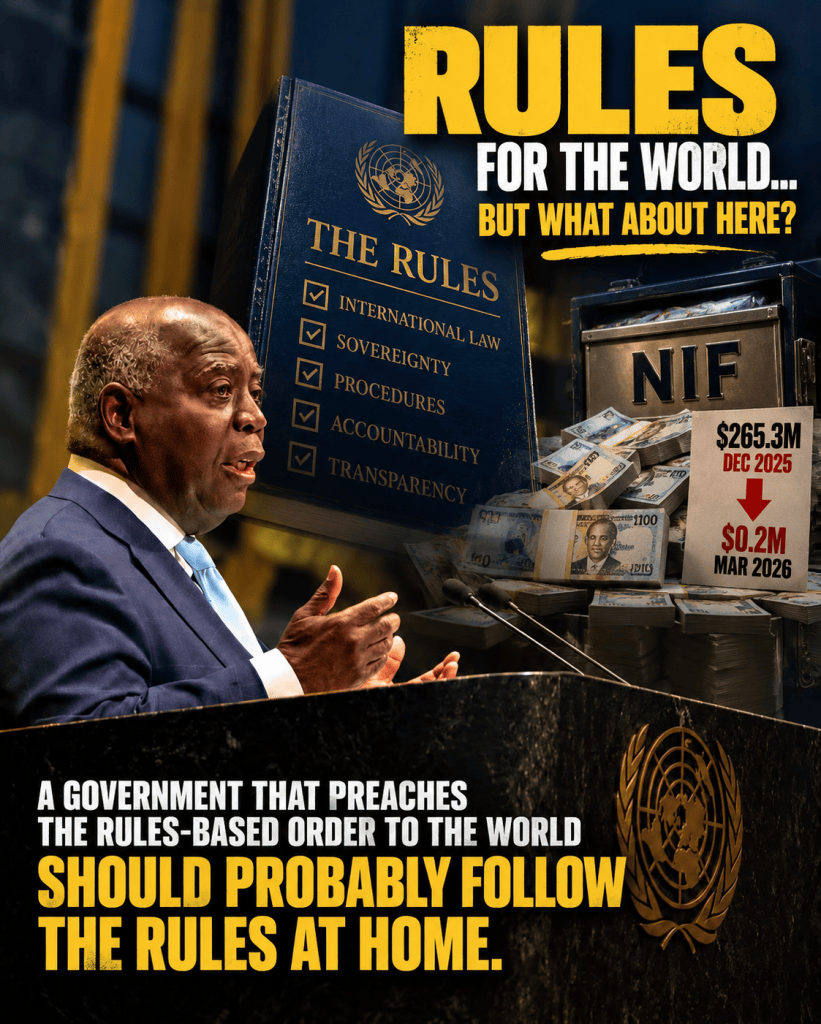
Consider the National Investment Fund.
This is not some $20,000 petty-cash drawer hidden beneath Michael Halkitis’ desk.
We are talking about hundreds of millions of dollars of public money.
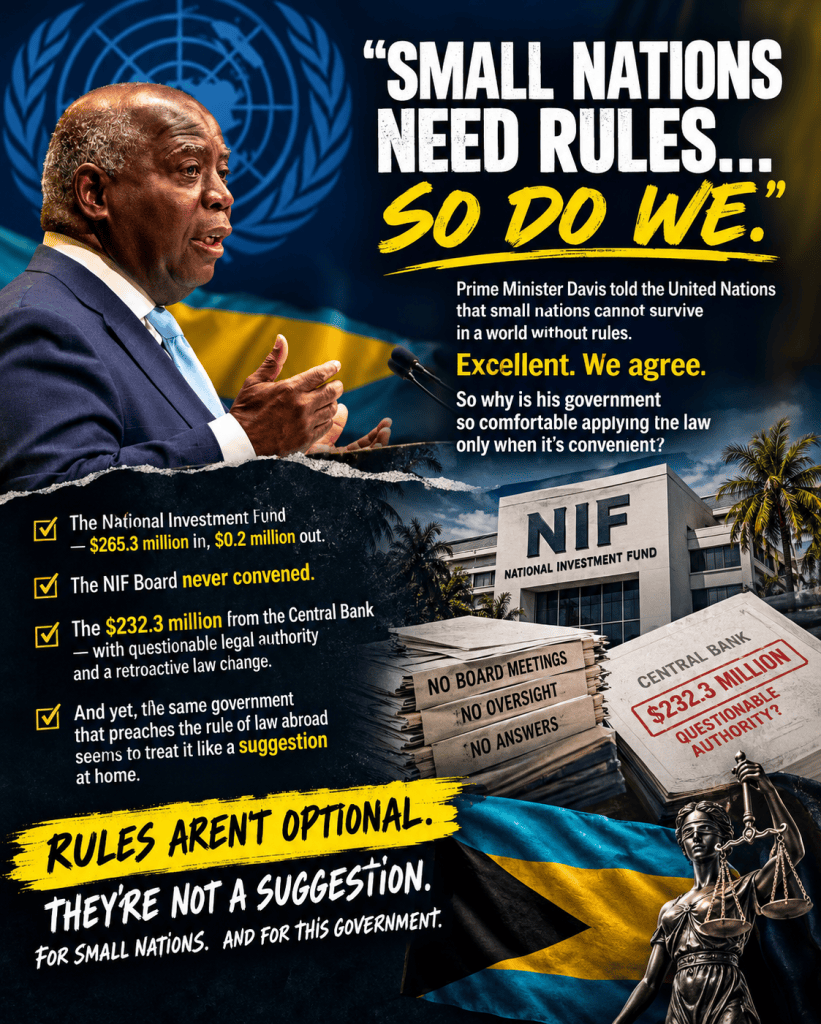
Government financial reports showed approximately $265.3 million in the NIF at the end of December 2025. By the end of March 2026, approximately $200,000 remained.
That’s a rather spectacular disappearing act.
David Copperfield might have taken notes.
Then came the Central Bank Governor, John Rolle.
And this is where the plot becomes particularly uncomfortable.
Governor Rolle confirmed that although he had been appointed to the NIF Board, the Board had never formally convened to deal with any matter.
Meanwhile, the Central Bank confirmed that an account bearing the name “National Investment Fund” existed and that transactions began through that account in July 2025.
Now, before anybody starts screaming “FRAUD!” from the top of Parliament, let’s be precise.
The Central Bank Governor did not declare the transactions illegal.
The government has also rejected the allegation that it broke the law.
Finance Minister Michael Halkitis says the government relied upon parliamentary borrowing authority and the Public Finance Management Act while the NIF’s governance arrangements were still being developed. He has insisted that no law was broken.
Fine.
That is the government’s position.
But here is the rather irritating little problem with that explanation:
The National Investment Funds Act actually provides for a Board of Governors to govern and manage the Fund, including responsibilities concerning its banking and investment arrangements.
And according to the Central Bank Governor:
the Board never formally met.
So naturally the Bahamian public is asking the completely unreasonable question:
Who was actually authorising what?
Who controlled the account?
Who authorised the transactions?
Who approved the transfers?
Under what statutory authority?
And where, exactly, did all the money go?
These are not partisan questions.
They are the kinds of questions people ask when hundreds of millions of dollars of public money are involved.
Apparently, asking where the money went is now considered political theatre.
Imagine that.
But the NIF isn’t the only time the Davis administration has had an interesting relationship with statutory authority.
Back in December 2022, the Central Bank reported a $232.3 million drawdown in IMF Special Drawing Rights by the Government. The Central Bank’s subsequent reporting described the SDR arrangement as a loan to the Government.
The controversy wasn’t simply that the money existed.
The controversy concerned the legal framework governing the government’s access to Central Bank financing.
And Parliament subsequently amended the Central Bank Act to address the legal framework surrounding the government’s access to the SDR allocation.
That distinction is important.
Because anyone saying flatly:
“The Davis government illegally borrowed $232.3 million from the Central Bank”
is going further than the evidence allows.
But anyone pretending there was never a legal-authority question is also conveniently forgetting an important part of the story.
The issue was serious enough to require legislative intervention.
So here we are again.
Rules.
Procedures.
Statutory authority.
Parliament.
Legal interpretation.
And eventually:
an amendment to the law.
Which brings us back to our Prime Minister’s United Nations lecture.
Maybe we have misunderstood Prime Minister Davis.
Perhaps what he actually means is:
Rules must bind the strong as firmly as the weak — particularly when the strong are somebody else.
Because when the United States is involved:
“Our laws must be respected.”
When great powers disregard international rules:
“Small states cannot survive without them.”
When powerful countries ignore sovereignty:
“That is not order. It is hierarchy.”
But when questions arise about the government’s own statutory procedures?
Suddenly there is a PowerPoint presentation about context.
Then a minister explains the intention.
Then somebody explains what Parliament meant.
Then somebody else explains what the law really says.
And eventually, somewhere in the distance, you can hear the faint sound of another regulation being drafted.
This is not how the rule of law is supposed to work.
The rule of law is not:
“First we act, then we explain.”
It is not:
“The money has moved, now let’s determine which statutory provision makes everyone comfortable about why it moved.”
And it certainly isn’t:
“Trust us. We have legal advice.”
The whole point of statutory safeguards is that governments are not supposed to be trusted simply because they say they can be trusted.
That is why there are laws.
That is why there are boards.
That is why there are committees.
That is why there are parliamentary procedures.
That is why there are audits.
That is why there are institutions designed specifically to prevent politicians from saying:
“Don’t worry. We got this.”
And this is the delicious irony.
I don’t have to invent an argument against Prime Minister Davis.
He already made the argument himself.
He told the United Nations:
“Every rule you break today is a rule you will need tomorrow.”
Well, Mr. Prime Minister…
Precisely.
That is the point.
Because the rules you defend when speaking to the world are the same rules Bahamians expect your government to respect when operating at home.
You told the world:
“A world without rules is not a free world.”
Agreed.
But a government that treats statutory safeguards as optional whenever administrative convenience demands it doesn’t exactly inspire confidence in the rules-based order either.
And Attorney General Munroe says:
“Every country has laws and procedures that must be respected.”
Again:
Correct.
So, let’s try something radical.
Let’s respect ours.
Not just America’s.
Not just international treaties.
Not just the UN Charter.
Not just the rules that make a magnificent speech sound magnificent.
Our rules.
The Bahamian rules.
The ones passed by the Bahamian Parliament.
The ones that apply when government is spending Bahamian taxpayers’ money.
The ones that establish checks and balances precisely because politicians — regardless of party — should never be allowed to become the final judge of their own compliance.
Prime Minister Davis is absolutely correct about one thing:
Small nations need rules.
But here’s the uncomfortable sequel to that sentence:
Small nations also need governments that obey them.
Because if rules are sacred when America allegedly violates them…
If sovereignty is sacred when foreigners operate on Bahamian soil…
If procedure is sacred when dealing with the United States…
If international law is sacred when addressing the United Nations…
then surely statutory law should be sacred when the Government of The Bahamas is moving hundreds of millions of dollars.
Otherwise, we are left with something that looks suspiciously like the very hierarchy the Prime Minister warned the United Nations about.
Except this time the hierarchy isn’t:
big country versus small country.
It’s:
government versus governed.
And that is a much more dangerous distinction.
Because the Bahamian people don’t need a government that merely speaks beautifully about the rule of law.
They need one that can demonstrate — transaction by transaction, dollar by dollar, statute by statute — that it actually lives by it.
So, Prime Minister…
You have already given us the standard.
You said:
“Every rule you break today is a rule you will need tomorrow.”
Excellent.
We agree.
Now let’s apply that philosophy somewhere incredibly radical.
Here.
At home.
In The Bahamas.
Inside the government.
Where the cameras are not from the United Nations…
And where the people asking the questions aren’t foreign diplomats…
They’re Bahamians.
Because if a small nation cannot survive without rules, then perhaps its government should stop treating compliance with those rules like an optional upgrade package.
The world is watching, Mr. Prime Minister.
But more importantly: So are many right-thinking Bahamians.
The Commonwealth of the Bahamas deserves so much better.
END

