
There is one rather elementary principle that the Chairman of the Progressive Liberal Party (PLP), Fred Mitchell, might want to consider:
The PLP cannot always be right.
It is a remarkably simple concept. Governments make mistakes. Ministers make mistakes. Political parties make mistakes. And, occasionally, governments are asked questions that cannot be answered by accusing the person asking them of being politically motivated.
Unfortunately, this apparently revolutionary concept seems to have escaped Mr. Mitchell.
His latest attack on The Nassau Guardian Executive Editor Ms. Candia Dames — and, more broadly, those who continue to ask questions about the National Investment Fund (NFI) — is therefore rather revealing.
According to The Nassau Guardian, Mitchell accused Free National Movement (FNM) Leader Michael Pintard, the FNM and Candia Dames of “moving the goalposts,” claiming that they “can never get it right” and that they began with a “false premise” before supposedly shifting their argument.
Well, splendid.
But there is a small problem with that defence.
What, precisely, was the “false premise”?
What exactly was the “falsehood”?
And, most importantly, where is the government’s detailed answer to the questions that caused the controversy in the first place?
Because calling journalists and political opponents “desperate” does not constitute an audit.
Calling questions “moving the goalposts” does not explain where the money went.
And attacking Candia Dames does not suddenly make the National Investment Fund (NFI) controversy disappear.
The controversy is not some imaginary creation of the opposition nor of the press.
The Government itself has acknowledged that approximately $700 million in excess borrowing proceeds were transferred to the NIF. Prime Minister Philip Davis has argued that the transfer was authorised by Parliament and consistent with the Public Debt Management Act and the NIF Act.
Fine.
Then explain it.
The problem became considerably more complicated when Central Bank Governor John Rolle confirmed that the NIF Board had never been formally convened, while an account in the name of the National Investment Fund (NFI) had nevertheless recorded transactions.
And the NIF Act is not exactly silent about governance. It establishes a Board of Governors and assigns the Board responsibility for the Fund’s banking and investment arrangements.
Then came another rather inconvenient fact.
Government financial reports showed approximately $265.3 million in the Fund at the end of December 2025, falling to approximately $200,000 by the end of March 2026.
That is not a small accounting footnote.
That is the sort of number that tends to attract questions.
And questions are precisely what the press, the Opposition and right-thinking Bahamians are supposed to ask.
SO, MR. MITCHELL, WHAT IS THE “FALSEHOOD”?
If Mr. Mitchell believes Candia Dames and others have got the story wrong, then there is an extraordinarily simple way to settle the matter:
Show the documents.
Show the legal authority.
Show the Board resolutions.
Show when the Board met.
Show who authorised the account.
Show who authorised the transfers.
Show the investment decisions.
Show where the money went.
Show the project-by-project expenditure.
Show the accounting.
Show the audit.
Then the argument can be settled with something considerably more persuasive than a voice note accusing journalists of moving goalposts.
Because here is the funny thing about goalposts:
They are supposed to remain in the same place.
The questions have not suddenly changed because the answers have become inconvenient.
The questions have evolved because new information has emerged.
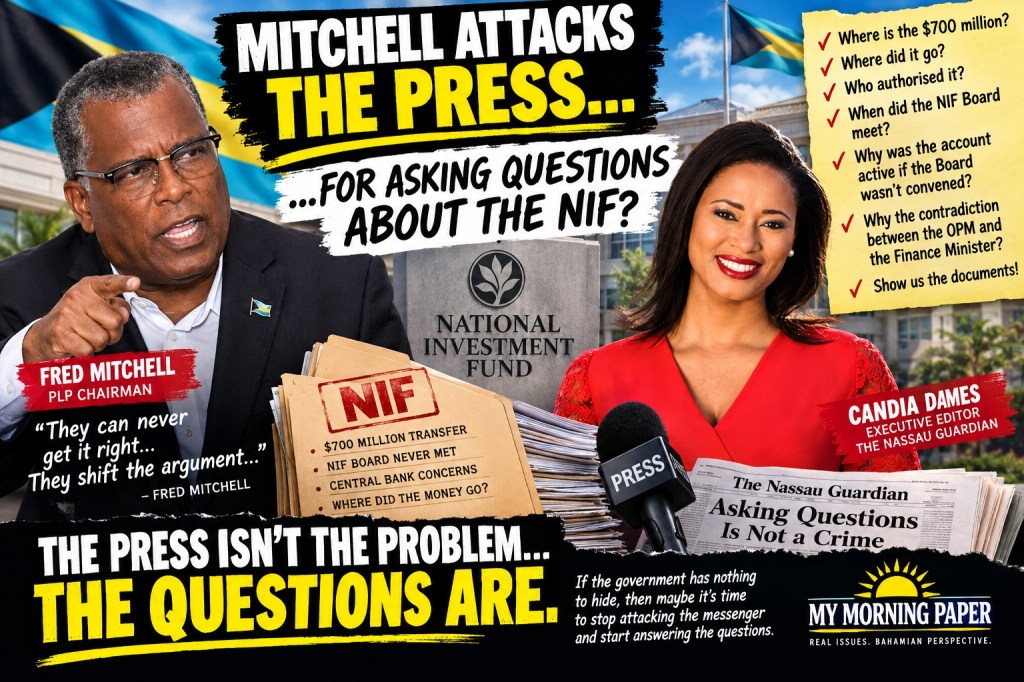
First, there were questions about the $700 million.
Then questions about the NIF’s governance.
Then the Central Bank Governor confirmed that the Board had not been formally convened.
Then questions arose about how an account bearing the NIF’s name was operating.
Then questions arose about the dramatic reduction in the Fund’s balance.
Then questions arose about how the money was actually used.
That isn’t “moving the goalposts.”
That is called following the evidence.
And this is where Mr. Mitchell’s attack on Candia Dames becomes particularly curious.
When a journalist asks uncomfortable questions about the management of public money, the appropriate response from a government is not:
“How dare you ask?”
It is:
“Here are the answers.”
The press is not required to accept the government’s explanation simply because the government has issued one.
Nor is the Opposition required to stop asking questions because a government minister finds the questions irritating.
And Candia Dames does not need permission from Fred Mitchell to ask questions about the administration of public affairs.
That is quite literally part of the job.
Indeed, the Government’s own Finance Minister has now acknowledged the principle rather neatly: “It’s their job to ask these questions. It’s our job to answer them.”
There it is.
Perhaps somebody should print that sentence, frame it and hang it prominently in Mr. Mitchell’s office.
THE GOVERNMENT DOES NOT OWN THE TRUTH
There seems to be a recurring misunderstanding in Bahamian politics that criticism of the government somehow constitutes an attack on The Bahamas.
It does not.
The PLP is not The Bahamas.
The Prime Minister is not The Bahamas.
Fred Mitchell is certainly not The Bahamas.
The Bahamian people are.
And when hundreds of millions of dollars of public money are involved, Bahamians have every right to ask where it came from, where it went, who authorised it, under what legal authority it was moved and whether the statutory safeguards were followed.
Those are not partisan questions.
They are accountability questions.
And if the government’s answers are solid, documented and lawful, then the questions should be relatively easy to dispatch.
But attacking the journalist asking the question?
That merely creates another question:
Why attack the question when you could simply answer it?
Here is a novel thought, perhaps the goalposts aren’t moving at all.
Perhaps the public is simply getting closer to them.
And perhaps what Mr. Mitchell finds so irritating is not that Candia Dames has changed the argument, but that the argument has become increasingly difficult to dismiss.
The Government says there is nothing to hide.
Excellent.
Then hide nothing.
Publish the documentation.
Explain the transactions.
Explain the governance.
Explain the apparent contradiction between the statutory framework and what actually occurred.
Explain where the money went.
And let the public decide.
Because in a functioning democracy, the government does not get to declare itself correct and then demand that everyone else stop asking questions.
That is not accountability.
That is political theatre.
And Bahamians have seen enough theatre.
They are asking for the receipts.
Mr. Mitchell can call that “moving the goalposts” if he wishes.
The rest of us might simply call it journalism and a request for accountability and transparency; as was promised.
So, this continuous attack on a FREE press for simply doing their job is only a step closer to fascism.
The Bahamian people deserve so much better.
END

