
An Editorial on Political Amnesia, National Debt, and the Convenient Mathematics of Governance
There is a certain kind of political theatre that could only be performed with a straight face and a sufficiently selective memory.
It is the performance in which a government spends years explaining why its predecessor was fiscally irresponsible, only to find itself standing in the very same financial quicksand—now insisting that the water level is perfectly acceptable because someone has produced a calculator.
Welcome to the latest episode of The Davis Administration Presents: Debt, But Make It Sound Responsible.
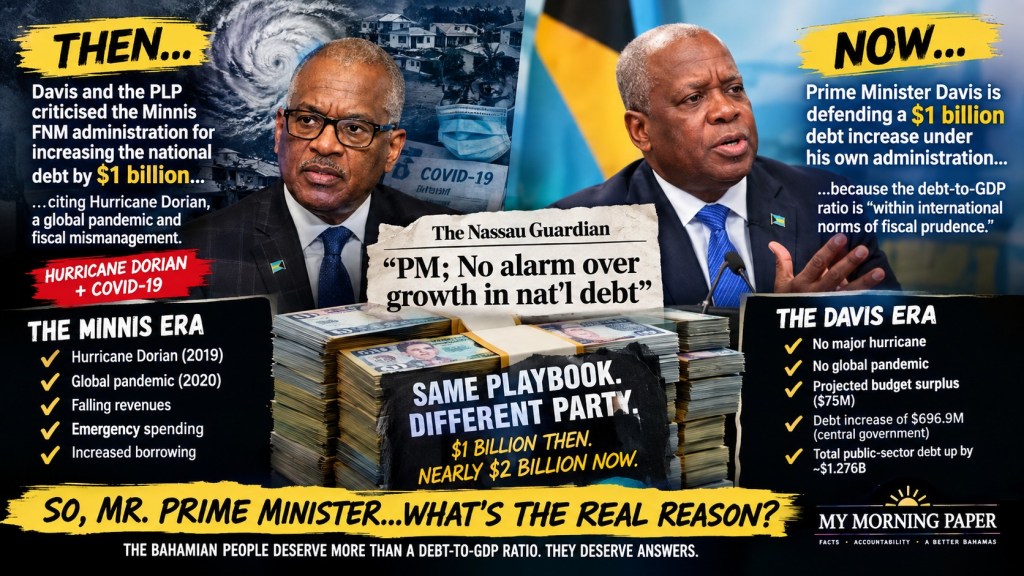
During the Minnis administration, Philip Davis and the Progressive Liberal Party criticised the Free National Movement (FNM) government over its borrowing and fiscal management. That criticism must be considered in the context of the extraordinary circumstances facing the Minnis administration, including Hurricane Dorian in 2019 and the COVID-19 pandemic beginning in 2020.
The economic consequences of those events were significant. Government revenues fell, public spending increased, and borrowing became necessary to finance emergency measures and protect the economy.
That context does not mean every financial decision made by the Minnis administration should be exempt from scrutiny. It does, however, mean that comparing its debt accumulation without acknowledging those circumstances would provide an incomplete and misleading picture.
And now, ladies and gentlemen, we arrive at the present administration where the prime minister has discovered the magic of the debt-to-GDP ratio.
According to the Nassau Guardian article titled “PM: No alarm over growth in nat’l debt,” Prime Minister Philip Davis defended the growth in national debt by pointing to the country’s expanding economy and declining debt-to-GDP ratio.
The Prime Minister reportedly said:
“When you talk about debt, you have to look at what the ratio of our debt is to our GDP.”
He further pointed to the debt-to-GDP ratio when the PLP assumed office, compared with the ratio during the Minnis administration’s final year.
The underlying economic principle is valid: Debt-to-GDP is an important measure of a country’s ability to manage its debt relative to the size of its economy.
But here’s where the conversation requires more than a carefully selected statistic.
A lower debt-to-GDP ratio does not mean that additional borrowing is cost-free, that the money was spent efficiently, or that the government has answered questions about its spending decisions.
A ratio is a measurement. It is not a certificate of good governance.
Here is what the numbers of the official data actually show:
The government’s Fourth Quarter 2025/26 Public Debt Statistical Bulletin, published in August 2026, reports the following:
| Indicator | Reported figure |
| Central government debt at end-June 2026 | $12.466 billion |
| Increase in central government debt during FY2025/26 | $696.9 million |
| Annual increase in central government debt | 5.9% |
| Central government debt as a percentage of GDP | Approximately 70.7% |
| Increase in outstanding public-sector debt during the year | Approximately $1.276 billion |
Here is an important distinction: The reported $696.9 million increase in central government debt is not the same as a $2 billion increase in a single fiscal year. The broader public-sector debt figure increased by approximately $1.276 billion over the year.
That distinction matters because responsible criticism requires accurate numbers—even when the political target is deserving of scrutiny.
The government’s debt-to-GDP ratio has improved from the exceptionally high levels experienced during the pandemic period. That is a relevant fact. Economic growth and fiscal consolidation can improve debt ratios.
But the question remains:
What did the government borrow, why did it borrow it, and what measurable benefit did the Bahamian people receive in return?
So now we seem to move from “Fiscal mismanagement” to “intrastromal norms”
During the previous administration, the PLP criticised the FNM’s fiscal record, including its borrowing and management of public finances.
Today, Prime Minister Davis is defending his government’s debt position by emphasising the debt-to-GDP ratio.
There is nothing inherently wrong with using that measure. The issue is whether the same standards of fiscal accountability are being applied consistently.
When the Minnis administration faced the financial consequences of a global pandemic and Hurricane Dorian, its borrowing was subject to political criticism.
Now, with the Davis administration reporting substantial debt growth during a period without a comparable global pandemic or major hurricane, Bahamians are entitled to ask whether the government’s spending and borrowing decisions are receiving the same level of scrutiny.
That is not an argument that governments should never borrow outside a disaster.
Governments borrow for infrastructure, investment, public services, refinancing, and other legitimate purposes.
But the absence of a major disaster makes transparency about the purpose and results of borrowing more important, not less.
If the government is borrowing hundreds of millions of dollars while simultaneously projecting fiscal surpluses, the public deserves a clear explanation of how those figures relate to one another.
This all leads us to a surplus that needs some explanation;
The Davis administration projected a $75 million budget surplus for fiscal year 2025/26.
However, the reported increase in central government debt during that fiscal year was approximately $696.9 million.
Does that automatically mean the government was fiscally irresponsible?
No.
A budget surplus and an increase in gross debt can occur simultaneously because debt movements include financing transactions, refinancing, changes in cash balances, and other factors beyond the year’s operating balance.
But it does mean that the public should not be expected to accept the word “surplus” as the complete story.
A surplus in the operating budget does not necessarily mean that the government’s total debt has declined.
A government can report a surplus while its debt stock increases. The public needs to understand the financing arrangements and how the government’s fiscal position is changing.
That is a financial distinction, not a political talking point.
The real question is not whether the ratio looks better
The Prime Minister is correct that debt-to-GDP matters.
But it is not the only measure that matters.
The people of The Bahamas also deserve answers about:
- How much new debt has been incurred since the Davis administration assumed office?
- What specific projects, programmes, and obligations account for that borrowing?
- How much of the borrowing financed productive investment versus recurring expenditure?
- What are the government’s annual interest costs and debt-servicing obligations?
- How does the government’s actual fiscal performance compare with its original budget projections?
- What safeguards ensure that public borrowing produces measurable value for taxpayers?
These questions are not answered simply by stating that the economy has grown.
Economic growth is welcome. But growth alone does not establish that every borrowing decision was necessary, efficient, or beneficial.
S o they say that we are on the road to progress but I ask is this just another signpost?
The PLP campaigned on promises of progress and better governance.
The public is therefore entitled to judge the administration against its commitments, its fiscal projections, and the results of its policies.
That assessment should include both the inherited economic circumstances and the government’s own decisions.
The Minnis administration’s debt record must be examined in the context of Dorian and COVID-19. The Davis administration’s record must likewise be examined in the context of the circumstances it has faced, the choices it has made, and the outcomes it has delivered.
The standard should not change simply because the political party in office has changed.
And so, Mr. Prime Minister, the question is not whether the debt-to-GDP ratio has improved.
The question is whether your administration can provide the Bahamian people with a sufficiently detailed, transparent, and convincing account of why the debt continues to grow, how the money is being used, and what the country is receiving in return.
Because when a government asks citizens to trust its fiscal management, it should be prepared to provide more than a ratio.
It should provide the receipts, something that we have seen from this past week this government has great problems with.
Because national debt deserves more than political amnesia and a well-rehearsed press conference.
The Bahamian people deserve so much better.
END

