
Apparently, the new educational technology is teaching Bahamian children how to learn without electricity.
There is something almost wonderfully ironic about a government that has spent years talking about transformation, progress and the modernization of the Bahamas’ energy infrastructure now asking students to regard unreliable electricity at their schools as a character-building exercise.
Apparently, the lights going out is no longer merely a power problem.
It is curriculum.
Last Friday, teachers at C.C. Sweeting Senior High School protested after weeks of electrical problems. Teachers said the outages were disrupting instruction and creating safety concerns, with one special-education teacher describing students as traumatized after witnessing an electrical fault.
Then came Monday.
Three students sustained minor burns during an electrical incident at the school. The Ministry of Education said the incident involved a faulty electrical wire feeding the campus. The students were assessed, the school was dismissed early as a precaution, and Bahamas Grid personnel were brought in to undertake corrective work.
That is not a metaphor.
That is not a philosophical exercise.
And it certainly is not what most parents would understand by “a learning opportunity.”
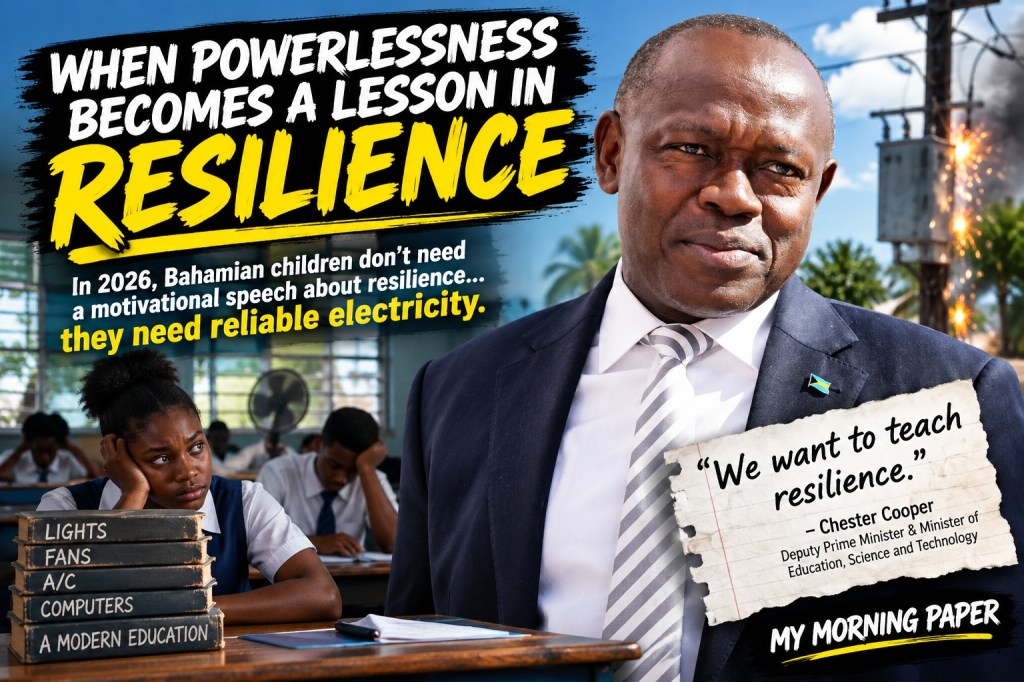
Yet, according to The Nassau Guardian, Deputy Prime Minister and Minister of Education, Science and Technology Chester Cooper said that while outages are an inconvenience, they can also be used to teach children resilience.
The argument, essentially, is that children should understand that life is not always easy and that previous generations managed without electricity.
There is undoubtedly value in teaching resilience.
Children should learn perseverance. They should learn how to overcome adversity. They should understand that life contains difficulties.
But there is a rather important distinction between teaching a child how to overcome adversity and allowing a preventable infrastructure problem to become the adversity you expect the child to overcome.
That distinction seems to have gotten lost somewhere between the classroom and the press microphone.
Because nobody is suggesting that children cannot survive a power outage.
The question is whether children attending a government school in 2026 should have to repeatedly endure inadequate electrical service as part of their education.
Schools require electricity.
Lights require electricity.
Fans and air-conditioning systems require electricity.
Computers require electricity.
Laboratories require electricity.
Modern educational technology requires electricity.
And, rather obviously, electrical systems are supposed to be safe.
So, when teachers have been complaining about electrical problems for weeks, when classes are being disrupted, when educators say the situation has become unbearable, and then three students suffer minor burns during an electrical incident, the natural question is not:
“How can we turn this into a lesson in resilience?”
The natural question is:
“Why has the problem not already been fixed?”
That is the question parents deserve answered.
That is the question teachers deserve answered.
And, frankly, that is the question the Ministry should be answering.
Because there is a certain danger in turning every government failure into a motivational seminar.
A pothole becomes an opportunity to learn patience.
A water interruption becomes an opportunity to appreciate running water.
A power outage becomes an opportunity to develop resilience.
A broken air conditioner becomes an opportunity to experience the historical lifestyle of our grandparents.
Eventually, one suspects the government could eliminate the entire infrastructure budget and simply rename the Ministry of Education the Ministry of Character Development Through Government Inconvenience.
But there is an even larger contradiction here.
The Progressive Liberal Party (PLP) has repeatedly presented itself as the party of progress and transformation. The government has also spoken about reform and modernization of the energy sector, including an objective of substantially increasing renewable-energy reliance.
So where exactly does repeatedly disrupted electricity at a government high school fit into that vision?
What does progress look like when students cannot reliably depend on the electricity needed to conduct a modern school day?
And what does transformation mean if the response to a persistent infrastructure problem is essentially:
“Look on the bright side, children. This will build character.”
Perhaps there is another lesson here.
Maybe the lesson is that resilience should be something we teach, not something we impose.
Maybe the lesson is that government has a responsibility to provide safe and functional schools while teachers have the responsibility to educate the children inside them.
Maybe the lesson is that parents should not have to choose between sending their children into an unreliable electrical environment and keeping them home because they are concerned about safety.
And perhaps the most important lesson of all is that progress should be measured by the problems government solves—not by how creatively government explains why citizens should endure them.
To be fair, Minister Cooper did acknowledge that the outages are a “major inconvenience” and said he looks forward to the day when disruptions are minimized. The Ministry has also said it is working with Bahamas Grid, BPL and school administrators to address the problem.
Those assurances matter.
But after weeks of complaints and an electrical incident that injured students, parents and teachers are entitled to more than assurances.
They are entitled to a clear explanation of what failed, why it failed, what work is being done, who is responsible for completing it, and when the school can reasonably expect reliable and safe electricity.
That is not asking for luxury.
That is not asking children to be sheltered from the hardships of life.
That is asking for a functioning school.
There will be plenty of time to teach children about adversity.
Perhaps government should first teach them something else:
that when something is broken, responsible adults are supposed to fix it.
Because there is a rather profound difference between a child becoming resilient because life occasionally presents obstacles—and a child being told to develop resilience because the adults responsible for the infrastructure have not yet solved the problem.
One is education.
The other is an excuse waiting for a lesson plan.
The Progressive Liberal Party (PLP) fails for one reason; it is their nature.
END

