
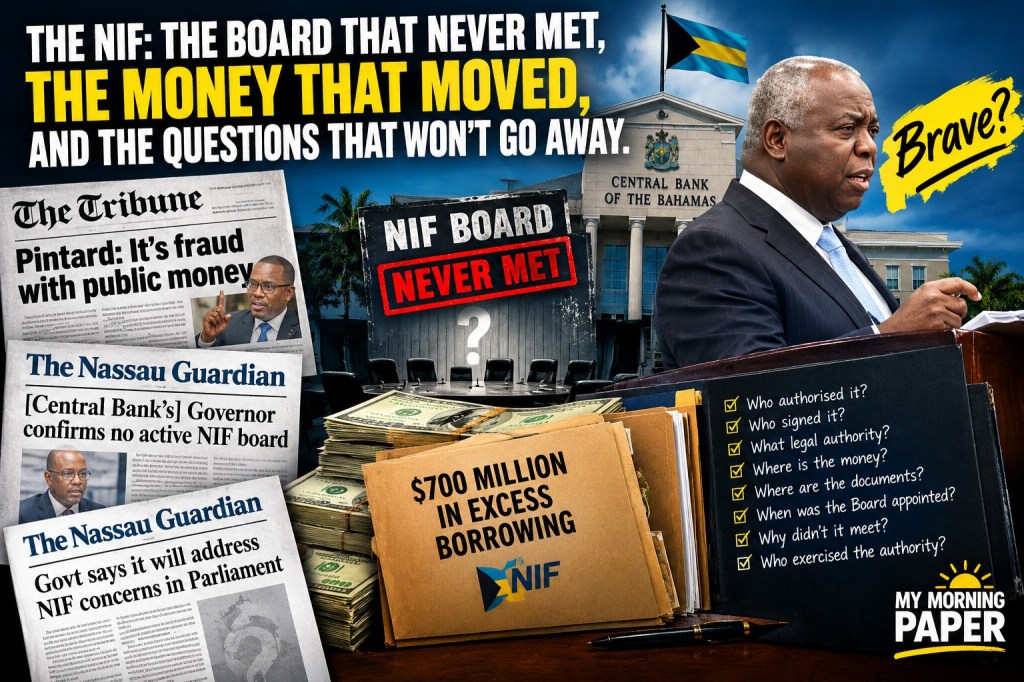
Yesterday, The Tribune gave us the headline:
“Pintard: It’s fraud with public money.”
Meanwhile, The Nassau Guardian reported the rather extraordinary revelation that the Central Bank Governor had confirmed there was no active NIF Board.
And now, in this morning’s Guardian, we are told:
“Govt says it will address NIF concerns in Parliament.”
Ah; Parliament.
The place where questions about hundreds of millions of dollars apparently go to receive the governmental equivalent of “capital punishment”.
The issue is not merely that the Opposition has raised questions about the National Investment Fund (NIF). The more serious problem is that the Central Bank’s Governor, John Rolle, has now confirmed that although he was appointed as the Central Bank’s representative to the NIF Board, the Board had never formally convened in respect of any matter.
That is not a minor administrative detail.
That is the sort of sentence that makes people reach for the Constitution, the legislation, their calculators—and possibly a stiff drink.
According to The Tribune, Governor Rolle’s correspondence also confirmed that the Central Bank maintained an account in the name of the National Investment Fund and that transactions on that account began in July 2025. He said details of those transactions would have to come from the Ministry of Finance.
And therein lies the deliciously uncomfortable question:
If the Board had never formally met, who was exercising the authority that the law contemplated the Board would exercise?
Because this is where the story gets rather interesting.
The Government has said that approximately $700 million in excess borrowing receipts were transferred to the NIF rather than being used for deficit financing. The Government’s own budget documents confirm that excess borrowing receipts were transferred to the NIF.
And this is not some Opposition invention pulled from a political hat.
It is the Government’s own explanation of where the money went.
Earlier, the Government also defended the transfer of $265.3 million into the NIF, saying that Parliament had authorised both the borrowing and subsequent deposit through a March 10, 2025, resolution.
So let us be fair.
The Government has a position.
The Government says the money was properly authorised.
The Opposition has a position.
The Opposition says the legal authority for moving and administering the money remains inadequately explained.
And now the Central Bank Governor has supplied another piece of the puzzle:
The Board that was supposed to govern the Fund had never formally convened.
That does not, by itself, prove that every transaction was illegal.
Let’s be very clear about that.
Calling something illegal is a legal conclusion, and neither Michael Pintard nor this newspaper column gets to issue a judicial ruling from a microphone.
But it does create a perfectly legitimate question:
Who authorised the transactions, under what authority, through what governance mechanism, and where is the documentary trail?
Those are not partisan questions.
Those are accountability questions.
And when the sums involved are hundreds of millions of dollars of public money, the Bahamian people are entitled to answers that contain more nouns, verbs and documents than adjectives.
Which brings us back to this extraordinary situation.
We are apparently being asked to contemplate a National Investment Fund in which:
- hundreds of millions of dollars were reported as being transferred;
- the Government says the funds were intended for strategic national investment;
- approximately $265.3 million was shown in the NIF at the end of December 2025;
- that reported balance fell to approximately $200,000 by the end of March 2026;
- the Government says additional excess borrowing of approximately $700 million was transferred to the Fund;
- the Central Bank confirms that an account in the NIF’s name existed and that transactions began in July 2025;
- and the Governor of the Central Bank says the NIF Board had never formally convened.
Ladies and gentlemen, welcome to Bahamas Accounting: The New Day Government’s Edition.
Where apparently the money can move before the meeting does.
And now the Government intends to “address the concerns” in Parliament.
Excellent.
Please do.
But when the Minister of Finance rises to speak, perhaps the Bahamian people could be spared the usual political fog machine.
We don’t need another lecture about how wonderful the NIF is supposed to become.
We don’t need another discussion about the Government’s grand infrastructure ambitions.
We don’t need another explanation of how sophisticated liability management is.
We need the boring stuff.
The beautiful, magnificent, revolutionary boring stuff.
Documents.
Who authorised the account?
Who authorised the transfers?
Who authorised the withdrawals?
Who authorised the expenditures?
What legal authority was relied upon?
When was the NIF Board appointed?
Who are the members of the NIF Board?
Why had the Board not formally convened?
Who exercised the powers that the Board was expected to exercise?
What happened to the approximately $265.3 million previously reported in the Fund?
And, perhaps most importantly:
Where is the complete accounting for the approximately $700 million in excess borrowing receipts that the Government says were transferred to the NIF?
Those are not unreasonable questions.
They are precisely the sort of questions that a government committed to good governance, transparency, accountability and respect for the rule of law should be delighted to answer.
Unless, of course, transparency has now become another national infrastructure project—announced with great enthusiasm, budgeted generously, and still waiting for construction to begin.
And this is where the Prime Minister’s nickname becomes almost irresistibly appropriate.
“Brave.”
Because it certainly takes a particular kind of political bravery to stand before the Bahamian people and explain how hundreds of millions of dollars can be moved through an investment structure whose governing board, according to the Central Bank Governor, never formally convened.
Very brave indeed.
But tomorrow’s parliamentary explanation should not be about bravery.
It should be about accountability.
And if the Government has done everything legally and properly, wonderful.
Open the books.
Show the authorisations.
Show the resolutions.
Show the account.
Show the transactions.
Show the Board.
Explain who exercised its authority.
Explain where the money went.
And then everyone can go home.
Because the Bahamian people are not asking for a miracle.
They are asking a much simpler question:
When hundreds of millions of dollars of public money move, who was holding the pen?
And if the answer turns out to be perfectly lawful, properly authorised and completely transparent, then congratulations.
The Davis administration will have the rare opportunity to prove its critics wrong.
But if tomorrow’s parliamentary performance produces more political smoke than financial light, then Bahamians may be forgiven for wondering whether the real national investment taking place here is an investment in the ancient Bahamian art of explaining everything except the thing people actually asked about.
At this point, one almost expects the chiccharneys to appear.
Not because they have anything to do with the NIF.
But because, at this rate, we’re going to need something magical to explain where the answers went.
The Bahamas deserves better.
END
 My Morning Paper