
Yesterday was World Literacy Day.
So, I feel reasonably comfortable writing a blog for my readers.
Now, I appreciate that literacy and comprehension are two different things. One can technically read every word on a page and still somehow miss the point entirely.
And then there is critical thinking.
But I digress.
Because apparently, when it comes to the finances of the Commonwealth of The Bahamas, we may all need to go back to school.
Preferably accounting.
The Davis administration has spent years reminding Bahamians about the fiscal mess it inherited from the Minnis administration.
And there is no question that Hurricane Dorian and COVID-19 created an extraordinary fiscal crisis.
The Minnis administration faced a hurricane that devastated Abaco and Grand Bahama, followed almost immediately by a global pandemic that shut down tourism, businesses and much of the economy.
Government revenues collapsed.
Government still had bills to pay.
Public servants continued to receive salaries.
Social assistance programs had to be expanded.
Food assistance had to be provided.
And the country had to borrow to respond to circumstances that nobody could have reasonably described as normal.
In fact, the government at the time explicitly said borrowing was being used to finance Dorian recovery and provide support to people affected by the disaster.
Yet the Progressive Liberal Party spent considerable political capital criticizing the Minnis administration over the country’s rapidly increasing debt.
And when the Davis administration took office in 2021, Prime Minister Philip Davis made the fiscal condition of the country a central part of his government’s argument.
The debt, we were told, was a problem.
The previous administration’s borrowing was a problem.
The previous administration’s fiscal management was a problem.
Fair enough.
Government changes.
Governments inherit problems.
And governments are expected to fix them.
But now comes the awkward part.
The Central Bank’s second-quarter 2026 economic report shows that The Bahamas’ national debt increased by $1.071 billion during the 2025-2026 fiscal year, reaching approximately $13.17 billion at the end of June 2026.
That increase consisted of approximately $697 million in additional direct government debt and $373.5 million in increased contingent liabilities.
And this is where things become rather interesting.
Because according to the government’s April 2026 fiscal report, the fiscal deficit was only $121.2 million.
Even more interestingly, as late as June 2026, the Davis administration was projecting a $32.7 million Budget surplus for the 2025-2026 fiscal year.
Let us pause there.
A $32.7 million projected surplus.
A $121.2 million fiscal deficit reported at the end of April.
And a $1.071 billion increase in national debt over the fiscal year.
Somewhere in that arithmetic is a story.
And the Bahamian people deserve to hear it.
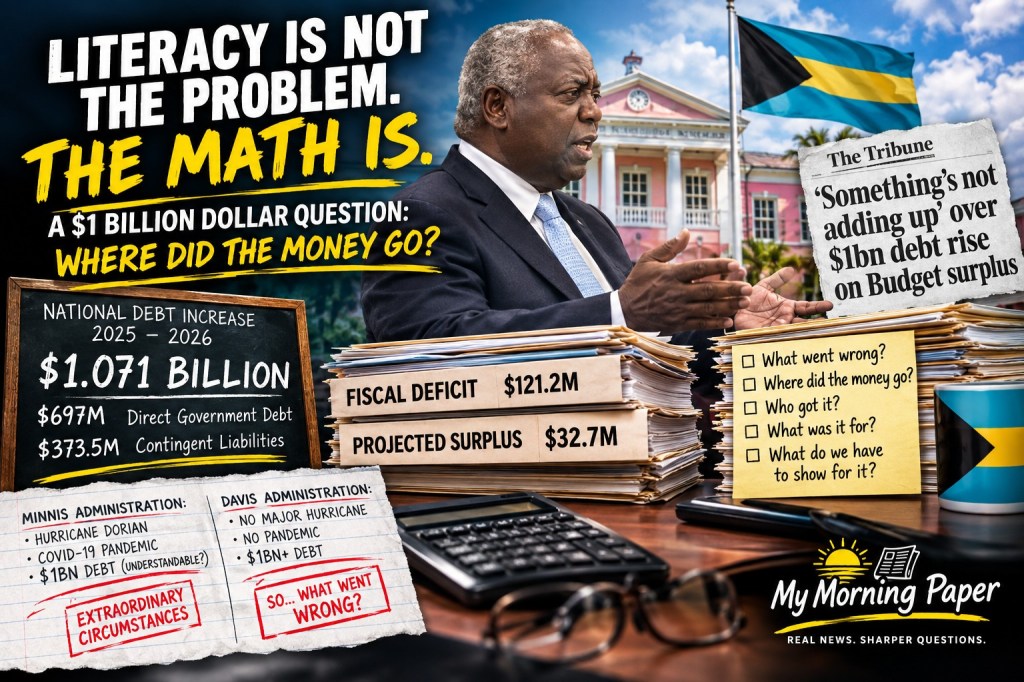
Economist Therese Turner-Jones has already raised precisely this concern, telling The Tribune that the lack of transparency surrounding the figures is “mind boggling” and that something is not adding up.
She is not suggesting that every dollar of the $1.071 billion was simply spent by central government.
And neither should we.
The $373.5 million increase in contingent liabilities matters. Those liabilities include government guarantees associated with state-owned enterprises, including borrowing connected to the Grand Bahama Power Company acquisition, LNG-related energy reforms and the Public Hospitals Authority.
But that distinction raises an even bigger question:
Why are these liabilities increasing by such an extraordinary amount while the government is simultaneously telling Bahamians that its fiscal position is improving?
What exactly is happening?
Where did the money go?
What was it borrowed for?
What was guaranteed?
Which entities received it?
What projects or acquisitions account for it?
How much of it remains sitting in government accounts?
How much was transferred to state-owned enterprises?
How much is connected to special-purpose vehicles?
And, most importantly:
Why doesn’t the government’s reported fiscal position appear to line up with the enormous increase in the national debt?
These are not unreasonable questions.
They are not partisan questions.
They are not FNM questions.
They are taxpayer questions.
And they deserve taxpayer answers.
Because this is where the Davis administration’s previous criticism of the Minnis administration becomes particularly interesting.
When the Minnis administration was dealing with the financial consequences of Dorian and COVID-19, the Davis opposition was perfectly entitled to question how much the country was borrowing and where the money was going.
But surely the same standard must apply when the government doing the borrowing is the Davis administration.
You cannot demand transparency when you are in Opposition and then ask the public to develop amnesia when you are in government.
That is not fiscal responsibility.
That’s political selective memory.
And there is another rather inconvenient fact.
Prime Minister Davis himself has repeatedly emphasized the fiscal turnaround achieved under his administration.
In his 2026 Budget contribution, he described the country’s progress as a transformation from a $1.3 billion deficit to a projected surplus and said the debt burden had fallen dramatically as a percentage of GDP. He also pointed to the government’s successful refinancing of older debt.
Fine.
But then somebody needs to explain the other side of the ledger.
Because while the debt-to-GDP ratio may have improved substantially from the extraordinary pandemic peak, the absolute national debt increased by $1.071 billion in one fiscal year.
Those are two different measurements.
Both can be true.
And pretending they are the same thing would be like telling a homeowner that his mortgage has become more affordable because his house increased in value while conveniently failing to mention that he borrowed another $700,000.
Percentages are wonderful things.
They can make almost anything look better.
Especially during Budget season.
But Bahamians don’t pay their bills with percentages.
They pay them with dollars.
And interest.
Lots and lots of interest.
The government’s own figures show that the national debt stood at approximately $13.17 billion at the end of June 2026, while the national debt-to-GDP ratio was approximately 74.7 percent.
So here is my question to the Davis administration:
What exactly happened during the 2025-2026 fiscal year that required the national debt to increase by more than $1 billion?
And before somebody reaches for the convenient Dorian-and-COVID explanation, let’s remember something:
Dorian happened in 2019.
COVID-19 arrived in 2020.
We are now in 2026.
Those were extraordinary circumstances.
But the $1.071 billion increase being discussed here occurred during the 2025-2026 fiscal year.
So what was the extraordinary circumstance this time?
Where was the hurricane?
Where was the lockdown?
Where was the collapse of tourism?
Where was the unprecedented economic shutdown?
There wasn’t one.
Instead, Bahamians were being taxed, revenues were increasing and the government was telling us that the country’s fiscal position had been transformed.
So why did the debt rise by another billion dollars?
And perhaps the most important question of all:
What do Bahamians have to show for it?
That is not an accusation.
It is an accountability question.
If the money was invested in productive infrastructure, show us.
If it went into BPL, show us.
If it went into Water & Sewerage, show us.
If it went into the Public Hospitals Authority, show us.
If it was connected to the Grand Bahama Power Company acquisition, explain it.
If it was related to LNG and energy reform, explain it.
If it was placed into special-purpose vehicles, identify them.
If it is sitting in accounts somewhere, tell us where.
And if there are legitimate accounting reasons why the increase in debt does not correspond directly with the reported fiscal deficit, then explain those reasons in language ordinary Bahamians can understand.
Because the answer cannot simply be:
“We have a surplus.”
The numbers are asking a rather impolite follow-up question:
“Then why did the debt go up by $1 billion?”
That is the question.
And it is not going away.
The government can point to debt-to-GDP ratios.
It can point to refinancing.
It can point to improved revenues.
It can point to international investors.
It can point to credit ratings.
All of those things matter.
But none of them answers the fundamental question being raised by the latest numbers.
Where did the additional billion dollars go?
The Minnis administration was criticized for the debt accumulated during one of the most extraordinary periods in modern Bahamian history.
Now the Davis administration has presided over another billion-dollar increase in national debt during a period when it is simultaneously telling Bahamians that the nation’s finances are stronger, revenues are higher and a surplus has been achieved—or is about to be achieved.
Perhaps there is a perfectly reasonable explanation.
If there is, this should be easy.
Produce the numbers.
Show the Bahamian people the money trail.
Explain the accounting.
Explain the guarantees.
Explain the borrowing.
Explain the contingent liabilities.
Explain the difference between the fiscal deficit and the increase in debt.
And explain what the country received in return.
Because after all the speeches about fiscal responsibility, after all the promises of surpluses, after all the celebrations about the economic turnaround, Bahamians are entitled to ask one very simple question:
If everything is going so well, why did we just become another $1 billion deeper in debt?
Perhaps the problem isn’t that Bahamians can’t read.
Perhaps we are reading the numbers just fine.
Perhaps the problem is that the government hasn’t finished writing the explanation.
The Commonwealth of The Bahamas deserves so much more.
END
 My Morning Paper