
On Warren “Spy” Ellis, government contracts, political association—and the extraordinary difficulty of simply saying “No”
There are some questions in public life that require a Royal Commission.
There are others that require a forensic audit, three lawyers, two parliamentary committees and several months of Freedom of Information requests.
And then there are questions that require two letters.
No.
The Warren “Spy” Ellis affair, at least as far as the government’s housing programme is concerned, appears to belong firmly in the third category.
The Ministry of Housing and Land Reform has now done what one might reasonably expect a ministry to do when confronted with a question about whether someone received a government contract.
It checked the records.
And according to the Ministry, there is no record of Warren Ellis receiving a contract from the Ministry since the Davis administration came to office.
The Ministry went further. It said there is also no record of a contract being awarded to a company identified in its records as being owned or controlled by Ellis.
Well, there we have it.
No contract.
Simple enough.
Which makes the Prime Minister’s earlier performance all the more intriguing.
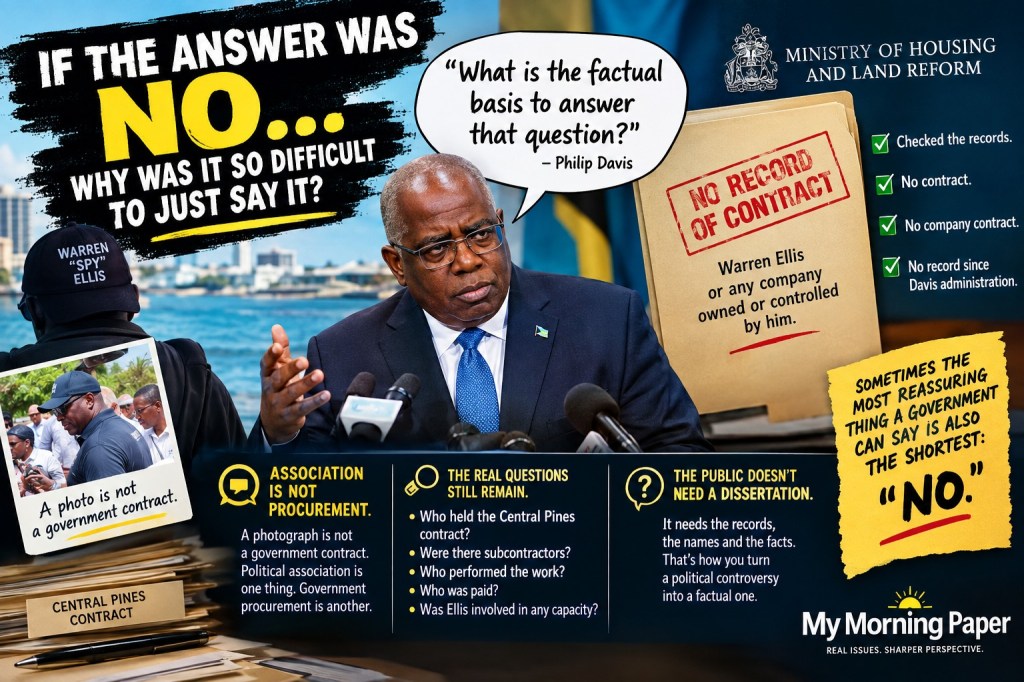
Because when asked about the allegation, Philip Davis did not say “No.”
He did not say, “The Ministry’s records show no such contract.”
He did not even say, “I don’t have that information in front of me, but I’ll have the Ministry check.”
Instead, the country was treated to an increasingly exasperated inquiry into the factual basis of the question.
“What is the factual basis to answer that question?”
The reporters were asked where they got the information.
The Prime Minister declared that he was tired of the allegations.
And then, with the dexterity of a politician who has spotted an escape hatch, the conversation moved on to UpSkill Bahamas, the school breakfast programme and the government’s other initiatives.
One could almost hear the collective whisper from the press gallery:
Sir, we asked about Warren Ellis.
The Ministry Apparently Found the Missing “No”
To be fair, the Ministry’s response is precisely what the government should have wanted.
It is specific.
It is factual.
It is based on records.
It doesn’t require anyone to speculate about photographs, friendships, political associations or who happened to stand next to whom at a political event.
It simply says: we checked, and the contract isn’t there.
That is a considerably more compelling response than telling journalists that you are tired of the question.
Indeed, it raises the most obvious question of the entire affair:
If the answer was no, why didn’t the Prime Minister simply say no?
Perhaps he didn’t have the records at hand.
Perfectly understandable.
Then say so.
Perhaps he thought the allegation was politically motivated.
Also, understandable.
Say that too.
Perhaps he was genuinely irritated by what he regarded as a continuing attempt to associate the government with a murdered man.
Again, understandable.
But none of these explanations prevents a Prime Minister from answering a straightforward factual question.
In fact, they make the appropriate response even easier:
“I don’t have those records in front of me. I’ll have the Ministry verify it.”
End of story.
Instead, the question became a political performance.
And now the Ministry has quietly come along afterwards and provided the answer that could have been given at the beginning.
Association Is Not Procurement
This is where the discussion needs a little intellectual discipline.
There has been considerable conversation about Ellis being photographed with politicians and supporters of the Progressive Liberal Party.
That is a separate issue.
The Prime Minister is perfectly entitled to point out that politicians interact with constituents and members of the public every day.
A photograph is not a government contract.
Standing beside somebody at a political event does not establish a business relationship.
And knowing, speaking to, or being photographed with a person does not make a politician responsible for that person’s actions.
All of that is true.
But it isn’t an answer to the housing-contract question.
The two things should not be mixed together.
Political association is one question. Government procurement is another.
One is subjective and potentially open to interpretation.
The other ought to be sitting somewhere in a filing system.
And that is why the Ministry’s statement is so important.
It moves the discussion away from political theatre and into the realm of documentary fact.
But Don’t Declare Victory Just Yet
There is, however, another trap here.
It would be just as irresponsible to take the Ministry’s statement and declare that every allegation concerning Ellis has now been completely disproved.
That isn’t what the Ministry said.
The Ministry said there is no record of a contract being awarded to Ellis or to a company identified in its records as being owned or controlled by him.
That is a narrower proposition.
It does not necessarily answer whether Ellis worked on a government-funded project through another contractor.
It does not necessarily answer whether he was a subcontractor.
It does not answer whether he had any other dealings with government agencies.
And it does not automatically disprove reports from construction workers who said they had worked for Ellis on the Central Pines project.
Those claims may ultimately turn out to be wrong.
They may turn out to be misunderstood.
They may turn out to describe subcontracting arrangements rather than government contracts.
But that is precisely why the matter should now be investigated with documents rather than political indignation.
The next question practically writes itself:
Who actually held the Central Pines housing contract in 2022?
Who was the principal contractor?
Were there subcontractors?
Who performed the work?
Who was paid?
Was Ellis involved in any capacity?
Those are questions that should be capable of being answered.
And if the answer to all of them is “No,” then the government’s position becomes substantially stronger.
The Prime Minister’s Real Problem May Be Communication
It would be tempting, in the overheated atmosphere of Bahamian politics, to interpret every awkward answer as evidence of a hidden scandal.
That would be a mistake.
The fact that Davis became aggravated does not prove that he was concealing anything.
The Ministry’s statement, in fact, gives the government a useful piece of evidence in defending itself against the specific contract allegation.
But there is a difference between proving wrongdoing and handling a question badly.
The Prime Minister may have done the latter without doing the former.
And that distinction is important.
Because when a Prime Minister is asked a factual question and responds with irritation, the public is left to fill in the blanks.
When the Ministry subsequently answers the question calmly and specifically, the contrast becomes even more pronounced.
The government has essentially demonstrated that the controversy could have been handled with a sentence.
Instead, we got a detour.
A lecture about political association.
A complaint about allegations.
A reminder of government programmes.
And finally, the answer.
It is a little like asking whether the Treasury wrote a cheque and being told that the government has done wonderful things for education.
Wonderful.
But did you write the cheque?
The Curious Politics of Being “Tired”
There is also something worth examining about politicians saying they are “tired” of allegations.
The public may well be tired too.
Tired of accusations.
Tired of denials.
Tired of counter-accusations.
Tired of photographs being treated as evidence of criminality and denials being treated as evidence of guilt.
But there is a simple solution.
Put the facts on the table.
If the allegation is false, demonstrate that it is false.
If the records don’t exist, say so.
If the records are being checked, say that.
If there was a contract, disclose who received it and under what circumstances.
That is how public confidence is built.
Not by becoming increasingly irritated that people keep asking.
Because there is a rather uncomfortable political reality here:
The more irritated a politician becomes while refusing to answer a simple question, the more interesting the question becomes.
It is not necessarily fair.
But it is politics.
The Government Should Welcome the Boring Answer
There is an old-fashioned virtue in boring government.
A contract was issued.
Here is the contract.
A company was paid.
Here is the payment record.
A person wasn’t awarded a contract.
Here is the procurement record showing that.
There is no need for drama.
No need for outrage.
No need to invoke Westminster.
No need to remind everybody about the breakfast programme.
Just documents.
The Ministry’s statement is therefore useful—not because it ends every question surrounding Ellis, but because it provides a factual answer to one of the most important allegations.
The government should now go one step further.
Tell the public who did receive the Central Pines contract.
Tell the public whether Ellis had any role whatsoever in the project.
If there was no relationship beyond what has already been reported, establish that.
If there was some other form of involvement, explain it.
And let the records speak.
Three Letters
Ultimately, the strangest thing about this episode may be that the government has managed to make a simple denial sound complicated.
The Ministry has now effectively said:
No.
That is the answer the Prime Minister could have given.
He could have said:
“No. The records show Warren Ellis was not awarded a Housing Ministry contract.”
And then moved on to UpSkill Bahamas.
Nobody would have objected to hearing about the breakfast programme.
But first, answer the question.
Because when the question is about whether someone received a government contract, the public is not asking for a dissertation on who is permitted to associate with whom.
It is asking whether the government’s records show a contract.
The Ministry says they don’t.
Good.
Now show us who held the contract.
That is how you turn a political controversy into a factual one.
And perhaps, next time, when the answer really is that simple, the Prime Minister will resist the temptation to take us on the scenic route.
Because sometimes the most reassuring thing a government can say is also the shortest:
No.
The Commonwealth of The Bahamas deserves so much more.
END
 My Morning Paper