
The Progressive Liberal Party’s (PLP’s) faithful are entitled to applaud the prime minister. The rest of Grand Bahama is entitled to ask what, precisely, the applause was for.
Was Prime Minister Philip “Brave” Davis announcing a completed legal breakthrough, a negotiated settlement with the Grand Bahama Port Authority (GBPA), or an immediate change in the way Freeport is governed?
No. He was announcing a proposed reform programme: a development council, a comprehensive review of the Hawksbill Creek Agreement (HCA), a proposed legislative framework and a consultation process.
Those are legitimate matters of public policy. They are not, however, the same thing as delivering Freeport from the arrangement the government has spent so much time condemning. An announcement that the government intends to work out how to change the system is not an announcement that the system has changed.
That distinction appears to have been misplaced somewhere between the political build-up and the applause.
What the arbitration actually established
Before anyone commissions a monument to this latest declaration of resolve, the arbitration deserves an accurate reading.
In its Partial Final Award dated February 27, 2026, the tribunal dismissed the government’s approximately $357 million reimbursement claim against the GBPA. It also rejected seven of the eight issues advanced in the GBPA’s counterclaim. The GBPA succeeded on the issue of the government’s delays in approving environmental byelaws, with damages and other outstanding matters left for further consideration.
That was neither an unqualified government victory nor an unqualified vindication of the Port Authority.
Importantly, the award rejected substantial elements of the GBPA’s arguments about restrictions on the government’s powers in Freeport. The government did not need a subsequent rally to discover that national authority and the public interest have a place there.
But neither did the award abolish the Hawksbill Creek Agreement (HCA), transfer the GBPA’s functions to the government, or hand the prime minister a licence to disregard existing contractual rights.
The tribunal decided legal disputes. It did not enact the government’s preferred replacement system.
So, what was actually new?
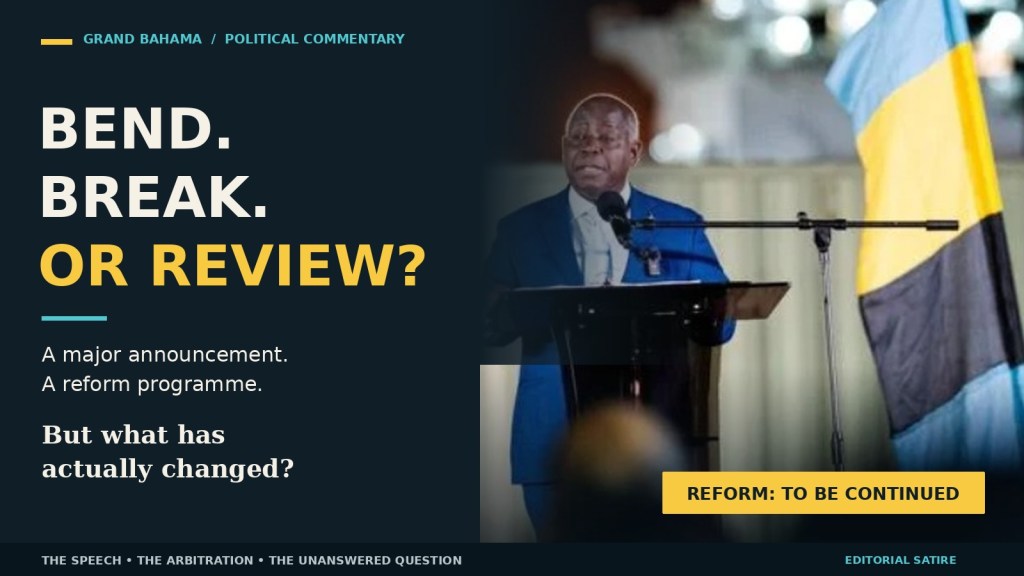
It would be inaccurate to say that the speech contained nothing new.
Davis set out a proposed government-led Grand Bahama Development Council, an attorney general-directed review of the Hawksbill Creek Agreement, and a proposed Grand Bahama Development Act within a wider legislative framework. He also supplied a reform timetable and updates on the airport, harbour and Grand Lucayan.
Those proposals and updates were not simply findings already delivered by the arbitrators. A tribunal determines the disputes before it; it does not design a development council or write a government’s legislative programme.
The sharper question is therefore not, “Was anything new mentioned?” It is:
What new legal result had actually been achieved to justify presenting the occasion as a decisive confrontation with the Port Authority?
On that question, the speech offered considerably more intention than accomplishment.
There was no announced agreement transferring the GBPA’s powers. No enacted replacement framework. No completed restructuring of Freeport’s governance.
Instead, the prime minister acknowledged that the Hawksbill Creek Agreement involves contractual and statutory arrangements, supplemental agreements, concessions and other legal relationships. He said the government would examine those arrangements function by function. He also expressly contemplated negotiated changes, amendments, targeted repeals and the preservation of lawful commercial arrangements where appropriate.
That is a programme of legal analysis, consultation, negotiation and legislation.
Worth doing, perhaps. Already done, certainly not.
“Bend or Break”—subject to consultation
Anyone tempted to dress this up as another “Bend or Break” moment should first read the administrative fine print.
The government’s stated target is a White Paper on July 1, 2027, completed draft legislation by December 31, 2027, and passage in the first quarter of 2028, supporting the new framework in the 2028/2029 Budget.
Whatever else that may be, it is not an immediate dismantling of the existing order.
“Bend or Break” has apparently acquired a consultation period, a drafting schedule and a future budget allocation.
There is nothing inherently wrong with proceeding carefully. Indeed, with an agreement of this complexity, care is preferable to an expensive performance of legal bravado. But the government cannot reasonably invite the public to celebrate a decisive breakthrough and then complain when people notice that the breakthrough is still awaiting legal analysis.
Nor is there necessarily a contradiction in announcing a policy objective before completing the legal work. Governments do that routinely. The problem arises when political presentation blurs the difference between choosing a destination and securing a lawful route to it.
So, what purpose did the announcement serve?
The prime minister’s private motives cannot be established from a speech. Its public political function, however, is open to scrutiny.
A reasonable reading is that the address sought to reposition the government: away from the argument over the arbitration’s mixed outcome and towards a broader claim to be the architect of Grand Bahama’s future.
That is political interpretation, not a tribunal finding. But it is a more defensible interpretation than pretending the speech itself delivered a legal victory that had not been announced.
The government now has a reform programme against which it can be judged. That is useful. It also has promises, deadlines and proposed institutions for which it must accept responsibility. That is more useful still.
What it does not yet have, on the evidence presented in the address, is a completed transformation of Freeport’s governance.
Grand Bahamians can support reform without applauding every announcement of an intention to pursue it. They can question the Port Authority’s structure without accepting that a government-led council will automatically produce better accountability. And they can demand change without confusing a forceful speech with an accomplished result; especially when the prime minister makes statements like “this is not open for negotiation” when he is actually trying to negotiate.
The prime minister announced a process towards change—not a completed legal breakthrough.
The party faithful may celebrate the process if they wish. The rest of the island is entitled to reserve its applause for the result.
The people of The Bahamas deserve so much better.
END

