
By Fred Mitchell’s telling, Senator Rick Fox has committed the unforgivable political sin of asking a question.
Not just any question, mind you.
A question about a private PLP meeting discussing Bahamian foreign policy and the way forward.
Mitchell’s response was essentially:
Relax, Rick. It was only a PLP meeting.
Ah.
That clears everything up.
Because apparently there are now two versions of Bahamian foreign policy:
The one belonging to the Bahamian people — and the one discussed by card-carrying members of the PLP behind a closed door.
Mitchell explained that branch meetings can be open to the public, but when the party is discussing policy, attendance can be restricted to PLP members.
Fair enough.
Political parties are entitled to have private meetings.
They can discuss their internal affairs, strategy, candidates, fundraising, election plans and whatever else political parties discuss when the public isn’t invited.
But foreign policy?
“Where we are today.”
“Where we’ve come from.”
“Plotting the course of the future.”
That sounds less like deciding where to put the Christmas decorations at Foxhill Branch and rather more like discussing matters of national consequence.
And that is where the comedy begins.
Mitchell tells Fox he doesn’t understand how the PLP operates.
Perhaps he’s right.
Because apparently Fox has made the quaint mistake of believing that national policy should involve the nation.
How terribly old-fashioned.
WELCOME TO THE PLP SCHOOL OF GOVERNMENT
But perhaps we should give Fred Mitchell the benefit of the doubt.
Maybe Senator Fox really doesn’t understand how the PLP operates.
Because the more one looks at the government’s handling of the National Investment Fund (NIF), the more one begins to suspect that the phrase:
“That’s how we operate”, has become the New Day government’s preferred substitute for:
“Here’s the legal authority.”
And now we arrive at the National Investment Fund.
This is where the joke stops being funny.
Government financial reports showed approximately $265.3 million in the NIF in December 2025, falling to roughly $200,000 by March 2026.
That’s roughly $265 million moving out of the reported balance in a matter of months.
Now, before the government starts screaming “fake news” from the Cabinet table, let’s be fair.
Prime Minister Davis has stated that the original $265.3 million transfer into the NIF was authorized by Parliament in a March 10, 2025, resolution for national infrastructure projects. Government reporting says the money was intended for projects including airports at New Bight, Arthur’s Town and Governor’s Harbour.
So no, the intellectually lazy argument that the government simply secretly deposited $265 million without parliamentary authorization doesn’t hold up against the government’s own explanation.
But congratulations.
You’ve answered the question nobody was ultimately asking.
The much more interesting question is:
What happened to the money after it got there?
And who authorized it?
And under what authority?
And what governance structure approved it?
And where are the records?
And where is the accounting?
And who was actually exercising oversight?
Because the NIF isn’t supposed to be a government wallet with a very impressive name.
It was created by legislation.
Which means there are supposed to be rules.
Rules.
You know.
That pesky thing Fred Mitchell keeps telling everybody they don’t understand.
THE BOARD THAT WASN’T THERE
And now comes the particularly awkward part.
Opposition Leader Michael Pintard has been demanding answers about the NIF’s governance, including the Board of Governors, investment committee, custody arrangements and authority for withdrawals.
And the issue becomes considerably more uncomfortable when the Central Bank Governor’s reported correspondence concerning the NIF Board enters the picture.
If the Board responsible for exercising statutory oversight was not formally convened, then the obvious question isn’t:
“Why are questions being asked?”
It is:
“Who was exercising the oversight?”
That is not an FNM question.
That is not a PLP question.
That is not a Michael Pintard question.
That is a Bahamian taxpayer question.
And here’s where the Mitchell defence becomes almost too perfect.
“You don’t understand how the PLP operates.”
Maybe not.
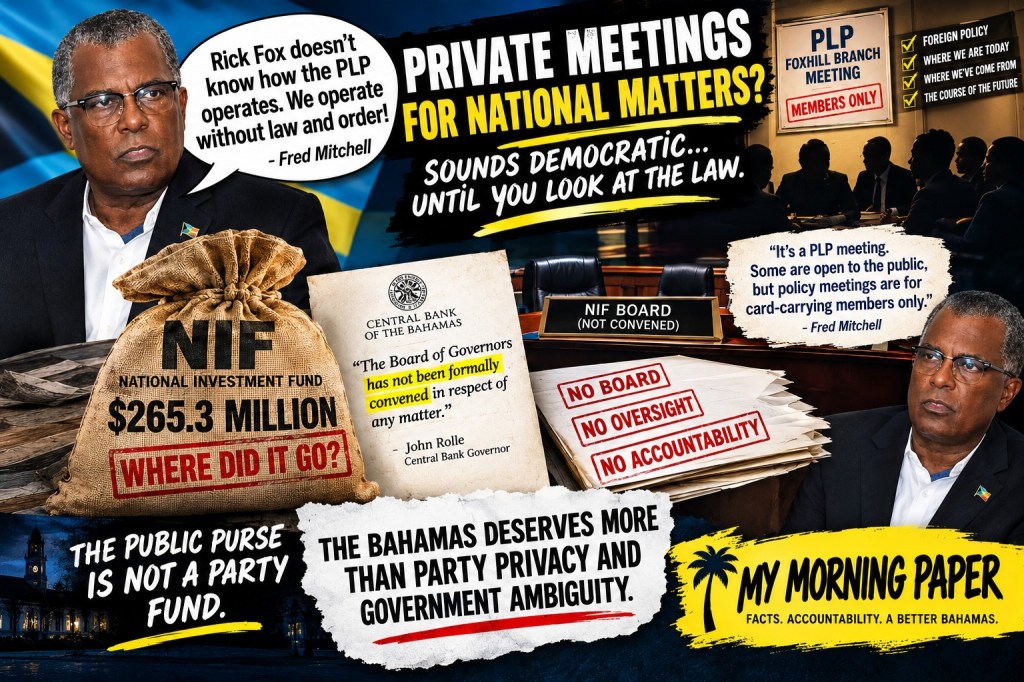
But government isn’t supposed to operate according to the internal customs of a political party.
THE GOVERNMENTAL VERSION OF “TRUST ME, BRO”
There is a wonderfully modern approach emerging here:
Don’t worry about the documentation.
Don’t worry about the approvals.
Don’t worry about the Board.
Don’t worry about the accounting.
Don’t worry about the questions.
Just trust us.
The government says the money went toward infrastructure.
Wonderful.
Then show us.
Show the allocations.
Show the approvals.
Show the projects.
Show the contracts.
Show the expenditure.
Show the statutory reporting.
Show the governance.
Show the paperwork.
This shouldn’t require a parliamentary séance.
The government has already said where the money was intended to go.
So why shouldn’t Bahamians be able to see exactly how much went where?
That is what accountability looks like.
Not:
“The Opposition is moaning.”
Not:
“They’re looking for relevance.”
Not:
“Ask the Ministry of Finance.”
Not:
“Rick Fox doesn’t understand the PLP.”
Answer the question.
AND HERE’S THE REALLY DELICIOUS IRONY
The PLP chairman is defending a private meeting about the future of Bahamian foreign policy by saying:
It’s a PLP meeting.
Meanwhile, Bahamians are asking questions about the administration of hundreds of millions of dollars through a statutory national investment vehicle.
And the government appears to want the public to understand that this is somehow somebody else’s business.
Apparently:
Foreign policy is private.
Public money is complicated.
Government questions are political.
And accountability is available by appointment only.
Wonderful.
Perhaps next year’s PLP convention should have a new membership category:
CARD-CARRYING TAXPAYER
Because apparently that’s the only way you’re going to get past the velvet rope.
THE “LAW AND ORDER” PROBLEM
Mitchell says Rick Fox doesn’t understand how the PLP operates.
Perhaps.
But the more appropriate question is whether the PLP understands how government operates.
Because the Government of The Bahamas isn’t supposed to be a private club.
It isn’t supposed to have a members-only policy manual.
It isn’t supposed to decide which rules are inconvenient and which questions are impolite.
And it certainly isn’t supposed to treat statutory safeguards as optional administrative suggestions.
If everything involving the NIF was properly authorized, properly governed, properly documented and properly spent, then this should be the easiest political controversy in the world to resolve.
Publish the evidence.
That’s it.
No dramatic press conference.
No attacks on the Opposition.
No accusations of “moaning.”
No lectures about relevance.
No explanation that somebody doesn’t understand the PLP.
Just the documents.
Because documents have one wonderful characteristic politician sometimes find deeply inconvenient:
They don’t require a political interpretation.
They simply show what happened.
And perhaps that is the real lesson here.
Maybe Rick Fox really doesn’t understand how the PLP operates.
Maybe he doesn’t understand the rules of the private meeting.
Maybe he doesn’t understand the political etiquette.
Maybe he doesn’t understand why national policy can apparently be discussed privately while the public is expected to applaud afterward.
But if he is asking:
Where is the money?
Who authorized it?
Who oversaw it?
What legal authority was used?
Where are the records?
Then perhaps Rick Fox understands something far more important.
He understands accountability.
And that may be precisely why the question is so uncomfortable.
Because the Bahamas doesn’t need a government that tells us:
“You don’t understand how we operate.”
It needs a government that can demonstrate:
“Here’s how the law says we must operate — and here’s the evidence that we followed it.”
Until then, Fred Mitchell may want to stop worrying about whether Rick Fox understands the PLP.
The bigger question is whether the PLP understands that it is supposed to be governing The Bahamas — not owning it.
And no, Mr. Mitchell, that isn’t a private meeting.
That’s the public’s business.
The Commonwealth of The Bahamas deserves so much more.
END
 My Morning Paper