
“Mind your own business.”
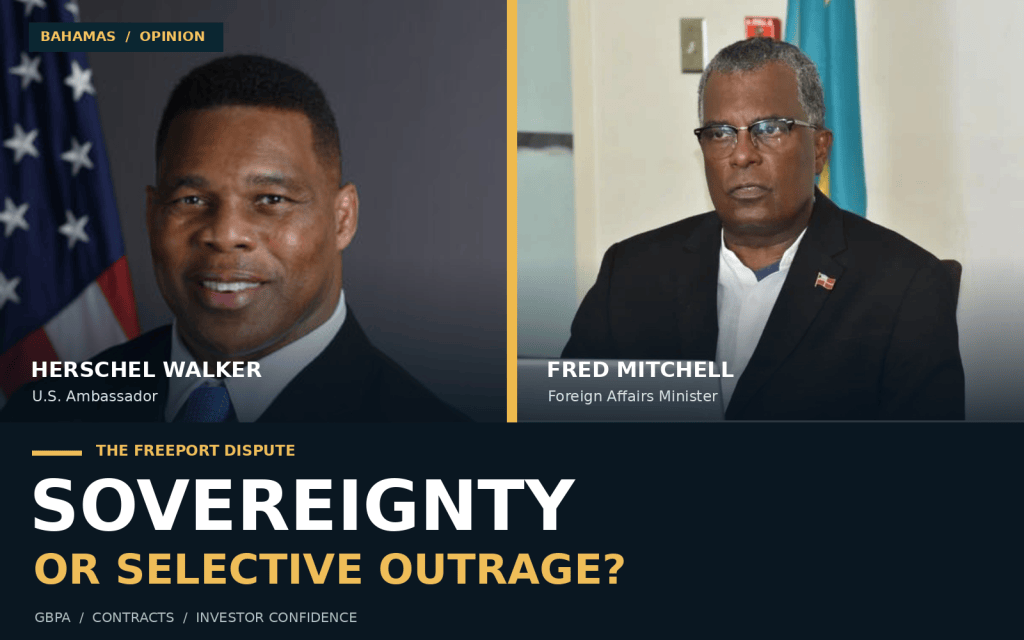
That, stripped of its diplomatic wrapping, was Foreign Affairs Minister Fred Mitchell’s response to United States Ambassador Herschel Walker’s concerns about the government’s handling of the Grand Bahama Port Authority dispute.
According to the Tribune headline: “MIND YOUR OWN BUSINESS: MITCHELL REBUKES WALKER — ‘Outsiders’ should stay out of Freeport fight, says Minister after U.S. Ambassador voices ‘real concern’.”
How reassuring to discover that the government’s sovereignty alarm is functioning. One might have wondered whether it had been disconnected when Washington raised objections to The Bahamas’ arrangements for Cuban professionals.
Let us establish the obvious: The Bahamas is a sovereign country. An American ambassador does not govern Freeport, dictate Bahamian legislation or possess a veto over national policy. The government is entitled to defend the public interest, challenge the GBPA and pursue remedies available under the law.
But sovereignty is not a diplomatic version of “Do not question me.” Nor does invoking it relieve a government of the obligation to explain how its actions respect existing agreements.
The Hawksbill Creek Agreement (HCA) framework contains long-term commitments extending to 2054. That does not put the Port Authority beyond scrutiny, and it certainly does not mean every disagreement must be resolved in its favour. It does mean that changing the arrangement requires more than political impatience and a microphone.
An agreement does not become optional simply because a government finds it inconvenient.
If the GBPA has failed to meet its obligations, establish those failures and pursue the appropriate legal remedies. If the government wants negotiated changes, negotiate them. If it proposes legislation, explain its legal basis and consequences.
What it should not do is treat every question about contractual certainty as an intrusion into the nation’s private affairs.
Freeport’s investment climate is not a family disagreement to be settled behind closed doors. The government wants international investors to bring their money, expertise and confidence into The Bahamas. Those investors are entitled to consider whether the rules governing their investment will remain dependable.
Apparently, foreign money is welcome. Foreign concern must clear immigration first.
Mr Mitchell reportedly insists that there are “no foreign affairs implications” in this debate. That is a remarkable assurance from a foreign affairs minister. A dispute involving investor confidence, long-term legal commitments and concerns publicly expressed by the United States ambassador may not be controlled by foreign policy, but it plainly has an international dimension.
Declaring otherwise does not make that dimension disappear.
Then there is the question of consistency.
Where was this particular brand of “mind your own business” diplomacy when Secretary of State Marco Rubio challenged arrangements involving Cuban workers, invoking allegations of forced labour?
Those allegations deserve serious examination. The welfare of workers matters, and the government should be able to demonstrate that its employment arrangements are lawful and fair. But allegations raised by Washington do not erase Bahamian sovereignty any more than concerns about Freeport do.
To be fair, Mr Mitchell has also defended Bahamian sovereignty in the Cuban-worker debate. The criticism, therefore, should not rest on pretending that he said nothing. The question is whether the government applies the same standard—and displays the same public indignation—when confronting different forms of American pressure.
If Washington’s objections to Cuban-worker arrangements warrant engagement, explanation and negotiation, why should concerns about Freeport warrant a scolding?
Is the governing principal sovereignty, or does the temperature of the response depend on which government policy is being challenged?
There are legitimate arguments on both sides of the Freeport dispute. The GBPA is not above accountability. Neither is the government. Defending one’s right to govern is not the same thing as establishing that one is governing wisely.
And that is where this administration’s posture becomes so tiresome: disagreement is too readily answered with a lecture about who has standing to speak, rather than a persuasive explanation of what the government intends to do.
The ambassador can be challenged on his reasoning. His assessment can be disputed. He can be reminded, firmly, that Bahamians make Bahamian policy. None of that requires pretending that investor confidence is “none of his business.”
A confident government would explain its legal position; identify the obligations it says have been breached and demonstrate how its proposed remedy protects both Bahamian interests and contractual credibility.
A defensive government tells the questioner to mind his own business.
Freeport needs investment, functioning infrastructure and a credible path forward—not another performance in which ministerial indignation is offered as a substitute for certainty.
Sovereignty is the authority to make our own decisions. It is not immunity from scrutiny of those decisions.
And if “mind your own business” is now the guiding doctrine of Bahamian foreign policy, perhaps the government could clarify whether it applies equally to the American ambassador and the American secretary of state—or whether this, too, is an arrangement whose terms change according to convenience.
The Bahamian people deserve more and much better.
END

