
Apparently, the Davis administration has discovered the missing ingredient in Grand Bahama’s recovery: a sufficiently stern speech about the Grand Bahama Port Authority (GBPA).
Not a completed airport. Not a convincing resolution of the Grand Lucayan saga. Not a record of transformation in the communities where the government already exercises authority. No—the great obstacle, we are now invited to believe, is a legal agreement that has survived for decades but must suddenly be confronted with all the urgency of a problem discovered yesterday.
The Hawksbill Creek Agreement (HCA)certainly deserves scrutiny. So does the GBPA. Neither should be treated as sacred, and Freeport’s residents are entitled to demand better governance, greater transparency and meaningful economic progress.
But scrutiny is not the same as scapegoating. And announcing that an agreement should change is not the same as possessing an uncomplicated legal right to dismantle it.
Can the PLP actually repeal the Hawksbill Creek Agreement?
The honest answer is more complicated than a political platform permits.
The agreement involves legislation, contractual obligations and rights held by the Port Authority and its licensees. Parliament’s ability to pass legislation is not necessarily the same thing as the government’s ability to extinguish those rights without legal challenge, potential compensation or other consequences. The precise answer depends on the provisions targeted, the mechanism used and the rights affected.
It would therefore be careless to declare that the government has absolutely no legal route to reform. It would be equally careless to suggest that a parliamentary majority is a magic eraser.
Indeed, the government’s own published framework acknowledges lawful existing rights and contemplates negotiated changes, amendments, targeted repeals and replacement provisions, subject to consultation and legal analysis. That is rather more qualified than the impression of a government preparing to sweep the entire arrangement off the table.
A green paper is a discussion document—not a court order, and certainly not a demolition permit.
Before the cheering begins, perhaps the administration could answer a few inconvenient questions. Which provisions does it intend to repeal? What legal advice supports the proposed route? Which rights would survive? What compensation exposure, if any, might taxpayers face? And what happens to investment while everyone waits for those questions to be settled?
“Trust us” is not a legal opinion, however confidently it is delivered.
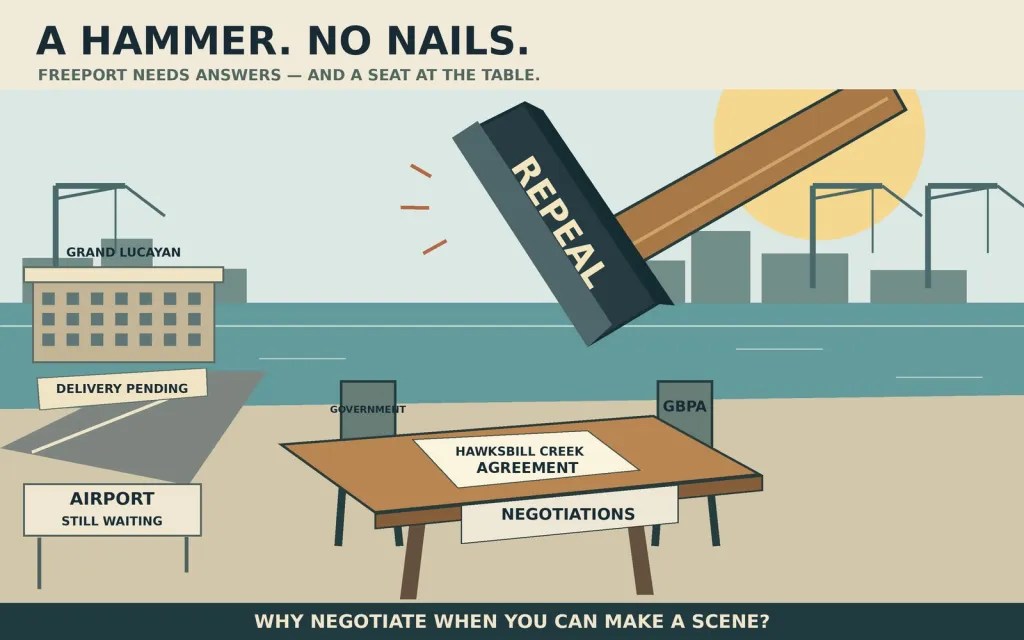
Before taking over Freeport, show us the areas you already govern
There is also a rather awkward practical question: if the government has the answers to Grand Bahama’s problems, why has it not demonstrated them more convincingly in the areas where the GBPA is not the governing obstacle?
Take East Grand Bahama. Take West Grand Bahama—particularly the western communities whose residents should not have to wait for a constitutional-sized confrontation in Freeport before seeing meaningful improvements.
Where is the record of delivery that makes the government’s case for it?
Show residents reliable infrastructure, effective public services, sustained investment and visible opportunity in the communities already under the government’s authority. Then the argument practically writes itself: Here is what we achieved where we had responsibility; here is what we propose for Freeport.
Instead, the public is being asked to make a considerable leap—from promises not yet fulfilled to confidence that additional powers will produce different results.
Apparently, the cure for disappointing delivery is a larger jurisdiction.
That is an ambitious theory. It would benefit from some evidence.
The airport and hotel cannot simply be reassigned to the blame department
The airport and the Grand Lucayan deserve particular attention because they are not merely abstract arguments about Freeport’s governance. They are tests of decisions, execution and accountability.
The Davis administration cancelled the inherited Royal Caribbean/ITM proposal for the Grand Lucayan, arguing that its terms were not in the national interest. It was entitled to assess that agreement critically. An inherited deal is not automatically a good deal.
But rejecting a predecessor’s approach creates an obligation to deliver a better one—not a permanent exemption from responsibility for what follows.
On the airport, too, the public deserves a clear account of the arrangements inherited, the decisions subsequently taken, the financing secured and the delivery timetable. The history is more complicated than pretending that both properties came with guaranteed, ready-to-go solutions. But complexity cannot become an all-purpose shelter from accountability.
Once a government changes course, it must eventually explain where its own course has taken us.
The GBPA should answer for its responsibilities. The government should answer for its own. Grand Bahamians deserve better than a political accounting system in which every outstanding liability is transferred to the Port Authority.
Has anyone considered the revolutionary act of negotiating?
The GBPA says it is willing to engage constructively. That statement should be tested, not merely applauded. Meaningful consultation must involve more than the Port defending its privileges, just as it must involve more than the government presenting a predetermined outcome with a microphone attached.
But if the government wants concessions, clearer responsibilities, stronger accountability and a better deal for Freeport, why not put specific proposals on the table and negotiate?
What, exactly, has it asked the GBPA to concede? What has the Port rejected? Where are the points of agreement? What remains unresolved?
Residents should not have to reconstruct the negotiations from competing press releases.
Sitting down with the GBPA would not make the Prime Minister weak. Securing enforceable commitments would make him effective. There is no surrender in negotiating a better arrangement; the surrender would be allowing political pride to obstruct one.
If the ambition is a legacy to rival Sir Lynden’s, it would help to remember that historical stature is not measured by the temperature of a confrontation. It is measured by what the country gains when the confrontation ends.
Arbitration was not a blank cheque—for either side
The arbitration outcome also requires a little more sobriety than political combat usually allows.
The rejection of the government’s substantial reimbursement claim does not prove that the GBPA is beyond criticism. Nor does it establish that every possible reform is unlawful.
But neither does disappointment in arbitration supply fresh legal authority to dismantle the agreement. A government cannot treat an unfavourable result as permission to move the argument from the hearing room to the political stage and declare the legal difficulties resolved.
The sensible response is to understand the ruling, explain its implications and identify a lawful, workable path forward.
The less sensible response is to reach for a bigger hammer.
Reform, yes. Another distraction, no.
Freeport needs change. Its residents should have a meaningful voice in decisions affecting their city. Its businesses need predictability. Its institutions—public and private—need accountability.
None of that requires accepting the proposition that the government is always right because the Port is sometimes wrong.
The administration must establish both its legal case for the changes it proposes and its practical case for being trusted to deliver them. The GBPA, in turn, must demonstrate that its invitation to dialogue includes a willingness to make meaningful concessions.
So, Prime Minister: publish the legal rationale, identify the protections for licensees and investors, explain the potential cost, and show the public what you are prepared to negotiate.
And while that work proceeds, deliver in the parts of Grand Bahama where you already have the authority you say Freeport needs.
That would be a far more persuasive argument than another speech about who is standing in your way.
At present, the administration appears to be approaching a delicate legal and economic problem with a hammer—without first establishing where the nails are, who owns the wall, or whether the taxpayer will receive the repair bill.
The people of the Bahamas and certainly of Freeport, Grand Bahama deserve more than talk and political rhetoric at this point.
END

