
There is something profoundly wrong when the Prime Minister of The Bahamas appears offended that a journalist would ask how much the Government is spending of the people’s money.
Let us make this simple, Prime Minister Philip Davis: you work for the Bahamian people. You do not own the Government, the Treasury or the right to decide that legitimate questions about public expenditure are beneath your attention.
Accountability is not an optional extra, switched on when politically convenient.
THE KING IS COMING. WHAT ARE WE PAYING?
Asked about the cost of King Charles III’s visit, Davis reportedly responded, according to The Nassau Guardian: “The dollar figure? I don’t know anything about that. See why I don’t want to … Why you want to raise that?” He subsequently walked away.
Nobody expects the Prime Minister to memorise every invoice. But there is a substantial difference between saying, “I don’t have the figure, but we will publish it,” and treating the question as an affront.
The reporter was not questioning the King’s welcome. The reporter was asking what taxpayers would pay.
That is not disrespectful, anti-monarchy or unpatriotic. It is journalism.
Nobody suggests welcoming the King with a folding chair and a handwritten apology about the budget. Security, transport and ceremonial arrangements may be entirely appropriate. But appropriateness does not eliminate the obligation to disclose their cost.
Foreign Affairs Minister Fred Mitchell reportedly said the spending was “appropriate” and would not “break the bank.”
Wonderful. But “it won’t break the bank” is not an accounting statement. The public asked for figures, not reassurance.
What is the total? Which departments are paying? What covers security, accommodation, transport and ceremonies? Will there be a final accounting?
A responsible government should anticipate those questions, not resent them.
THE PROMISE WAS TRANSPARENCY
The PLP’s 2021 “Blueprint for Change” and the October 6 Speech from the Throne promised accountability, transparency and implementation of the Freedom of Information Act.
Those were commitments to the electorate, not decorative language.
The Government’s 2026 progress report presents the manifesto as its governing agenda and accountability as part of its purpose. Transparency, therefore, is not an expectation invented by the Opposition nor the public. It is the administration’s own advertised standard.
But publishing achievements is easy. Publishing politically inconvenient financial records is the real test.
On that test, uncomfortable questions keep accumulating.
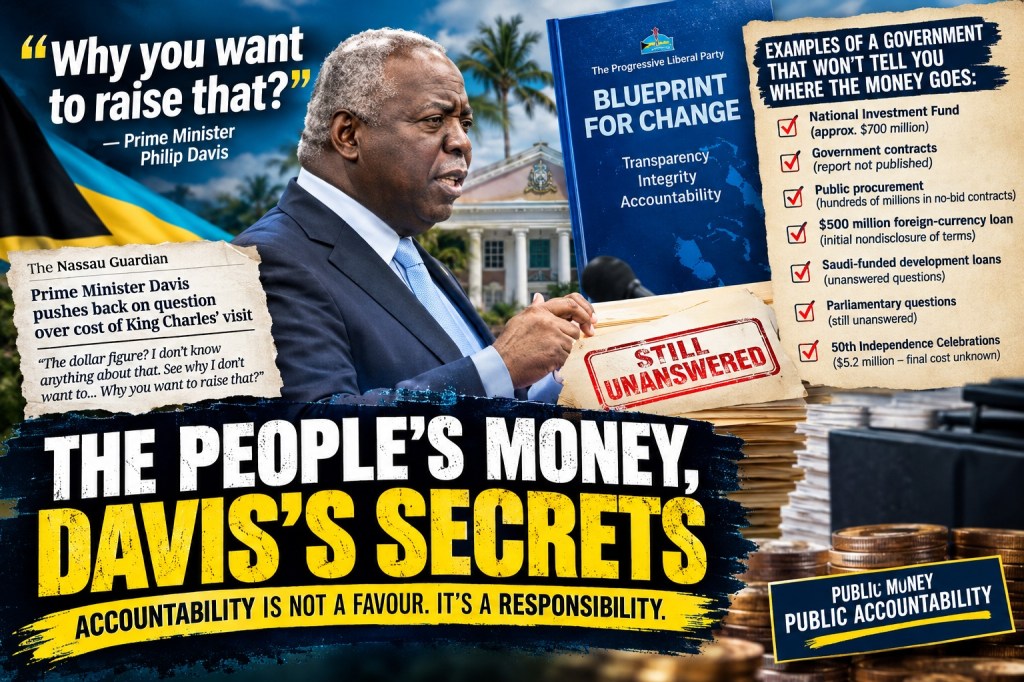
THE NATIONAL INVESTMENT FUND
In May 2026, Finance Minister Michael Halkitis told Parliament that approximately $700 million in excess borrowing receipts had been transferred to the National Investment Fund.
Central Bank Governor John Rolle confirmed that the Fund’s Board of Governors had never formally convened, although an account bearing its name had operated at the Central Bank, with transactions beginning in July 2025.
In September 2026, Halkitis identified approximately $310.9 million in expenditure on infrastructure and strategic assets. The Opposition continued seeking a complete accounting of the roughly $700 million, including the remaining funds, transaction accounts and authorisations. By October 14, The Tribune reported that the Public Accounts Committee was still seeking documents.
The Government has cited parliamentary borrowing authority and the Public Finance Management Act. Davis has denied wrongdoing. Opposition allegations are not findings of criminal liability.
Nevertheless, the questions remain: who authorised the transactions, under what authority, and where is the complete reconciliation? Why had the statutory board never formally convened?
“Nothing untoward happened” cannot replace independently verifiable records. Reassurance is welcome. Documentation is indispensable.
CONTRACT REPORTS AND NO-BID AWARDS
In February 2023, Davis said a report on contracts awarded since his administration took office was being finalised. Months later, it remained unpublished. August reporting recorded Opposition criticism and an explanation involving missing information in the eProcurement system.
The public deserves to know who received contracts, their value, what was promised and what was delivered. Legitimate legal exceptions exist, but a government signature does not automatically turn a contract into a state secret.
“Being finalised” is not a permanent reporting category.
In April 2026, The Tribune reported that its review of official procurement records identified 927 of 3,881 categorised contracts as awarded without competitive bidding, worth approximately $233.6 million.
No-bid does not automatically mean unlawful. Procurement legislation permits exceptions. But exceptions require explanations, not immunity from scrutiny.
Why was competition bypassed? Which exception applied? Who benefited? What demonstrated value for money?
If the decisions were justified, publish the justification. If the work was delivered, publish the supporting records. Incomplete procurement information makes meaningful scrutiny harder, not less necessary.
BORROWING IS NOT FREE MONEY
In January 2024, the Government announced a $500 million foreign-currency loan supported by an Inter-American Development Bank guarantee. Full financial terms were not initially disclosed, with Financial Secretary Simon Wilson referring to nondisclosure restrictions.
Additional information subsequently appeared in the mid-year budget statement, including an all-in interest rate of 8.6467% for the first interest period. It would therefore be wrong to claim the terms were never released.
But eventual disclosure does not settle the question of timely disclosure.
Taxpayers ultimately service public debt. Interest rates, repayment schedules, guarantees and risks are central facts, not inconvenient technicalities. Confidential negotiations may be legitimate; indefinite secrecy after completion is another matter.
Questions about Saudi-related development financing, including the North Eleuthera airport, deserve equally clear answers. What entities borrowed? Who must repay? What guarantees exist? What liabilities fall on the Government or public corporations?
Development financing can benefit the country. That does not excuse withholding the obligations undertaken in its name. Publish agreements and guarantees wherever legally permissible.
PARLIAMENT IS NOT A NUISANCE
Reported disputes over unanswered parliamentary questions have also concerned borrowing, BPL financing and public expenditure. The Tribune recorded Opposition criticism in May 2024; further complaints about outstanding financial questions followed in December 2025.
Technical answers sometimes require verification. That is reasonable. Repeatedly leaving basic financial questions unresolved is not.
Opposition MPs are not entitled to have allegations accepted as facts. They are entitled to seek answers, and ministers should substantiate decisions with accurate records.
Parliament is an institution of accountability, not an irritation to be managed. Citizens should not need a political controversy every time they want information about their money.
THE INDEPENDENCE CELEBRATIONS
The fiftieth anniversary of Independence deserved celebration. Patriotism, however, does not suspend bookkeeping.
The Government budgeted $5.2 million for the celebrations in 2022–2023, compared with $750,000 previously budgeted for ceremonial events. Officials subsequently said costs were still being compiled. In June 2024, The Tribune reported that the final cost remained unknown; July 2026 reporting again indicated uncertainty about whether expenditure had stayed within budget.
The distinction matters: $5.2 million was the allocation, not verified final spending. Without evidence, nobody should claim that exact expenditure or an overrun.
But where is the reconciliation? What covered local and overseas events, concerts, ceremonies and logistics? Were additional allocations required? Were commitments outstanding?
A national celebration should leave wonderful memories, not taxpayers indefinitely waiting for the invoice.
MR PRIME MINISTER, ANSWER THE QUESTION
The reporter asked because government expenditure is not private expenditure. Because your party promised transparency. Because the people financing the state deserve to know how their money is used.
“It won’t break the bank” is not an answer. “The spending was appropriate” is not a full accounting. “The report is being finalised” is not publication. And “we acted within the law” does not remove the obligation to explain what happened.
This is not an argument against the King, national celebrations, infrastructure or development financing. It is an argument for one principle governing them all: public money demands public accountability.
Each controversy has its own facts. Government explanations deserve fair consideration. Not every delay proves misconduct, every disputed transaction illegality, or every no-bid award impropriety.
But when the same questions recur across funds, contracts, borrowing and celebrations, the pattern cannot simply be dismissed as politics.
Where are the records? Who authorised the spending? What did it cost? Where is the complete account?
The Prime Minister need not memorise every figure. He must ensure figures are available, records maintained and Parliament answered.
If information is unavailable, say so. Set a reasonable deadline. Publish the records. Explain lawful exceptions. Correct mistakes.
The standard should not depend on whether a question comes from a friendly supporter, an Opposition MP or a persistent reporter. Public ownership of the money does not change with the questioner. Neither should the Government’s willingness to provide a clear and documented answer.
That is confidence in stewardship. Walking away is not.
Bahamians do not need a government telling them not to worry about the money. They need accounts demonstrating why they should have confidence.
Transparency belongs where questions are difficult and answers inconvenient, not merely in campaign slogans and glossy reports.
Accountability is not a favour a Prime Minister grants. It is an obligation of office.
Mr Prime Minister, the public is not asking why it should stop asking questions. It is asking you to answer them.
The Treasury belongs to the people. The responsibility belongs to the Government. The right to demand an accounting belongs to every Bahamian taxpayer.
The Bahama deserves better.
END

