
The July 22 Nassau Guardian report describing the Bahamian economy as being on a stable growth path should not be treated as proof that every sector of the economy is functioning efficiently. In fact, developments immediately afterward expose a significant vulnerability: an economy cannot sustainably grow if one of its most basic productive inputs—reliable electricity—remains unreliable.
What the evidence shows
The IMF projected real GDP growth of about 2.2% for 2026, following estimated growth of 2.8% in 2025. It also specifically identified electricity-sector reform as important to sustaining growth and improving the cost and reliability of power.
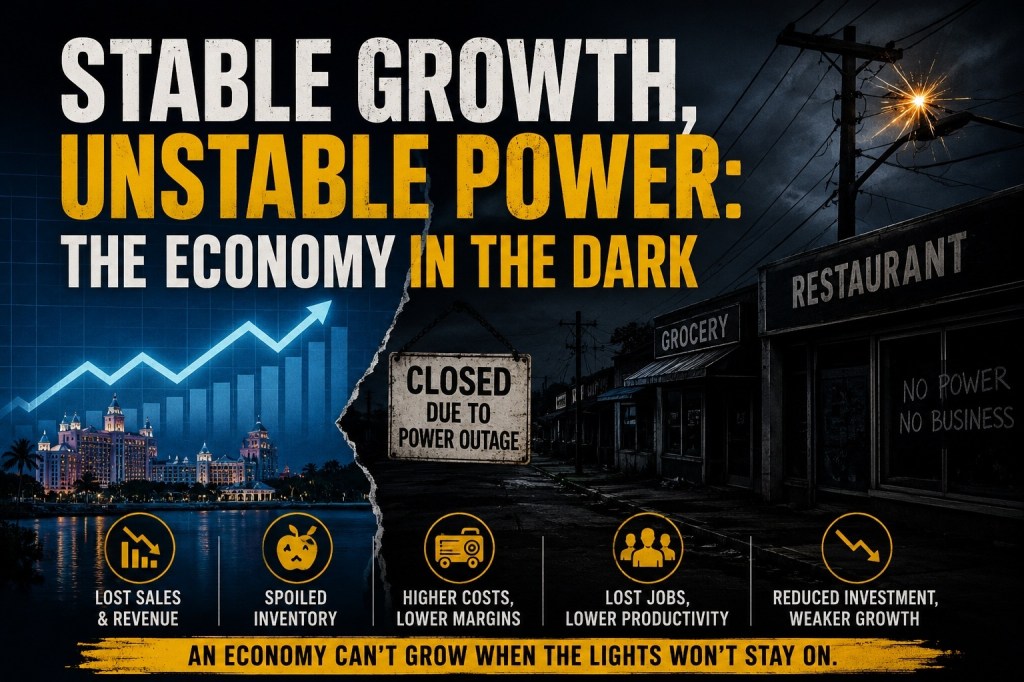
Then, within days of the July 22 economic-growth story, the Bahamas Chamber of Commerce warned that businesses across New Providence and the Family Islands were suffering financial losses from persistent outages. Restaurants, grocery stores, pharmacies, manufacturers, retailers and service providers reported closures, lost sales, payment-system failures and spoiled inventory.
That matters economically for several reasons:
1. Lost electricity becomes lost GDP.
When a restaurant closes for several hours, it doesn’t simply lose electricity—it loses meals sold, wages paid during productive hours, sales tax generated and income that would otherwise circulate through the economy.
2. Businesses incur costs even when they remain open.
Generators require fuel and maintenance. Employees may have to be paid overtime to recover work delayed during outages. Refrigerated businesses face spoiled inventory. The Chamber has specifically reported these consequences.
3. Productivity falls.
A business that should complete 100 units of work but can only complete 70 because of repeated interruptions has experienced an effective reduction in productive capacity. The problem becomes particularly serious for manufacturing, technology, professional services and businesses dependent upon electronic payment and communications systems.
4. Tourism becomes vulnerable.
The Bahamas’ economic growth is heavily dependent upon tourism. An unreliable electricity system raises operating costs for hotels, restaurants, attractions and other tourism businesses. The IMF has already identified electricity costs and reliability as important factors affecting investment and competitiveness.
5. Investment decisions are affected.
This is perhaps the most important long-term issue. Central Bank Governor John Rolle cautioned in July that it was premature to conclude that the summer outages had already materially reduced overall economic growth. But he also acknowledged that the cost of energy is a factor in investment decisions and competitiveness.
That distinction is crucial.
It is entirely possible for the Central Bank to say, “We don’t yet have evidence that the outages have materially reduced GDP,” while simultaneously acknowledging that unreliable and expensive electricity is damaging the country’s investment environment.
The warning from the IMF is particularly significant
The IMF’s own research provides some historical context. It found that more than 80% of Bahamian firms experienced power outages in 2019/20, compared with 67% across the Caribbean. Those outages occurred about three times a month and were associated with an estimated 2.5% loss of annual sales for affected firms.
So, the economic question isn’t simply:
“Did the July/August 2026 outages reduce GDP?”
The more important question is:
“How much economic growth is The Bahamas failing to achieve because businesses cannot depend on the electricity system?”
Those are two very different questions.
The July 22 headline versus the August reality
This is where the political and economic contradiction becomes interesting.
On July 22, the story was essentially: the economy is on a stable growth path.
By July 28, the Chamber was reporting businesses closing, customers being turned away and inventory being spoiled because of power outages.
By July 31, the Central Bank was saying it was too early to quantify the impact of the outages on overall economic growth.
And by August, BPL was still issuing updates concerning extended outages affecting areas and islands around the country.
That creates an important analytical point:
The absence of measured GDP damage is not the same thing as the absence of economic damage.
GDP statistics are backward-looking and aggregate. A small business owner who loses $5,000 in spoiled inventory, a restaurant that closes for an afternoon, or a contractor who loses a day’s productivity may feel the economic impact immediately—even though the national GDP statistics may not yet capture it.
The bigger problem: confidence
There is also a less visible economic cost.
Businesses make investment decisions based partly on whether they can predict their operating environment. If an investor has to ask:
- Can I operate eight hours a day reliably?
- Do I need to purchase a generator?
- How much fuel will I have to keep on hand?
- What happens to refrigerated inventory?
- Can my customers pay electronically during an outage?
- Will my employees be productive?
- Will outages affect hotel guests and tourism customers?
then electricity becomes more than an operating expense.
It becomes an investment-risk calculation.
That is precisely why the IMF has described electricity reliability and cost as a constraint on private-sector growth.
The uncomfortable conclusion
The July 22 “stable growth” narrative may be economically defensible at the macro level, particularly because tourism, construction and major investment projects continue to support the economy.
But it would be misleading to interpret that headline as evidence that the underlying economy is without serious structural problems.
The IMF’s 2026 projection is only 2.2% real GDP growth, and the IMF expects growth to moderate toward roughly 1½% over the medium term.
Against that relatively modest growth trajectory, persistent electricity disruptions are particularly dangerous.
If businesses are losing operating hours, inventory, productivity and sales, then the country isn’t merely experiencing an inconvenience.
It is potentially destroying some of the very economic activity it is trying to grow.
And that raises the most important question for the Davis administration:
If the economy was supposedly on a stable growth path on July 22, how stable can that growth really be when businesses cannot depend on the electricity required to produce, sell, communicate, preserve inventory and serve customers?
The government’s economic scorecard cannot simply measure how much GDP grew.
It should also ask how much growth was lost because the infrastructure necessary to produce that GDP failed.
That is the real economic test of the electricity crisis.
The Bahamas deserves so much better.
END
 My Morning Paper