
There are few things quite as entertaining in our Bahamian politics as Fred Mitchell lecturing the country about the evils of the Free National Movement (FNM) while standing on a piece of political history that the FNM itself helped create.
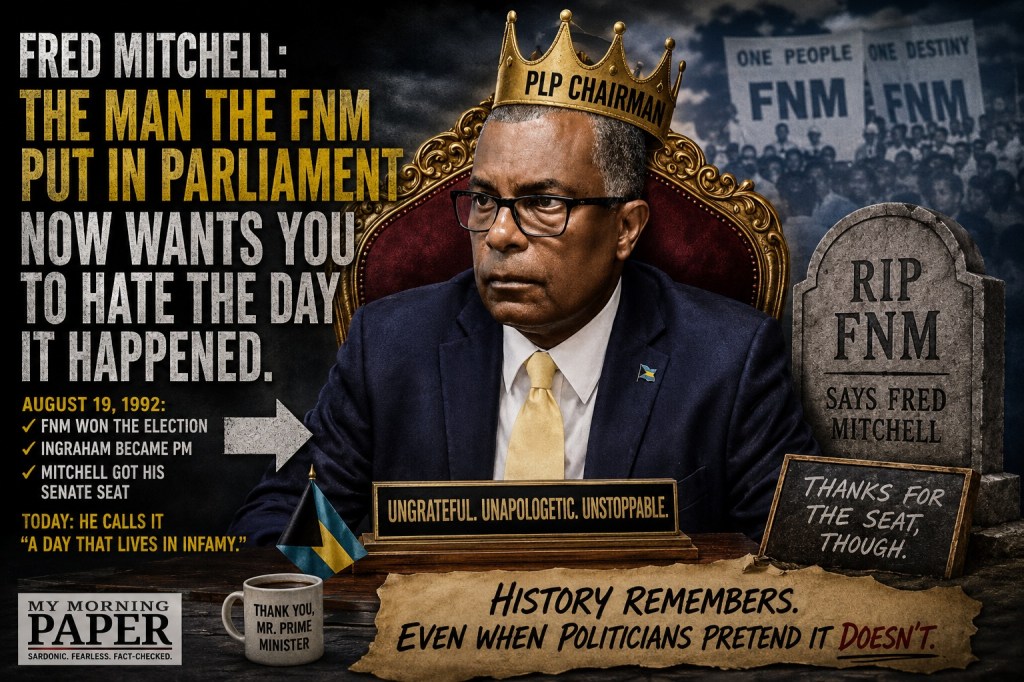
Today, August 19, Fred Mitchell would apparently like right-thinking Bahamians to regard the election of the FNM government in 1992 as some sort of “National Day of Infamy”.
That is quite a performance.
Especially from a man who, although never an FNM member, entered Parliament in 1992 because FNM Prime Minister Hubert Ingraham appointed him to an independent Senate seat. Mitchell served in the Senate from 1992 until 1996/97 before eventually joining the PLP and winning election to the House.
So here we are, three decades later, watching the Chairman of the PLP attempting to turn August 19 into something resembling a national crime scene.
Apparently the FNM’s greatest historical offence is that it won.
And apparently Mr. Mitchell’s first parliamentary appointment is to be treated as an unfortunate clerical error because without it he would probably still outside of parliament burning constitutions.
Mitchell describes the FNM’s 1992 victory as a day that “lives in infamy.”
One almost expects the next sentence to begin:
“Previously, on Days of Our Political Lives…”
But before we allow the Chairman to rewrite the history books, perhaps we should read a few of the pages he would rather have us skip.
Yes, the FNM changed the direction of the country in 1992.
Yes, reasonable Bahamians can debate the merits and consequences of individual FNM policies.
Yes, the International Persons Landholding framework remains a legitimate subject for criticism and debate.
But here is the inconvenient part for Mr. Mitchell’s historical sermon:
The PLP has had ample time to change policies it believes were disastrous.
The FNM did not remain in office for the next thirty years.
The PLP has governed for substantial periods since 1992, including the present administration.
So, if the land policy is responsible for today’s problems, the obvious question is not merely:
“Why did Ingraham do it?”
It is:
“Why hasn’t the PLP fixed it?”
At some point, blaming a government from the last century becomes less an explanation and more a substitute for governing.
Then comes BTC.
Mitchell presents the privatization of BTC as though Hubert Ingraham wandered into the Cabinet one morning, spotted the national telephone company and announced:
“Let’s sell that.”
History is slightly less theatrical.
The Ingraham government completed the privatization of BTC in April 2011, selling 51% to Cable & Wireless for US$210 million.
And, rather inconveniently for today’s political mythology, the government’s stated plan included offering shares to Bahamians so that the public could participate in ownership. Ingraham told Parliament that the government intended to sell approximately 9% of the shares to the Bahamian public.
That does not mean everyone must agree with the BTC sale.
It does mean that honest political debate requires something more than selecting the portions of history that fit neatly into a press statement.
And there is another little historical wrinkle.
The privatization process did not originate in a political vacuum. Ingraham said the government had concluded that privatization and liberalization were necessary to improve telecommunications, after years of considering different arrangements.
So, by all means criticize the transaction.
But criticize it with the facts.
Mitchell also invokes the destruction of Bahamian agriculture.
Fair enough.
Agriculture deserves serious discussion.
But if the PLP wants to present itself as the permanent guardian of Bahamian farmers, perhaps the public is entitled to ask a wonderfully simple question:
After all these years, where is the agricultural revolution?
Where is the dramatic reduction in the nation’s dependence on imported food?
Where is the corresponding reduction in grocery prices?
Where is the transformation that ordinary Bahamians can actually see when they walk into a supermarket?
BAMSI can be discussed.
Government expenditure can be discussed.
Programs can be discussed.
But eventually the conversation has to leave the conference room and arrive at the grocery counter.
Because the Bahamian consumer doesn’t eat press releases.
And then we arrive at the port.
According to Mitchell’s argument, the FNM’s legacy includes handing the country’s principal seaport over to a handful of families and contributing to monopoly pricing.
Yet when the cruise industry generates record or increased passenger numbers, governments are perfectly happy to celebrate the economic benefits.
One begins to wonder whether the port is a national disaster or an economic triumph depending upon which microphone is switched on.
Perhaps it can be both.
But again, political honesty requires acknowledging the complexity rather than converting history into a morality play with the FNM permanently cast as the villain.
The really delicious irony in Mitchell’s speech is that he wants Bahamians to believe that August 19, 1992, should be remembered principally as the beginning of everything that is wrong with The Bahamas.
Except that August 19, 1992, was also the beginning of Fred Mitchell’s parliamentary career.
That is not an opinion.
That is history.
The FNM won.
Hubert Ingraham became Prime Minister.
And Fred Mitchell received an independent Senate appointment from the government he now describes with such extraordinary contempt.
Politics can produce some remarkable transformations.
Apparently one of them is the ability to receive a parliamentary appointment from a government and, three decades later, describe the election that produced that government as a day that “lives in infamy.”
That is some Olympic-level political gymnastics.
Mr. Mitchell concludes:
“Let the FNM rest in peace. Amen.”
But that may be the one part of his speech that requires correction.
The FNM is not dead.
It is a political party.
It has won elections.
It has lost elections.
It has made mistakes.
It has accomplished things.
It has been criticized.
It has been praised.
And, most importantly, it remains part of Bahamian democratic history.
August 19, 1992, cannot be erased because Fred Mitchell finds the anniversary inconvenient.
The FNM’s victory ended 25 consecutive years of PLP government under Lynden Pindling. That fact alone makes the date historically significant.
One does not have to support the FNM to acknowledge that.
And one certainly does not have to pretend that everything the FNM did was perfect.
But neither should we allow politicians to turn their version of history into a political weapon by demanding that the public forget the inconvenient parts.
So perhaps, before Fred Mitchell asks Bahamians to remember August 19 as a day of infamy, he might take a moment to remember something else:
The FNM government he now wants the country to despise was the same government that opened the door to his first seat in Parliament.
That little historical footnote doesn’t quite fit the sermon.
But then again, inconvenient facts rarely do.
And if the Chairman wants to bury August 19, he might want to be careful about digging the grave too deep.
He may discover that his own political biography is buried in there with it.
The Commonwealth of The Bahamas deserves better.
END
 My Morning Paper