
My Dear Mr. Prime Minister,
How exquisitely appropriate.
There you were last night, addressing the nation about the darkness enveloping The Bahamas — explaining, reassuring, diagnosing, promising.
And, almost as if the electrical grid itself had developed a rather refined sense of political irony, a large portion of New Providence was plunged into darkness as you began speaking.
One almost hates to interrupt such a perfectly staged moment.
But let us examine your explanation, shall we?
You told Bahamians that the electrical system you inherited was effectively “on life support.” You described ageing infrastructure, failed equipment, decades of temporary fixes and a system that was never properly modernised. You said more than 60 percent of New Providence’s generation equipment needed replacement when your administration took office, with the figure even higher in the Family Islands.
Quite a dreadful condition, pure doom and gloom.
One question, however, keeps scratching at the door:
Who, exactly, was supposed to have noticed?
Because, Mr. Prime Minister, this is where your little tale becomes rather interesting.
You were not some unsuspecting gentlemen who wandered into the Ministry of Works one morning and discovered, to his horror, that BEC had been neglected.
From 2012 to 2017, you were Deputy Prime Minister and Minister of Works and Urban Development, with responsibility that included BEC and the country’s physical infrastructure.
And it was your own Christie administration, under your ministerial responsibility, that formally confronted the miserable state of BEC.
In 2015, you announced PowerSecure as the preferred bidder to manage the corporation. In 2016, under your watch as Minister of Works, the government entered into a five-year management agreement giving PowerSecure responsibility for generation, transmission and distribution.
Indeed, your own government’s presentation of the problem was remarkably familiar.
BEC, you said at the time, was unsustainable, debt-ridden and suffering from inadequate generation assets. The government identified the need for at least $450 million in capital investment over five years to address the problems confronting the system.
So, forgive the question, Prime Minister:
When did the infrastructure become old?
Was it sometime after you left the Ministry of Works in 2017?
Or was it already old when you were sitting in the ministerial chair?
And if it was already sufficiently decrepit in 2016 to require hundreds of millions of dollars of investment, why are we sitting here in August 2026 listening to essentially the same diagnosis?
Perhaps the infrastructure did not age.
Perhaps the explanation did.
Because now, after five years as Prime Minister, we are being invited to contemplate the fascinating proposition that the principal problem confronting your government is the condition of a system that you have known about for years.
You became Prime Minister in September 2021.
You were subsequently returned to office in May 2026 for a second consecutive term.
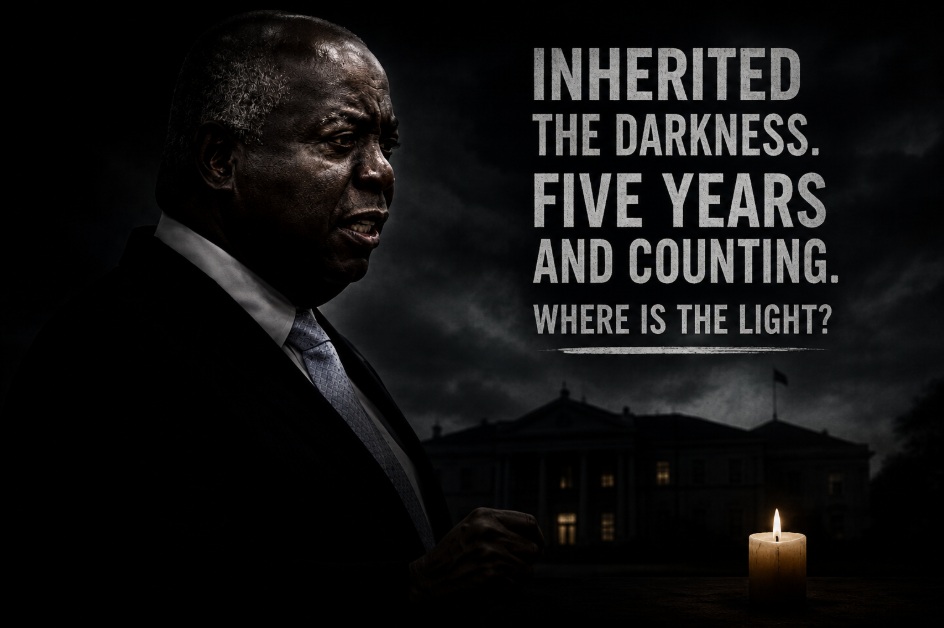
That means the word “inherited” has now had rather a long life in your administration.
Five years.
Then another mandate.
And yet the electrical system is still being presented to the Bahamian people as though it were a recently discovered crime scene.
My dear Prime Minister, you have had five years to investigate the body.
You have had another five-year mandate to repair the morgue.
At some point, one must stop asking who killed the patient and start asking who has been holding the clipboard.
The Overtime Mystery
Now, to be fair, you raised a legitimate issue last night.
The Tribune reports that BPL spent approximately $20 million on overtime last year. Three employees in the Fuel and Performance Department reportedly received a combined $601,295.16 in overtime between May 2025 and April 2026. One employee’s records reportedly showed 18 hours claimed on Christmas Day followed by 24 hours on each of the next three days — 90 hours over four days.
You quite properly called that a management and oversight problem.
Quite right.
But management and oversight, Mr. Prime Minister, have a rather nasty habit of eventually finding their way upstairs.
If there has been a failure of management, controls and oversight “across administrations,” as you said, then perhaps the country is entitled to ask:
When does “across administrations” become “this administration”?
Because those three employees did not apparently collect that $601,295 in 2016.
They collected it between May 2025 and April 2026.
That is your administration.
The policy you are now defending is your government’s policy.
The management structure is operating under your government.
And the company was spending the money while you were Prime Minister.
So yes, investigate the overtime.
But please don’t mistake investigation for absolution.
And Then There Is the Fuel
There is another little detail history has inconveniently preserved.
When your administration came to office in 2021, BPL’s fuel-hedging programme was already producing significant savings.
An October 2021 letter from then-BPL CEO Whitney Heastie to Works Minister Alfred Sears said the programme had produced approximately $30 million in fuel-cost savings through September 2021, with estimated savings of $55 million by January 2022.
The subsequent argument over whether the Davis administration received and acted upon specific advice regarding additional hedging trades remains politically contested.
So, I would not present the matter as the simple fairy tale that “Davis cancelled the hedge and therefore electricity bills exploded.”
That would be too convenient.
But this much is beyond dispute:
Your government inherited a fuel-hedging mechanism designed to stabilise costs, and your government subsequently had to confront rapidly rising electricity charges.
That deserves examination.
Especially because governments cannot simultaneously claim credit for everything that works and blame everybody else for everything that doesn’t.
That is not governance.
That is accounting by séance.
What Went Wrong?
You told Bahamians last night that you could have simply rented another engine and patched another cable — as governments had allegedly done for decades.
But, Mr. Prime Minister, you were one of the people who occupied the room when those decisions were being made.
Your government in 2016 understood the system needed massive investment.
Your government established PowerSecure to manage the utility.
The succeeding FNM administration ended that management agreement in 2017.
Then you returned as Prime Minister in 2021.
Five years later, you are telling us that the system is still old, still fragile, still requiring massive investment, still dependent upon temporary generation and still vulnerable to catastrophic outages.
And now you tell us:
“I am not here to manage this. I am here to fix it.”
Beautiful.
Absolutely beautiful.
Except, Mr. Prime Minister, that was the job description five years ago.
The Curious Case of Responsibility
You also said something else rather revealing.
You said:
“The responsibility to act is ours.”
There we agree.
Entirely.
It is yours.
It has been yours.
And, before that, you personally had direct ministerial responsibility for BEC.
That is precisely why the constant invocation of the word “inherited” is becoming less persuasive with every passing blackout.
A government can inherit a problem.
It cannot reasonably inherit the same problem for five years, repeatedly diagnose it, announce reforms, make promises, spend money, change ministers, create companies, launch initiatives and then return to the electorate saying:
“Look what we inherited.”
At some point, Prime Minister, the inheritance becomes an estate you have been administering.
And the beneficiaries are beginning to wonder where the money went.
And What of Minister Coleby-Davis?
Which brings us, rather delicately, to the question of the Minister responsible for Energy.
JoBeth Coleby-Davis has been one of the public faces of the government’s energy agenda. Yet last night’s address had the unmistakable character of a Prime Minister stepping directly into the centre of a crisis that has become too large to leave at ministerial level.
That raises an uncomfortable question.
Is the Prime Minister merely taking charge during an extraordinary national emergency?
Or has the BPL crisis become so politically radioactive that the Prime Minister now has to personally explain what the responsible ministry has been unable to explain convincingly?
Either way, the optics are not particularly comforting.
Because if the minister has the authority, why must the Prime Minister rescue the portfolio?
And if the Prime Minister must rescue the portfolio, why have we been paying for the portfolio?
One begins to suspect that somewhere inside the machinery of government there is a very lonely switch marked:
“ACCOUNTABILITY.”
Perhaps someone should turn it on.
Assuming, of course, BPL permits it.
The Final Question
Mr. Prime Minister, nobody seriously expects you to manufacture electricity with a wave of your hand.
Nobody expects you to prevent every mechanical failure.
Nobody expects an ageing utility to become modern overnight.
And nobody should pretend that the FNM bears no responsibility for the decisions it made while in office.
But political accountability has a rather simple principle:
You inherit circumstances. You own decisions.
And after five years in government — followed by a successful campaign for another five years — your administration cannot forever occupy the comfortable territory between “we inherited it” and “give us credit for fixing it.”
You cannot have both.
If the infrastructure was already in crisis when you arrived, tell us precisely what your government did about it.
If you spent five years rebuilding it, show us the results.
If you say the system is finally being transformed, show us the contracts, the timelines, the expenditure, the milestones and the measurable improvements.
And if there were failures in management, controls and oversight under your government, investigate them without using the word “inherited” as a diplomatic fog machine.
Because last night, while you were telling Bahamians that you were going to bring light to the darkness, the lights went out.
Some might call that coincidence.
Others might call it irony.
And somewhere, I suspect, the electrical grid itself was quietly smiling.
Yours rather darkly,
My Morning Paper
P.S. Prime Minister, when you said “What we inherited is not what we will leave behind,” the country heard the promise. After five years, however, Bahamians are entitled to ask whether the next inheritance will be another explanation — or finally an electrical system that works.
The Bahamian people deserve better.
END

