
Apparently, here in the Bahamas of 2026, there is a new political theory emerging from the chairman of the Progressive Liberal Party (PLP): if the lights go out, look for an FNM talking point.
If the courts cannot function because of power interruptions, apparently that too is an FNM talking point.
And if the President of the Bahamas Bar Association raises concerns about the effect of those interruptions on the administration of justice, well, according to Fred Mitchell, perhaps he is not really talking about justice at all. Perhaps he is simply helping the FNM win an election that is still some 56 months away.
One has to admire the creativity.
But there is a problem with this argument.
The electricity went off.
That is not a political opinion.
That is not an FNM slogan.
That is not a headline manufactured by Kahlil Parker.
It is a practical problem when a court cannot operate normally because there is no electricity.
And when that happens, it is entirely legitimate for the President of the Bar Association to raise the issue of access to justice.
In fact, the Bahamas Bar Association’s own stated mission includes ensuring continued access to justice and preserving the rule of law.
So let us separate the politics from the facts.
Mitchell is correct about one important point: the courts are no longer simply another department of government operating under the old administrative structure.
The Court Services Act, 2023 established the Court Services Council and transferred responsibility for the administration and support services of the courts to an autonomous body. The Chief Justice himself described the legislation as a major step toward allowing the judiciary to manage its administrative and financial affairs.
But that fact does not make the problem of electricity disappear.
Nor does it make the Bar President’s concerns illegitimate.
And it certainly does not establish that Parker’s comments were politically motivated.
That is where Mitchell’s argument takes an unfortunate turn.
Instead of asking the obvious question — “Why are the courts experiencing power interruptions, and what is being done to ensure that justice is not disrupted?” — Mitchell spends much of his commentary attempting to establish the political pedigree of the person asking the question.
Apparently, Parker is using “FNM talking points.”
Apparently, he should have telephoned the Chief Justice rather than speaking publicly.
Apparently, his statement was more about his newspaper photograph than the functioning of the courts.
And apparently, somewhere in all of this, there is a grand conspiracy to help the FNM win the next election.
That is a remarkable amount of political analysis for a problem that could apparently be solved by keeping the electricity on.
More importantly, there is no evidence presented in Mitchell’s remarks establishing that Parker’s statement was politically motivated.
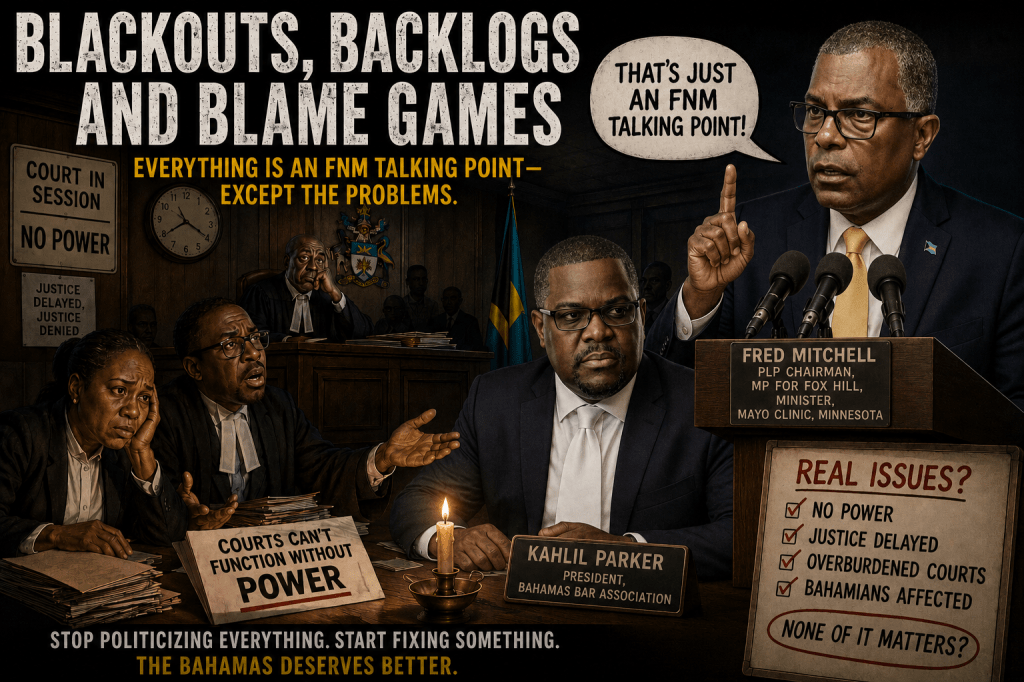
Parker is the elected President of the Bahamas Bar Association. The Bar’s own records identify him as its current president, and his professional biography describes his work in public law, litigation, appellate law and law reform.
The Chief Justice’s own 2026 opening-of-the-legal-year remarks also thanked Parker and the Bar Council for their work and described the relationship between the judiciary and the Bar as a continuing partnership.
So, the attempt to turn Parker into an FNM political operative requires evidence.
Where is it?
If Mitchell has evidence that Parker’s statement was coordinated with the FNM, he should produce it.
If he has evidence that Parker was acting politically rather than professionally, he should produce that too.
Otherwise, it is simply a political accusation being substituted for an answer to a substantive question.
And that brings us to the bigger issue.
Mitchell asks: what about all the cases that are delayed because lawyers routinely seek adjournments?
Fair question.
But it is also a spectacular example of changing the subject.
The existence of one problem does not cancel another.
If lawyers unnecessarily delay cases, deal with that problem.
If court administration is inefficient, fix it.
If the Court Services Council requires additional resources, provide them.
If the electricity infrastructure at court facilities is inadequate, correct it.
And if BPL’s reliability is affecting essential public institutions, explain why and tell the Bahamian people what is being done about it.
All of those things can be true at the same time.
What should not happen is the political sleight of hand whereby criticism of an infrastructure failure becomes an attack on the political affiliation of the person who points it out.
Because this is not merely about lawyers.
It is not merely about the Bar.
It is not merely about the FNM.
It is about whether a citizen can walk into a court expecting the machinery of justice to function.
The government may quite properly point out that the Court Services Council has administrative responsibility for the courts. But that does not absolve the wider government from answering questions about public infrastructure, financing, energy reliability or the resources being made available to institutions that perform essential public functions.
Indeed, the Chief Justice has previously publicly thanked the Minister of Finance and the Prime Minister for providing significant capital expenditure for the judiciary.
So, the real question is not whether Parker should have called the Chief Justice before speaking to the media.
Perhaps he did.
Perhaps he did not.
Unless Mitchell has evidence otherwise, we simply do not know.
The real question is much simpler:
Why are the courts losing power, what effect has that had on court proceedings, and what is being done to prevent it from happening again?
That is the question ordinary Bahamians can understand.
And it is a question that does not require a political party attached to it.
But this is where Fred Mitchell’s commentary becomes particularly revealing.
For a politician who has spent decades talking about the importance of public accountability, he seems remarkably uncomfortable when accountability points in his own government’s direction.
Electricity reliability is not an FNM issue.
Justice delayed is not a PLP issue.
Working courts are not an FNM issue.
Functional infrastructure is not a PLP issue.
They are Bahamian issues.
And that is precisely why the constant political reframing is so exhausting.
When BPL fails, blame somebody else.
When the courts complain, accuse the complainant of helping the opposition.
When citizens raise concerns, explain why their concerns are politically motivated.
When criticism becomes uncomfortable, change the subject.
Eventually, one begins to wonder whether the government’s greatest energy project is not fixing the electricity system but finding new ways to explain why every problem is somebody else’s fault.
And perhaps that is the most important question Mitchell should answer:
When does a problem stop being an FNM talking point and become a problem that the government is actually responsible for fixing?
Because the lights do not know which political party you support.
The courts do not know which party you voted for.
And justice certainly should not care.
The people of the Commonwealth of The Bahamian deserve much better.
END

