
There are moments in politics when the spin becomes so elaborate that you almost need a scorecard to keep track of which version of reality you are supposed to believe.
Fred Mitchell, Chairman of the Progressive Liberal Party, has now given us his version of Grand Bahama: the economy is in a “dynamic mode,” there is a comeback underway, there is a “positivity spirit” in Freeport — but somehow, at the same time, Freeport’s problems can be laid at the feet of the Grand Bahama Port Authority (GBPA).
Well, which is it, Mr. Chairman?
Is Freeport experiencing a robust economic revival under the stewardship of the Davis administration, or is Freeport being held back by an institution over which the government says it now has substantial regulatory authority?
Because you really cannot have it both ways.
Mitchell’s comments are particularly interesting in light of the government’s own history with the Grand Bahama Port Authority (GBPA). In March, following the international arbitration, the Davis administration celebrated what the Prime Minister described as a “historic victory,” emphasizing that the tribunal confirmed the government’s regulatory authority over Freeport and rejected most of GBPA’s counterclaims.
But there is another side to that arbitration which deserves to be remembered.
The government’s $357 million reimbursement claim against GBPA was dismissed. The tribunal also found that successive governments had failed to act in a timely manner on certain proposed environmental by-laws, although it did not immediately establish a basis for damages.
So perhaps the Chairman should explain something.
If the government has spent years telling Grand Bahamians that it needed to confront the GBPA because the Port Authority was standing in the way of Freeport’s development, and if the government then went to arbitration to settle precisely these questions, what exactly is the government doing with the authority it says the tribunal has now confirmed?
And while we are asking questions, let’s ask some that actually matter to the people of Grand Bahama.
What is happening with the airport?
Because the airport was not some minor detail in the grand political narrative of Grand Bahama’s revival.
The redevelopment of Grand Bahama International Airport has been discussed for years. In 2022, government officials described the airport redevelopment and the sale of the Grand Lucayan as major components of the island’s economic revitalisation strategy.
Indeed, when the earlier $100 million Electra America deal for the Grand Lucayan collapsed in 2022, the importance of the airport was hardly a secret. Former Lucayan Renewal Holdings chairman Michael Scott argued that a substantial airport commitment was essential to attracting serious investment into the resort.
The Davis administration itself said in November 2022 that it was in the final stages of selecting a provider for the airport’s redevelopment.
Fast-forward several years and Grand Bahamians are still entitled to ask:
Where is the finished airport?
And if the answer is that the airport is progressing, then show the people the schedule, the scope, the financing, the operator, the construction milestones and the completion date.
Because Grand Bahamians have heard enough announcements.
They need delivery.
The same applies to the Grand Lucayan.
The government eventually signed a Heads of Agreement in May 2025 to sell the 56-acre beachfront resort and adjacent Reef Golf Course to Ancient Waters Bahamas, a subsidiary of Concord Wilshire Capital, for $120 million. The redevelopment was presented as an approximately $827 million project.
There has subsequently been real movement around the project. The development has attracted Hilton branding, and MSC’s cruise division has committed to a beach club component. Officials have also said that airport redevelopment is important to the success of the Grand Lucayan project.
So, this is not an argument that absolutely nothing is happening.
It is an argument about time, delivery and political accountability.
Because there is a profound difference between saying:
“Grand Bahama is recovering.”
and saying:
“Grand Bahama’s economy is robust.”
The government’s own 2026 budget figures show that Grand Bahama recorded more than one million visitor arrivals in 2025, a 91.2 percent increase over the previous year, largely driven by the opening of Carnival’s Celebration Key. Arrivals continued strongly into 2026. Those are unquestionably positive numbers.
But visitor arrivals are not the entire economy.
A cruise passenger arriving at a private cruise destination is not automatically the same thing as a thriving Freeport economy.
A headline announcing billions in proposed investment is not the same thing as completed projects.
A promise of an airport is not an airport.
A Heads of Agreement is not a finished hotel.
And a political speech describing an economy as “robust” does not make it so.
That is where Mr. Mitchell’s version of the “tale of two cities” becomes problematic.
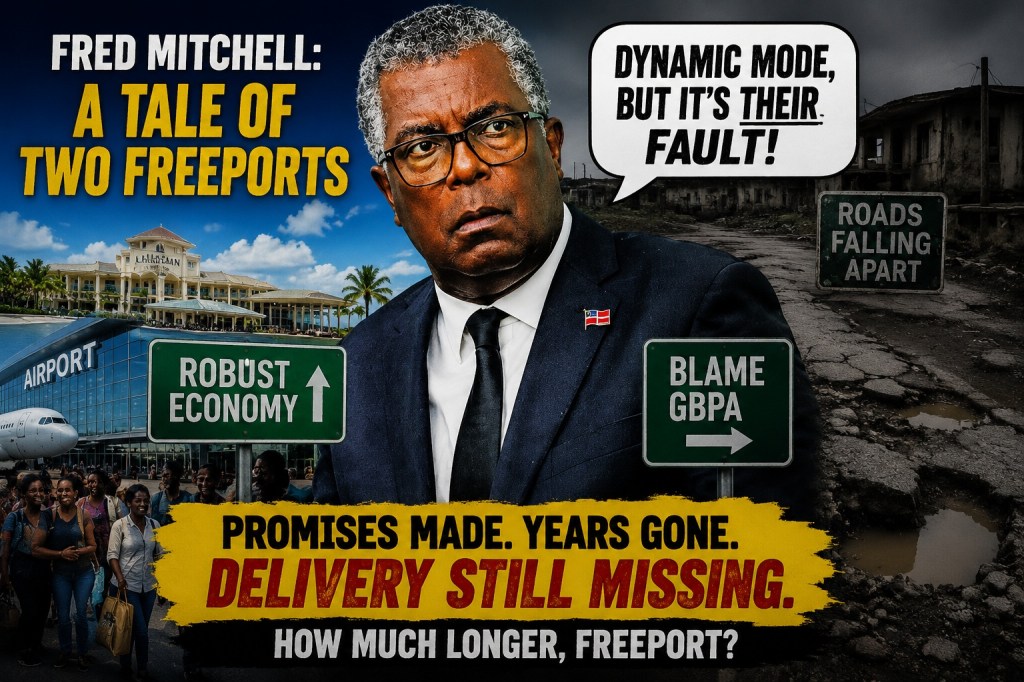
He talks about the positive spirit in Freeport while pointing toward the GBPA as the institution responsible for the roads, the airport and other failures.
But Grand Bahamians have every right to ask the government:
What part of this is now your responsibility?
The tribunal confirmed that the government has regulatory authority in Freeport. The government’s own case was that Freeport could no longer be treated as some private kingdom outside the reach of the Bahamian state.
Fine.
Then govern.
Fix what you have the authority to fix.
Build what you promised to build.
Finish what you promised to finish.
And stop treating every unfinished piece of Grand Bahama as somebody else’s fault.
Because that is the real problem with this latest political performance.
For years, Grand Bahamians were promised a new economic dawn.
They were promised the resurrection of the Grand Lucayan.
They were promised an airport capable of supporting that redevelopment.
They were promised investment.
They were promised jobs.
They were promised that Grand Bahama would be transformed.
And now, after years in office, the political conversation increasingly sounds like an exercise in explaining why somebody else is responsible for the things that remain undone.
First, it was COVID.
Then Dorian.
Then investors.
Then the Port Authority.
Then arbitration.
Then regulations.
Then somebody else.
At some point, Mr. Mitchell, the government has to become the adult in the room.
You cannot campaign as the government that will fix Grand Bahama and then, years later, become the government explaining why Grand Bahama’s problems are somebody else’s fault.
And perhaps that is the most important question arising from Mitchell’s “tale of two cities.”
If Freeport is truly as robust as he suggests, why does the government still have so much explaining to do?
Why are Grand Bahamians still asking about the airport?
Why are they still asking about the Grand Lucayan?
Why are they still asking about roads and infrastructure?
Why are they still asking when the promised transformation will actually be felt in their businesses, their paycheques and their communities?
And why, after nearly five years of a PLP government, are we still being offered political optimism where measurable delivery should be?
Grand Bahama does not need another inspirational speech.
It does not need another announcement.
It certainly does not need another political fairy tale.
It needs execution.
So, forgive Grand Bahamians if they are somewhat sceptical when Fred Mitchell tells them that Freeport is “dynamic,” “positive” and “coming back.”
They have heard that story before.
What they would really like to see is the next chapter.
And preferably, this time, with an airport, a functioning tourism anchor, functioning infrastructure and actual economic opportunity in it.
Because if this is what the PLP calls a “robust” economy, perhaps Grand Bahamians should be forgiven for asking the most politically inconvenient question of all:
Robust for whom?
The Bahamas deserves so much more.
END

