
In 2016, after The Bahamas was downgraded to non-investment grade (“junk”) by Standard & Poor’s, then-Prime Minister Perry Christie famously declared that it was up to his government to “prove them wrong.” History records the statement. Whether his administration ultimately did is a matter of political debate.
Fast forward to 2026, and Bahamians once again find themselves watching a government insist that the experts simply don’t see the full picture.
This week’s headlines in The Nassau Guardian tell the story:
“Rating agency projects deficit — $64 million deficit this year, Fitch says, not $223.1 million surplus government projects.”
The disagreement is not a few million dollars.
It is $287 million.
The Davis administration’s 2026/27 Budget forecasts a $223.1 million surplus, while Fitch Ratings projects a $64 million deficit for the very same fiscal year. That is a swing of nearly $300 million between what the government expects and what one of the world’s leading credit-rating agencies believes is more likely.
To be fair, Fitch did not suggest that The Bahamas is moving in the wrong direction overall. On the contrary, it acknowledged continuing fiscal consolidation and declining government debt. The disagreement is over the pace of that improvement—not whether improvement is occurring. Fitch simply concludes that the government’s timetable for reaching a surplus is too optimistic.
That distinction matters.
Because this is not occurring in a vacuum.
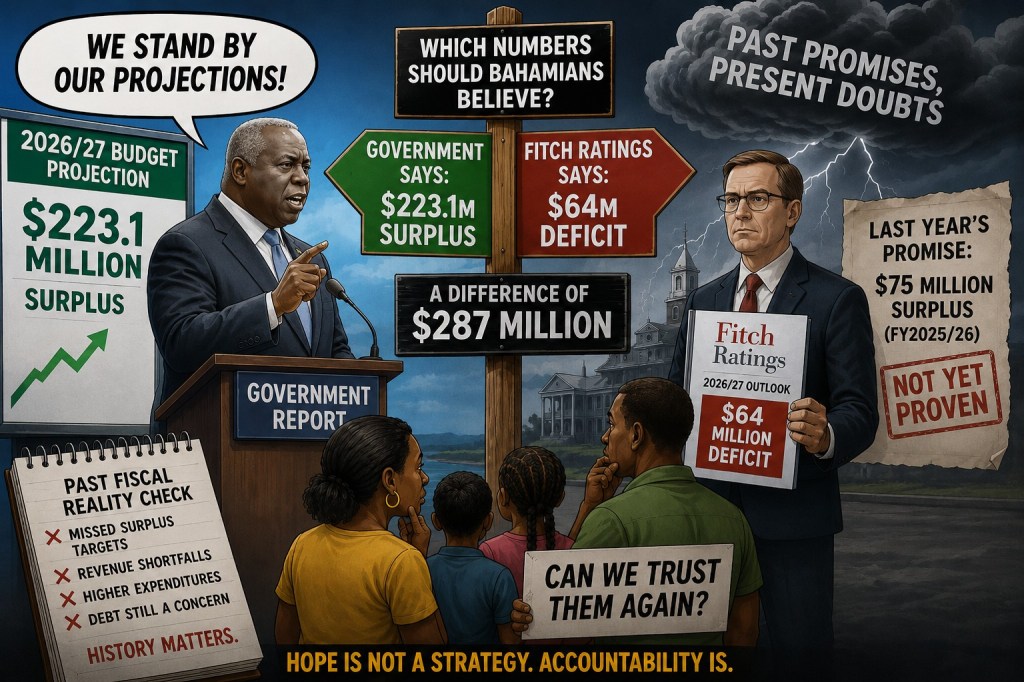
Last year, the government confidently projected a $75 million surplus for FY2025/26. However, as of today, the audited year-end figures have not yet been released, meaning there is still no official confirmation that the projected surplus was actually achieved. Fitch’s latest assessment likewise indicates it does not expect that surplus to have materialized.
Yet despite that uncertainty, the government has responded with confidence.
Finance Minister Michael Halkitis has said:
“We stand by our projections.”
That is certainly the government’s prerogative.
But it also raises a straightforward question.
If last year’s projected surplus has not yet been demonstrated with final results—and Fitch believes it was overly optimistic—why should Bahamians simply assume this year’s projection will prove accurate?
This is not about rooting against the country.
Every Bahamian should hope the government delivers a surplus.
The question is whether hope should replace evidence.
Ironically, the government’s own 2026 Fiscal Strategy Report acknowledges that previous fiscal forecasts have shown a “systematic optimistic bias,” noting that deficits have historically been underestimated because revenues often fall short of expectations while expenditures exceed projections. The report even warns that there remains a meaningful risk that future fiscal outcomes could be weaker than the baseline forecast.
That admission makes Fitch’s caution appear less like pessimism and more like a recognition of the same forecasting risks identified by the government itself.
So, Bahamians are left with two competing stories.
The government says a $223.1 million surplus is coming.
Fitch says a $64 million deficit is more likely.
One side is asking the public to trust its projections.
The other is asking investors to temper their expectations.
Ultimately, only the final audited public accounts will determine who was closer to reality.
Until then, perhaps the better question is not whether the government can achieve a surplus.
It is whether a government that has yet to conclusively demonstrate it met its previous surplus target has earned the public’s confidence that this much larger one is within reach. That is a question for voters, taxpayers, and investors alike.
The Bahamian people deserve better.
END

