
One of the more refreshing moments in today’s public debate did not come from a politician. It came from Gowon Bowe, Chief Executive Officer of Fidelity Bank & Trust International Limited Group, whose comments in The Nassau Guardian amounted to something many Bahamians have been asking for all along: evidence, transparency and accountability.
That should not be a controversial request. Yet, somehow, it has become one.
Bowe was responding to the Davis administration’s projection that it will end the 2026/2027 fiscal year with a $223.1 million budget surplus. His comments came after Fitch Ratings, one of the world’s leading credit rating agencies, publicly questioned those projections and instead forecast that The Bahamas is more likely to record a fiscal deficit of approximately $64 million rather than a surplus.
According to The Nassau Guardian, Bowe observed:
“None of the international observers have adopted the position that the government has been articulating in their budget communications.”
He added that rather than becoming defensive, the government should ask a simple question:
“Why not?”
Even more importantly, Bowe pointed out that the issue is not necessarily whether the government’s projections are wrong. The real issue is whether the information made available to the public actually supports those optimistic conclusions.
That is a perfectly reasonable position.
In fact, it is the very foundation of responsible governance.
Fool Me Once…
My skepticism has very little to do with political preference and everything to do with recent history.
This is not the first time the Davis administration has projected a budget surplus.
For the past two budget cycles, government officials have repeatedly expressed confidence that they were on track to achieve a surplus or balanced fiscal outcome. Yet the final fiscal results did not fully match those optimistic projections. While the government’s fiscal position has undoubtedly improved compared with the severe deficits experienced during the COVID-19 period, the promised surplus has remained elusive.
That history naturally raises a simple question:
Why should Bahamians simply accept another surplus projection without stronger supporting evidence?
That is precisely the point Bowe appears to be making.
He is not saying the government cannot achieve its target.
He is saying that the public evidence currently available does not sufficiently support the government’s conclusion.
Those are two very different things that the average PLP supporter seems unable to differentiate.
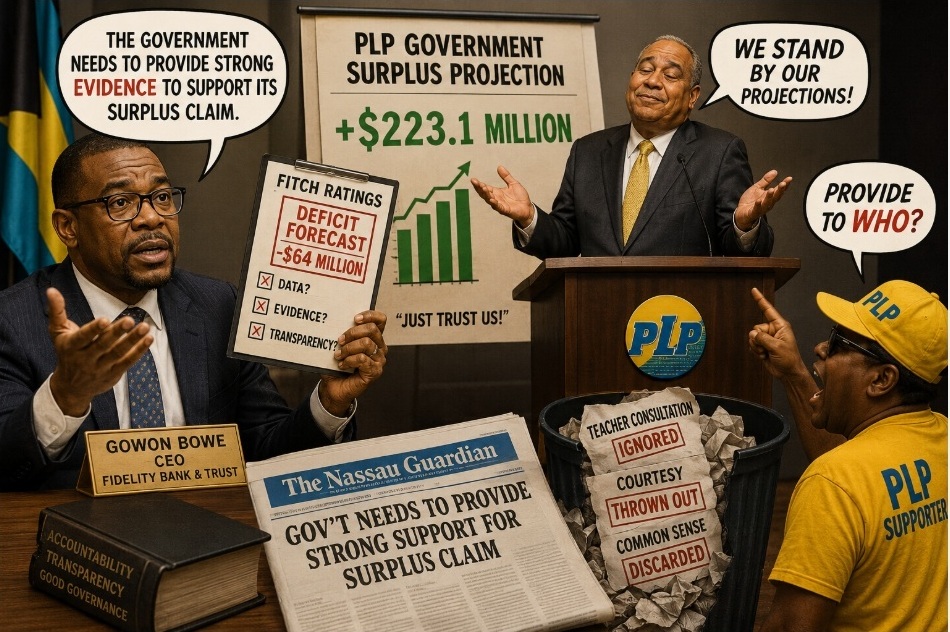
“Provide to Who?”
Perhaps the most astonishing response came not from government officials, but from one of the Progressive Liberal Party (PLP) supporters.
This person question was remarkably simple:
“Provide to who?”
Think about that for a moment.
Provide evidence… to whom?
To the taxpayers?
To the voters?
To Parliament?
To the businesses making investment decisions?
To international credit agencies?
Or perhaps to the Bahamian people who are ultimately paying the bills?
In any healthy democracy, the answer should be obvious.
Governments are accountable to the people.
Transparency is not an optional public relations exercise.
It is a democratic obligation.
When respected financial institutions, independent economists or international credit agencies question government projections, the proper response is not indignation or blind demands for trust.
The appropriate response is evidence.
A Familiar Pattern
Unfortunately, this dismissive attitude toward legitimate public questions is becoming increasingly familiar.
Consider the government’s handling of its plan to recruit hundreds of teachers from Ghana.
Few reasonable people argued that additional teachers were unnecessary. The concern expressed by many educators was the apparent lack of meaningful consultation with local teachers and the Bahamas Union of Teachers before the initiative was announced.
Good governance is not simply about arriving at the right destination.
It is also about respecting the people affected by the journey.
Consultation.
Transparency.
Professional courtesy.
These are not signs of weakness.
They are signs of competent leadership.
Yet increasingly, asking questions seems to be treated as an act of political hostility rather than civic responsibility.
Trust Is Earned
No government—PLP, FNM or otherwise—should expect citizens to suspend critical thinking simply because a minister stands behind a podium and declares that everything is on track.
Trust is earned.
Credibility is built.
And confidence comes from providing evidence that allows independent observers to arrive at the same conclusion as the government itself.
That, incidentally, was exactly the point Gowon Bowe was making.
He was not asking Bahamians to distrust the government.
He was encouraging the government to provide enough information so that trust becomes the natural conclusion—not a compulsory act of faith.
Until then, Bahamians are left with an uncomfortable question:
If even independent international analysts remain unconvinced by the government’s numbers, why should the public be expected to applaud first and ask questions later?
The Bahamian deserves better.
END

