
After receiving my $8.45 Bahamas Power and Light (BPL) credit, I was almost overcome with gratitude. I briefly considered sending Prime Minister Philip Davis a thank-you card. But sarcasm aside, that isn’t today’s issue.
Today’s issue is a statement by Progressive Liberal Party (PLP) Chairman Fred Mitchell, who has once again attempted to convince Bahamians that the current electricity crisis should be laid at the feet of the previous Free National Movement (FNM) administration.
According to reports, Mitchell said New Providence’s electrical grid is now “in a state of collapse” because the FNM “did nothing” to fix it, and therefore FNM Chairman Dr. Duane Sands has no standing to criticize the current administration.
It is a clever piece of political wordplay.
The implication is not merely that the FNM left behind problems. Every government inherits problems. The implication is that five years into the Davis administration, the PLP bears little responsibility for the condition of the very system it has controlled, managed and repeatedly promised to transform.
That is where the argument begins to collapse.
Five Years Is a Long Time
The Davis administration has been in office since September 2021.
During that period, energy reform has been one of the government’s flagship initiatives. The administration has repeatedly announced that it was rebuilding BPL, modernizing the transmission and distribution (T&D) network, and putting the country on a path toward a more reliable electricity supply.
Indeed, the government’s own position has consistently been that the transmission and distribution grid required major investment and that this work was being undertaken through the Bahamas Grid Company and its partnership with Island Grid/Pike.
So, Mr. Mitchell cannot simultaneously argue that:
- the PLP has spent five years fixing the grid; and
- every major failure today remains solely the fault of the FNM.
Both statements cannot be true.
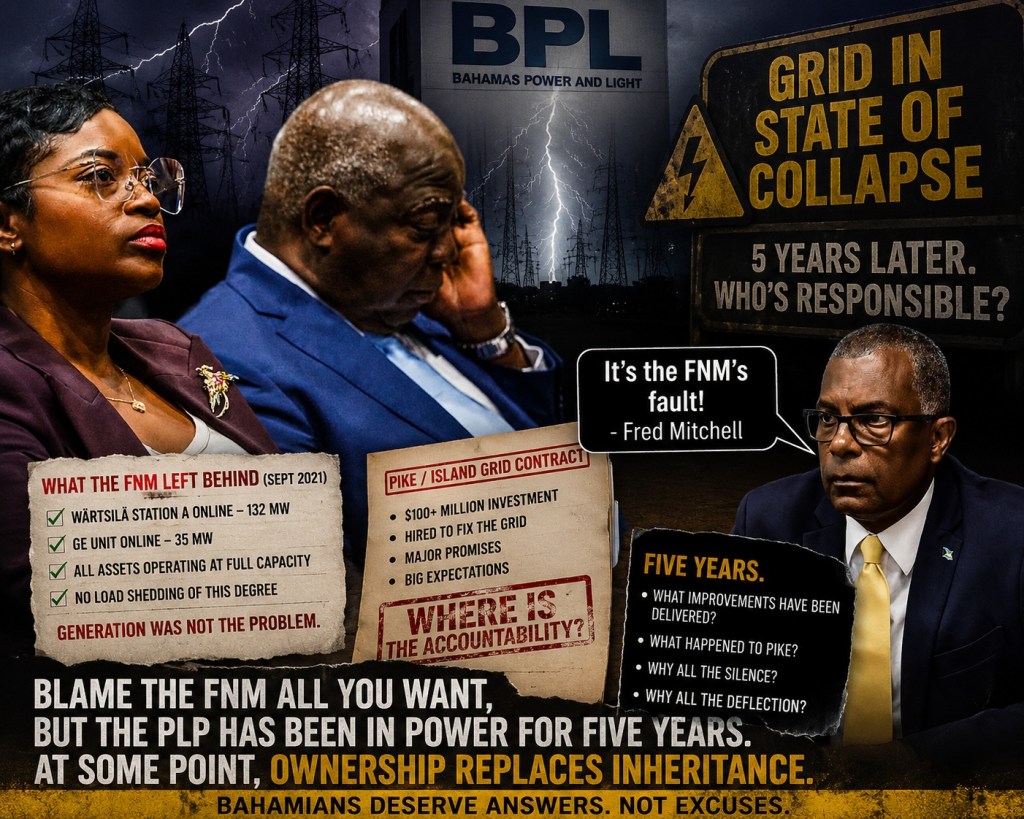
What the FNM Actually Left Behind
There is also important context.
By the time the Minnis administration left office in September 2021, the new Wärtsilä Station A plant had already been commissioned, providing approximately 132 MW of generation capacity under its operating agreement.
Whether one agrees with every aspect of the FNM’s energy policy is a legitimate political debate. The Davis administration itself has heavily criticized the Wärtsilä project, alleging deficiencies in its execution and maintenance.
But that debate concerns generation.
Fred Mitchell’s latest comments concern the transmission and distribution grid—the poles, substations and lines that actually deliver electricity.
That is precisely the area the Davis administration said it intended to overhaul.
Whatever Happened to Pike?
This is where the unanswered questions begin.
The PLP introduced one of the largest energy reform initiatives in modern Bahamian history by entering into a long-term arrangement involving Pike Corporation, operating through Island Grid, to modernize New Providence’s transmission and distribution system. The agreement was promoted as a transformational solution to the grid’s long-standing weaknesses.
Yet in 2026, reports emerged that Island Grid had withdrawn from its management role, senior executives including Eric Pike stepped down, and questions immediately arose about the future of the project. Government officials insisted that investment would continue but offered limited public detail on why the management arrangement ended.
Those developments raise legitimate questions.
- What exactly happened with the Pike arrangement?
- Why did the management relationship end so abruptly?
- What obligations remain under the agreement?
- What measurable improvements have been achieved after millions of dollars in investment?
- Why has the government been reluctant to provide comprehensive public answers regarding the contract?
- What was the state of grid with Pikes sudden departure?
These are questions of accountability—not politics.
Transparency becomes even more important given that controversy has already surrounded whether the full Pike agreement had been tabled in Parliament, with public statements by senior government officials creating confusion over its status.
Responsibility Cannot Be Deferred Forever
Governments frequently remind us that “government is continuous” when taking credit for projects begun by previous administrations.
If that principle applies to successes, it must also apply to responsibility.
After nearly five years in office, the condition of BPL’s transmission and distribution system can no longer be explained solely by decisions made before September 2021.
At some point, ownership replaces inheritance.
At some point, execution replaces promises.
At some point, voters stop asking what was inherited and start asking what was accomplished.
The Real Question
Instead of another voice note blaming an administration that left office five years ago, Bahamians deserve a straightforward accounting.
What measurable improvements has the Davis administration delivered to New Providence’s electrical grid?
What became of the Pike strategy that was supposed to modernize it?
Why has transparency surrounding that agreement remained a recurring issue?
And if the grid is, as Mr. Mitchell now claims, truly “in a state of collapse,” after five years of PLP stewardship, isn’t the first place to look not the Opposition benches—but the Cabinet table?
Political blame may generate headlines.
Reliable electricity powers a country.
The Bahamian people deserve more of the latter and considerably less of the former.
The Progressive Liberal Party (PLP) government fails for one reason; it is their nature.
END
 My Morning Paper