
When Fred Mitchell speaks about protecting reputations, one almost expects him to reach for a fire extinguisher every time transparency threatens to spark.
In his latest voice note, the Chairman of the Progressive Liberal Party warned of what he described as the Opposition’s “constant drumbeat of misinformation and defamatory rhetoric” and criticized efforts to introduce into parliamentary debate material originating from foreign court proceedings under the protection of parliamentary privilege.
That, of course, raises an awkward question.
Since when did asking questions become an attack on the country?
If public officials are accused of wrongdoing, the answer in a democracy is not to barricade the doors, lower the blinds, and lecture the public about the dangers of curiosity. The answer is sunlight. Transparency has an inconvenient habit of clearing the air.
Mr. Mitchell argues that individuals named or implicated in allegations deserve the opportunity to defend themselves. On that point he is correct. Due process matters. Reputations matter.
But accountability matters too.
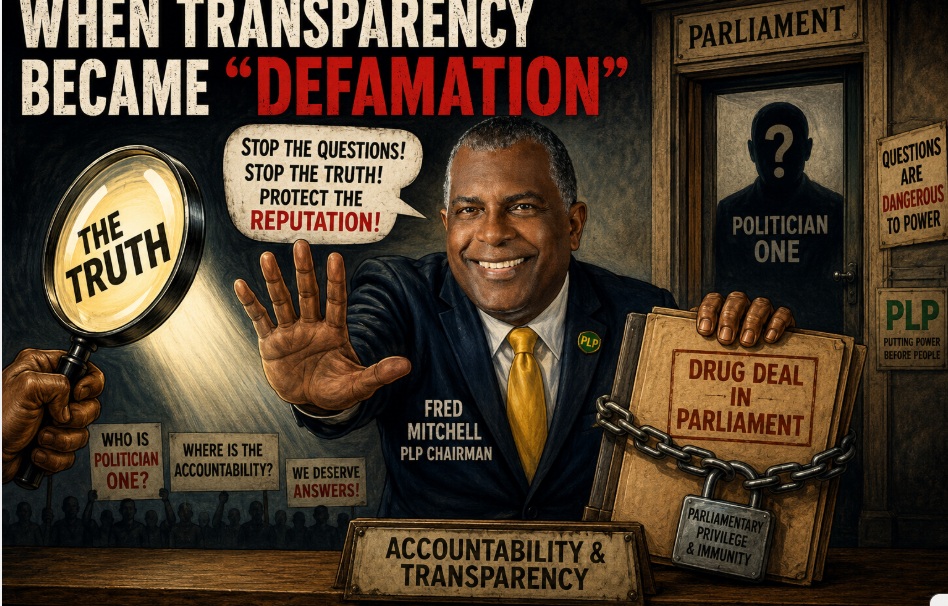
The public discussion surrounding the identity of the individual referred to in foreign court documents as “Politician One” did not emerge because Bahamians suddenly developed an unhealthy fascination with mystery novels. It emerged because questions exist, allegations exist, and information remains incomplete in the public domain.
History teaches a simple lesson: where information is absent, speculation moves in and signs a long-term lease.
Ironically, the quickest way to kill rumours is not censorship, outrage, or warnings about “defamation.” It is disclosure.
The Chairman’s argument appears to be that parliamentary privilege should not be used as a shield to repeat allegations that cannot be tested in court. That is a legitimate constitutional debate. However, it is equally legitimate for citizens to ask whether sufficient transparency is being provided on matters that have generated significant public concern.
After all, if there is nothing to hide, transparency is not a threat.
It is a defence.
And perhaps that is the central frustration many Bahamians feel today. Every request for answers is treated as an attack. Every question becomes “misinformation.” Every call for disclosure becomes “defamation.”
Eventually, citizens begin to wonder whether the real danger is not the questions being asked, but the answers that never seem to arrive.
In politics, nature abhors a vacuum.
So does public trust.
The people of The Bahamas deserve better.
END
 My Morning Paper