
Only a leader desperate for to remain in power takes to a national stage and chooses to engage in political propaganda instead of addressing meaningful ways to deal with real issues that affect the lives of the average working person. This type of leader amounts to nothing more than a political entertainer and cannot and should not be taken seriously.
Now, what stands out most from that rally is not simply that the Progressive Liberal Party (PLP) chose to criticize the opposition—that’s expected in politics—but that it did so while sidestepping the very issues it is constitutionally responsible for addressing. When a governing party devotes significant time to attacking opponents instead of accounting for its own record, it invites scrutiny about what it is avoiding.
Philip Davis framed the Free National Movement (FNM) and its leader the Hon. Michael Pintard as unserious and desperate. But that line of attack cuts both ways. If the government believes the opposition’s proposals are weak, the most effective rebuttal would be to clearly present stronger alternatives and demonstrate measurable progress on national priorities—economic growth, cost of living, public services, and fiscal discipline. Instead, the emphasis appeared to be on character attacks and political framing rather than substance.
That absence becomes even more glaring when considering unresolved matters of public concern. The issue surrounding overspending within Beaches and Parks is not a trivial administrative detail—it speaks directly to fiscal management and accountability. McKell Bonaby had an opportunity, both at the rally and previously during the Budget Debate, to provide clarity: What caused the overruns? Were there procurement failures, poor forecasting, or mismanagement? What corrective measures are in place? Those are straightforward questions that taxpayers reasonably expect answers to.
Instead, the decision to pivot toward attacking the opposition—both at the rally and during the Budget Debate—creates the impression of deflection. Criticism of the opposition is politically convenient; explaining budget overruns is politically difficult. But governance demands the latter. When a sitting member of parliament repeatedly avoids addressing a documented financial concern while engaging in partisan attacks, it raises legitimate doubts about transparency and accountability.
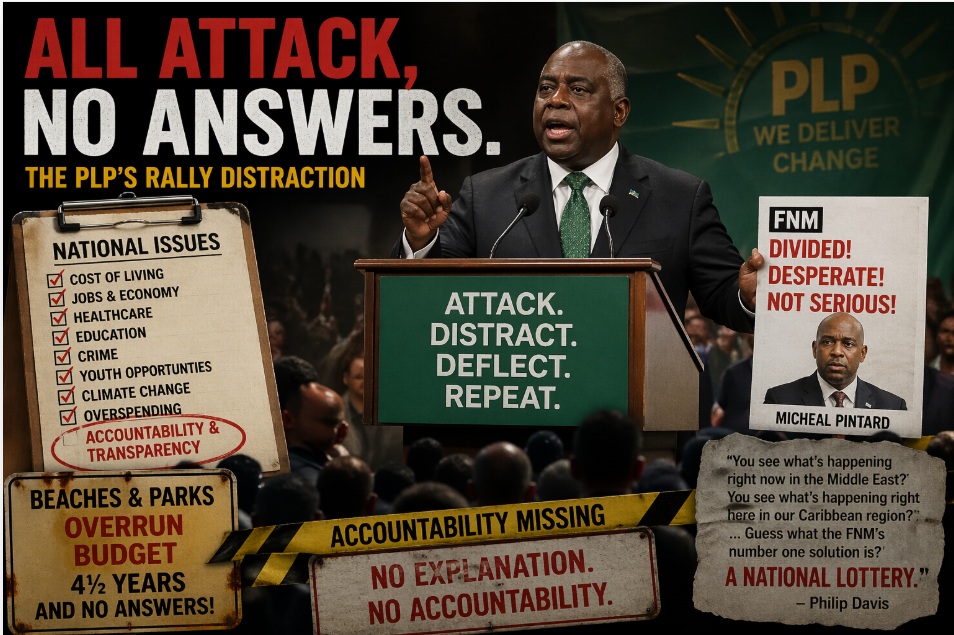
Prime Minister Davis’s remarks on global instability—referencing geopolitical tensions, regional challenges, climate change, and economic shifts—introduce an even deeper contradiction. He suggests these are “serious times” requiring “serious people,” yet does not clearly articulate his administration’s concrete policy responses to those very challenges. If these are indeed the defining issues of the moment, then where are the detailed strategies? Where is the roadmap for economic resilience, climate adaptation, or regional competitiveness?
His critique of the national lottery proposal hinges on the argument that it is insufficient in the face of global crises. But that argument only holds weight if it is paired with a clear articulation of what is sufficient. Simply dismissing an opposition idea without presenting a robust alternative leaves a vacuum. The obvious question follows: what are the administration’s priority solutions, and why were they not the focus of the address?
There is also an internal inconsistency in the rhetoric. On one hand, the Prime Minister claims the opposition is engaging in negativity and desperation. On the other, a significant portion of his own platform at the rally is dedicated to questioning the opposition leader’s competence and unity. If the stated standard is to avoid “getting in the mud,” then the messaging should reflect a higher level of policy-driven engagement.
Ultimately, political rallies are opportunities—not just to energize supporters—but to demonstrate leadership through clarity, accountability, and vision. When those opportunities are used primarily for partisan attacks, it weakens public confidence in the seriousness of governance. The electorate is left not with a clearer understanding of how their challenges will be addressed, but with unanswered questions:
• Why has overspending in key departments not been fully explained?
• What specific policies are being implemented to address the global and regional challenges cited?
• If a national lottery is dismissed as inadequate, what are the administration’s primary economic solutions?
Those are not opposition talking points—they are governance obligations. Until they are answered directly and transparently, criticisms of the opposition risk sounding less like leadership and more like distraction.
The Progressive Liberal Party (PLP) fails for one reason; it is their nature.
END

