
On Monday night, Philip Davis took to the national stage—not to clarify policy, not to account for governance, but to mount what can only be described as a carefully dressed act of political desperation. This came, of course, after sidestepping growing public concern over issues like reported overspending within Beaches and Parks—matters that demand transparency but instead receive theatrical deflection.
Prime Minister Davis ran the full gamut of what Bahamians have come to recognize as “politicks”: a blend of insinuation, selective outrage, and a not-so-subtle pivot into fearmongering. The irony is almost too neat. While referencing the satirical book Politricks – “A Confidential Handbook for Politicians and Aspiring Politicians and Political Squirrels”, the Prime Minister and his Progressive Liberal Party seem less amused by its humour and more committed to turning its caricature into governing strategy—weaponizing satire against Michael Pintard while embodying its very lessons.
A headline from The Tribune reads: “Davis: Lottery would benefit private operators rather than public.” It is a striking claim—serious, consequential, and notably unsupported by any publicly presented evidence. The Prime Minister asserts that the Free National Movement’s (FNM’s) proposal for a national lottery would enrich unnamed “private operators” at the expense of the Bahamian people. But who are these operators? Where is the documentation? What contractual framework is being referenced?
In the absence of specifics, the accusation reads less like policy critique and more like a calculated attempt to seed suspicion and fear. If such a claim were grounded in fact, it would demand immediate disclosure and national scrutiny. Instead, Bahamians are left with an allegation suspended in midair—heavy enough to alarm, but too vague to verify.
Equally concerning is the Prime Minister’s pivot into familiar territory: fear. The suggestion that a future FNM administration would dismantle social initiatives such as the National School Breakfast Programme or the National Youth Guard is a serious charge. Yet, again, no direct policy statements, manifesto excerpts, or verifiable commitments have been cited to substantiate this claim. Political debate is expected; unsubstantiated warnings presented as inevitabilities are something else entirely.
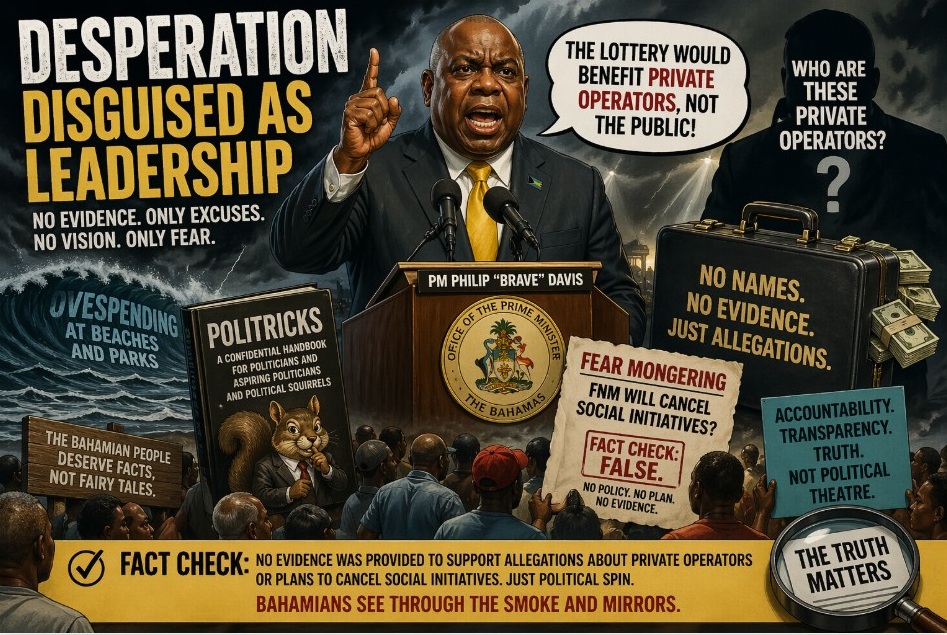
This raises an uncomfortable question: who, exactly, is being “desperate” here?
The Davis administration has been quick to label the Opposition as such. Yet the pattern on display tells a different story—one where allegations are made without evidence, and hypothetical rollbacks are presented as certainties. That is not the language of confidence; it is the language of a campaign searching for traction.
The Prime Minister also took aim at Michael Pintard’s leadership, suggesting he is unable to command his party. This line of attack appears rooted in internal political shifts—members who have chosen to depart. But political parties, by their nature, evolve. Individuals make decisions, alliances shift, and leadership is ultimately measured not by unanimity but by the confidence of those who remain. By that standard, the FNM’s base continues to signal its support.
What remains unanswered, however, is perhaps more telling than what was said. If the government opposes a national lottery so vigorously, whose interests are being protected? The Bahamas already operates within a legalized gaming environment—one in which domestic “number houses” function openly. The question is not whether gaming exists, but how it is structured, regulated, and who ultimately benefits. Opposition to reform, without clarity, invites scrutiny.
As PLP supporters hung on the Prime Minister’s every word at the rally, the scene may have felt energizing in the moment. But beyond the applause, beyond the rhetoric, the substance was thin. What emerged was not a roadmap for governance, but a portrait of a government leaning heavily on accusation and apprehension—hoping, perhaps, that one will compensate for the absence of the other.
In the end, the “wave” the Prime Minister referenced may indeed be real—but not in the way he intended. It is a wave of public frustration, built not on opposition slogans, but on unanswered questions, unmet expectations, and a growing impatience with politics that substitutes clarity with conjecture.
And if that wave is now turning, it is not because of what the Opposition has done—but because of what the government has failed to convincingly explain.
The Progressive Liberal Party (PLP) government fails for one reason; it is their nature.
END

